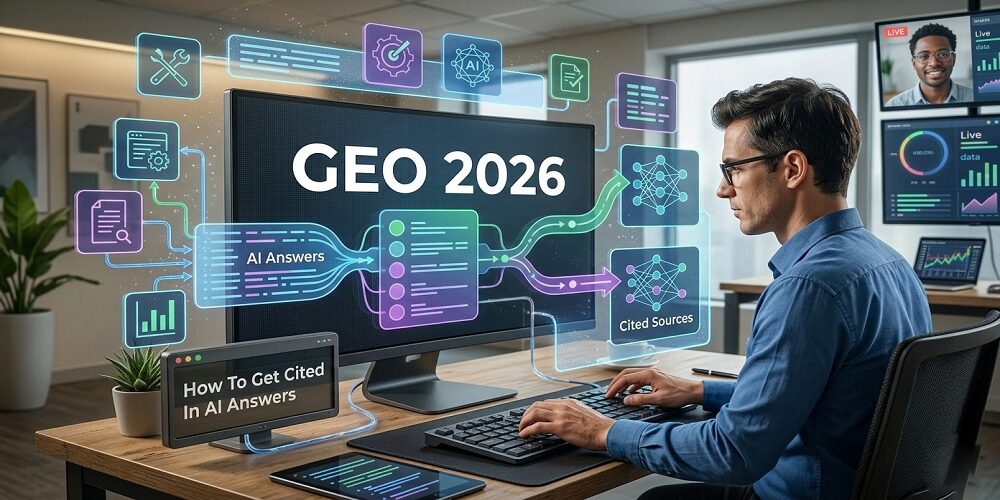
Search is changing. People still Google, but more of them also ask questions in chat tools. They want one clear answer, fast.
Generative Engine Optimization helps you show up inside those AI answers, even when the user never clicks your site.
Key Takeaways
- GEO helps you appear inside AI-generated answers, not just classic search results.
- GEO rewards authority, context, and structure, because models pull clean facts.
- SEO alone is not enough when AI summaries reduce clicks.
- AI search prefers expert-backed content, not generic advice.
- Early adoption in 2026 builds a long-term edge, while others catch up later.
- You should combine GEO plus SEO, because AI still pulls from web pages.
- You need new tracking, like mentions and citations, not only clicks.
Generative Engine Optimization Explained

Generative Engine Optimization (GEO) is the process of shaping your content so AI tools can understand it, trust it, and include it in their generated answers. It is not only about ranking a page. It is about becoming a source an AI is willing to reference.
Here is what is different now. Tools like ChatGPT-style assistants, Google AI Overviews, Perplexity, Gemini, and Claude often scan many sources. They pull key facts. Then they write one blended reply. The answer is generated, not just ranked.
In 2026, this matters more because AI summaries keep spreading across more searches. More people get what they need on the results page. That means fewer clicks, even when your page is “visible.”
A quick example makes this real. A user asks: “What’s the safest way to migrate a WordPress site without losing rankings?” A strong AI answer will give steps, common risks, and a checklist. If your page has clear steps, warnings, and checks, your odds of being mentioned go up.
Related Article: What Is Google SGE?
How AI answers get built (and where your content fits)
Most AI answers follow a simple flow:
- Understand the question (intent, scope, and context).
- Retrieve sources (pages, docs, trusted brands, known entities).
- Extract key points (facts, steps, definitions, limits).
- Summarize and format (short answer, bullets, quick comparisons).
- Cite or mention sources (links, brand names, page titles).
That is why structure helps. Clear headings, tight bullets, and simple tables make it easier to pull the right parts.
GEO vs traditional SEO, what actually changes
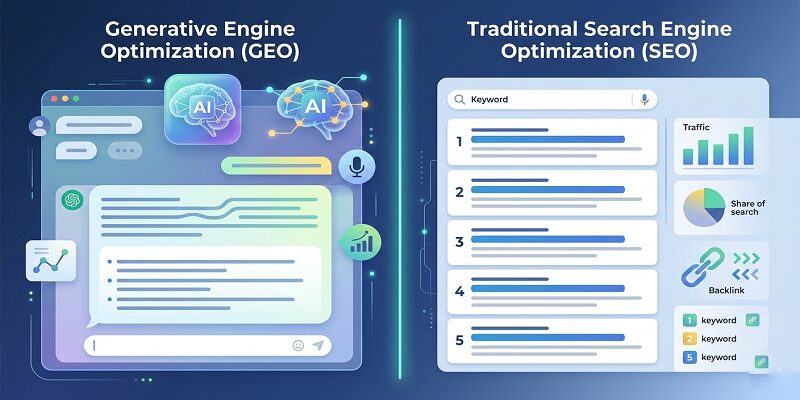
Here is the clean comparison.
| Focus area | Traditional SEO | GEO |
| Keyword rankings vs AI citations | Rank pages | Earn citations and mentions |
| Traffic focus vs visibility focus | Drive clicks | Win presence inside answers |
| Click based vs mention based | CTR and sessions | Mentions, citations, recall |
| Page optimization vs entity and context optimization | On-page signals | Entities, context, trust |
What you will notice in real work:
- SEO ranks pages. GEO helps you get quoted inside AI results.
- SEO leans on keywords. GEO leans on intent and clarity.
- Links still matter, but GEO also depends on trust signals.
How You Do GEO Step By Step, Without Guessing

- Do not chase buzzwords.
Do GEO by making your content easy to find, trust, and summarize. - Lock in SEO basics first.
Make sure pages can be crawled and indexed. Improve speed. Fix broken templates. Then add GEO on top. - Collect real questions from real users.
Use sales calls, support tickets, live chat logs, demos, and community threads. These questions often match AI prompts. - Build topical clusters.
Create one strong pillar page and several supporting pages. This shows consistency, not one-off content. - Improve entity clarity.
Use the same brand name everywhere. Add clear author bios. Explain what you do. Define key terms once (like “subscription analytics”), then use them the same way. - Add structured data where it fits.
Use Article, Organization, FAQ, and author markup to help machines understand the page and the source. - Write for extraction.
Put the direct answer near the top. Then expand. Use short summaries, clear subheads, and simple rules that can be quoted easily.
Build your GEO strategy on these principles (so AI can trust you)
- Context over keywords: AI looks for meaning, not exact matches.
- Authority over volume: Ten strong pages can beat fifty weak ones.
- Clarity over complexity: Simple writing gets summarized more accurately.
- Intent over traffic: Some pages build trust, even with fewer clicks.
- Trust over tricks: Spam signals can get ignored or filtered out.
- Experience-backed content: Real steps, real checks, and real edge cases win.
Implement GEO in your business, a practical 6 step plan
Step 1: Audit your SEO foundation
Check technical health, find content gaps, and confirm your brand details are consistent.
Step 2: Identify AI search opportunities
List long-tail questions and clusters. Focus on how, why, best, vs, and “what should I do if…”
Step 3: Create AI-optimized assets
Publish definitive guides, expert opinion posts, FAQ hubs, and comparison pages. Add clear takeaways.
Step 4: Improve structured data and technical signals
Use FAQ schema only when you truly answer questions. Add Article and Organization markup. Add author details.
Step 5: Strengthen brand authority
Earn mentions through digital PR, partnerships, podcasts, and founder-led content.
Step 6: Measure GEO performance
Track mentions in AI answers, citation frequency, share of voice for prompts, and engagement signals beyond clicks.
What To Expect, What Gets Hard, And How To Win In 2026
GEO is worth the effort because AI discovery is now normal. AI Overviews show up on many searches. Chat tools also keep growing. At the same time, zero-click behavior can reduce direct traffic.
So treat GEO as an extension of SEO, not a replacement. If your basics are weak, fix those first. This modern SEO strategy guide covers the foundation you still need.
Benefits, Drawbacks, And The Biggest GEO Challenges You Will Run Into
Benefits:
- AI visibility: You can show up inside AI answers, even when users do not click.
- Higher trust: Being cited makes your brand feel safer and more credible.
- Competitive edge: Early GEO work can help you get mentioned before rivals do.
- Long-term authority: Strong topic coverage builds a reputation for AI systems reuse.
- Future-proofing: You rely less on only rankings and more on overall presence.
Drawbacks:
- Traffic is harder to read: You may gain visibility but see fewer clear clicks.
- Quality takes time: GEO works best with consistent, expert-level updates.
- More planning, less quick wins: It needs structure, content systems, and review.
- Models keep changing: What gets cited today may shift as AI systems update.
Challenges:
- Zero-click behavior: Users may stop at the AI summary and never visit your site.
- Lower CTR: Even if you rank well, AI answers can pull attention away.
- Hallucinations and misquotes: AI can mix details or summarize your point wrong.
- Limited tracking: Mentions and citations are harder to measure than rankings.
- Duplication risk: Others may copy your content style or ideas fast.
- Authority competition: Bigger brands and strong publishers can be favored more often.
Best Practices That Increase Your Chances Of Being Cited In AI Answers
- Expert-backed content with real limits and edge cases
- Clear heading structure that matches how people ask questions
- Frequent updates for pages that age fast
- Fact-based references (numbers, definitions, standards)
- Better UX signals (speed, clean layout, readable pages)
- Combine SEO plus GEO so retrieval and trust both improve
- Depth over volume, answer the next question too
- Strong entity clarity (who you are, what you do, where you serve)
- Test prompts in AI tools and fix what gets misunderstood
Industries That Tend To See The Fastest GEO Gains
- SaaS: Buyers ask AI to compare tools, pricing, and features before a demo.
- Healthcare: People search symptoms, treatments, and providers, so trust and accuracy drive mentions.
- Financial services: “Best” and “safest” questions are common, and AI summaries shape choices fast.
- Ecommerce: AI product summaries and shopping suggestions influence what gets shortlisted.
- Marketing agencies: Prospects ask AI who to hire, what to expect, and how to choose an agency.
- Education: Course, career, and certification questions fit AI answers and comparison-style results.
Is GEO The Future Of SEO, And How Do You Measure Success
In 2026, the direction is clear. Google is pushing more AI summaries. Conversational search keeps rising. Keyword-only tactics keep fading.
The strongest approach is hybrid. Keep classic SEO strong, then add Generative Engine Optimization to improve AI visibility.
To measure progress, look beyond sessions:
Mentions and citations in AI answers, share of voice for key prompts, assisted conversions, lift in branded search, and freshness checks on pages that get referenced often.
Read Also:How to Use Answer The Public for SEO
FAQ: Quick Answers About Generative Engine Optimization
What is Generative Engine Optimization in simple terms?
Generative Engine Optimization (GEO) is how you improve your content so AI tools can understand it, trust it, and include it in generated answers. You focus on clear definitions, strong structure, and real expertise so your brand can be cited or mentioned.
How much do Generative Engine Optimization services cost?
Pricing depends on your site size and goals. Updating a few key pages costs less. Building clusters, adding structured data, and doing authority work costs more. Ask for a scoped audit, a clear plan, and monthly reporting on mentions and citations.
Is GEO better than traditional SEO?
GEO is not better than SEO, it is different. SEO helps pages get crawled, indexed, and ranked. GEO increases the chance your content gets used inside AI-generated answers. A combined approach usually works best.
Can Techeasify help implement GEO strategies?
Yes. You can work with Techeasify on Generative Engine Optimization services like content restructuring, entity clarity, structured data, and AI visibility tracking. You get a practical plan tied to business outcomes. Start with an audit so you know what matters first.
Which industries benefit most from GEO?
Industries with heavy research and comparison searches tend to benefit most. SaaS, healthcare, finance, ecommerce, marketing agencies, and education often see faster gains because people ask many questions that AI tools summarize and cite.
Conclusion
Generative Engine Optimization matters now because AI answers take space that used to belong to blue links. If you want steady visibility in 2026, you need trust, clear structure, and content that is easy to pull into an answer. Track mentions, not only clicks.
Do not drop the basics. Strong SEO still helps AI find your content in the first place.
If you want help, you have three simple next steps with Techeasify: contact the team, schedule a free consultation, or get a free AI search audit to see where you show up today (and where you do not).