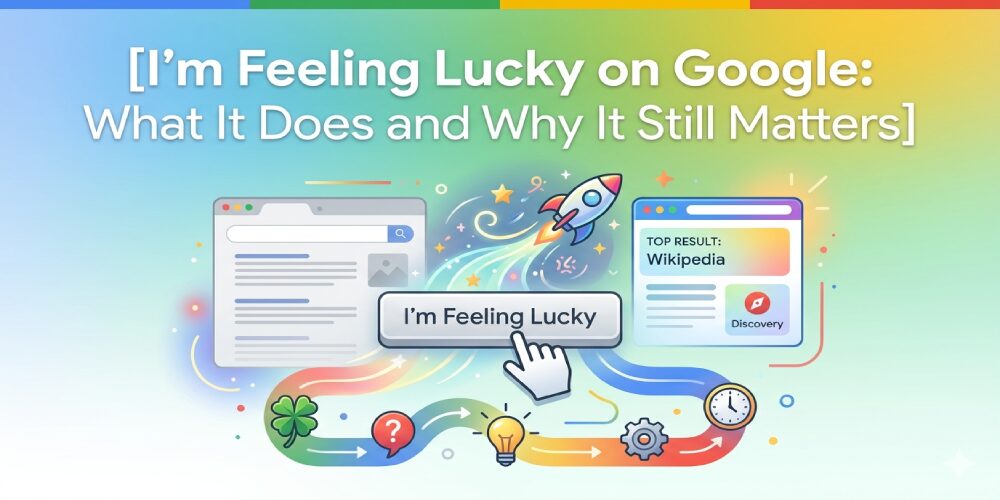
Most people have seen Google’s I’m Feeling Lucky button on Google.com, but far fewer have clicked it. This iconic feature sits there like a side door next to the main entrance, easy to ignore unless you’re curious. If you do click it, Google skips the usual results page and sends you straight to a page it sees as the best match for your search.
That simple move is why the feature still gets attention in 2026. You get a faster path through Google search, a clearer look at how Google makes choices, and a small reminder of the company’s early confidence in search. If you’ve ever wondered what does I’m Feeling Lucky do, how it works today, and why it still matters for users and businesses, you’re in the right place.
What is Google’s “I’m Feeling Lucky” button, and where can you find it?
Google’s “I’m Feeling Lucky” button is a shortcut on this popular search engine. Instead of showing you a full page of search results, it tries to send you directly to one page. In plain terms, Google makes one strong guess and moves you there right away.
On desktop, you can usually find the button under the search bar on the Google homepage. On mobile, it’s much less obvious. Depending on your browser, app, region, or test group, you may not see it in the same way, or at all. You can also replicate this functionality using a Chrome extension or by right-clicking selected text to access the context menu in some browsers.
As of March 2026, the classic button still exists for many users. However, Google has also tested an AI Mode replacement or addition for some users since 2025. So if your screen looks a little different from someone else’s, that’s not unusual. Google often tests small layout changes before making bigger decisions.
Here’s the quick difference at a glance:
| Search action | What happens |
|---|---|
| Normal Google search | You see a results page with many links |
| I’m Feeling Lucky | You go straight to one chosen page |
That’s why the button feels old-school and bold at the same time.
How it differs from a normal Google search
A normal search gives you options. You can compare sites, read snippets, open several tabs, and decide what fits best.
I’m Feeling Lucky does the opposite. It removes that choice step and sends you forward fast. That makes it handy when you want speed, but less useful when you want to browse.
It doesn’t pick a random page. It picks the page Google believes is your best match.
What does “I’m Feeling Lucky” do when you click it?
When you click I’m Feeling Lucky, Google tries to take you directly to the best-match page for your search query without showing the standard search results page first. Many people describe this as “going to the top-result webpage,” and that’s often close enough. Still, today it’s better to think of it as Google’s best match, not just a fixed number-one link.
Why does that wording matter? Because modern search is more layered than it used to be. Google weighs relevance, trust, page quality, search intent, and the overall experience. So the destination reflects Google’s current systems and testing, not just a simple list order frozen in place.
If you search for a search term like a brand name, the button will often send you to that brand’s official website. If you search for a famous place, Google may send you to a trusted reference page, an official tourism page, or another source it sees as the strongest fit.
That’s the heart of what I’m Feeling Lucky does. It acts like a shortcut based on Google’s confidence, using a redirect page to the destination URL.
For quick, obvious searches, that can feel almost magical. For broad or messy searches, it can feel like Google made the call before you had a say.
A simple example so you can see it in action
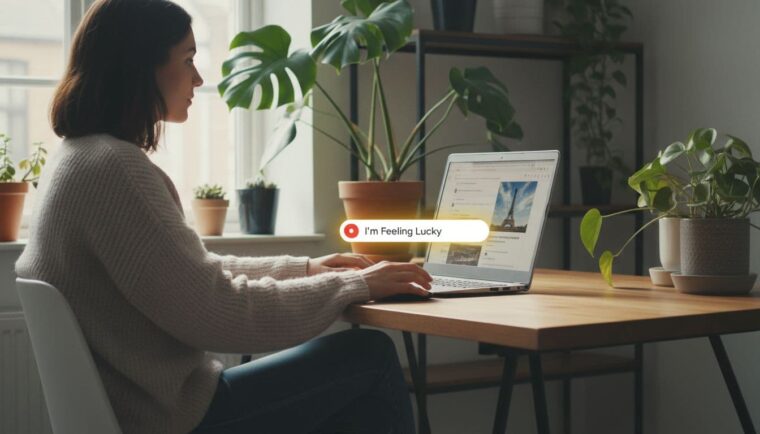
Say you type “Eiffel Tower” and click I’m Feeling Lucky. Instead of seeing ten blue links, maps, videos, and image results, you may land right on a strong page about the Eiffel Tower.
If you type “Nike,” you’ll likely go straight to Nike’s official site. In both cases, Google assumes your intent is clear, so it skips the extra step.
How Google decides where the button sends you
When you click I’m Feeling Lucky, Google doesn’t make that choice by luck. It uses the same broad ranking logic behind search, powered by complex algorithms and advanced search technology, then picks one destination. In simple terms, Google looks for relevance, quality, trust, usefulness, and a solid page experience.
So if your search is clear, Google asks, “What page would most likely help this person right now?” It evaluates user intent to make the call.
That’s also why the feature feels instant. You aren’t being shown many choices like in search listings. You’re getting one answer-shaped choice.
For website owners, this matters more than it might seem. If your page earns strong visibility, Google features that favor trusted results can send users to you faster. That’s one reason businesses invest in better content, site speed, and professional SEO services. The same basics support normal rankings and faster single-result experiences.
If you run a store, service brand, or local business, this connects directly to how you improve website ranking on Google. A weak page won’t earn that kind of confidence. A clear, trusted page has a much better shot.
Why being the best match matters for businesses
Being the best match means less friction for the user and more visibility for you. That’s powerful.
A business site with strong content, solid technical health, and clear intent can benefit from Google’s trust. Whether you work with a website development company, compare an SEO company in india, or hire a digital marketing agency in India, the goal is similar: help Google understand your pages and trust them enough to show the relevant website high.
That’s where SEO services for business and Google search optimization services stop sounding abstract. They’re really about becoming the page Google feels safe sending people to first.
Why Google created it, and whether it still matters today
Google employee Douglas Edwards proposed I’m Feeling Lucky to show confidence in search. The idea was simple and a little playful: “We think our first choice is good enough that you won’t need the rest.” It also made search feel fast, which fit Google’s early identity perfectly.
Today, the web works differently. You search more on phones. You skim. You compare. You also see artificial intelligence summaries like those from OpenAI’s ChatGPT, shopping panels, maps, and other layers before you ever click a classic result. Because of that, usage of the button is much lower than it once was.
Still, the button matters. It captures an old promise that still shapes search in 2026, instant search with one-click searching. Even Google’s newer AI tests in Google Labs point in that same direction. Whether the path goes to a webpage or an AI-style answer, the idea is speed and confidence.
That’s why the button remains interesting. It’s small, but it reveals a lot about how Google wants search to feel.
The fun side of “I’m Feeling Lucky” that many users miss
The button also has a playful side. Over the years, Google has used it for special experiences, doodle-like surprises, and creative redirects that feel more like a wink than a tool.
If you enjoy hidden Google features, this is part of the charm. It’s not just about speed. It’s also about personality. In that sense, it sits in the same family as other search-based extras, like Google Word Coach, which turns a search feature into something fun and useful.

So even if you never use the button every day, it still says something about Google’s style. Search doesn’t have to feel cold. Sometimes it can feel a little curious, too.
FAQ
What does the I’m Feeling Lucky button do?
It takes you directly to the first search result for your query. Instead of showing the full results page, Google sends you straight to the top result.
Is I’m Feeling Lucky still available on Google?
Yes, the I’m Feeling Lucky button is still available on Google Search. It works on the desktop version of Google, and in some cases on related Google features too.
Why does Google use the I’m Feeling Lucky button?
Google created it to help users go directly to a result without browsing the full list. It is also a fun feature that gives Google Search a unique feel.
Does I’m Feeling Lucky save time?
Yes, it can save time if you already know what you want. It works best when your search query is very specific and the first result is likely the right one.
Is I’m Feeling Lucky useful for SEO?
Yes, it can be useful for SEO in a small way. If your page ranks first for a query, it may receive traffic from users who click the I’m Feeling Lucky button.
Can I use I’m Feeling Lucky on mobile?
The classic I’m Feeling Lucky button is mainly known on desktop Google Search. Mobile Google may not always show it in the same way.
Conclusion
In simple terms, I’m Feeling Lucky skips the regular results page in Google search and sends you straight to the page Google sees as the best match for your search query. That’s why the button still stands out in 2026, even with mobile habits and AI features changing how search looks.
For you as a user, it’s a fast shortcut. For you as a business owner or marketer, it’s a clue. If Google trusts one page enough to send people there instantly for a search term, visibility matters. And if you want to improve website ranking on Google, that’s the real lesson behind I’m Feeling Lucky.