Your Google traffic is slipping and you do not know why. Rankings may be dropping, clicks may be slowing, and the usual SEO checks do not always explain it. That is where AI SEO comes in. In 2026, we need a smarter way to improve visibility, save time, and keep up with how search is changing. AI can help us research faster, write better, audit more efficiently, and create content that search engines and AI systems can actually understand. In this guide, we will explain what AI SEO is, why it matters now, how it works, which tools are worth using, and how to avoid common mistakes. By the end, you will have a clear, practical way to use AI in your SEO strategy.
Key Takeaways
- AI SEO uses artificial intelligence to make SEO work faster, smarter, and with better results.
- AI does not replace SEO, it supports it. Human strategy, judgment, and experience still matter.
- In 2026, Google AI Overviews appear in a large share of searches, so ranking alone is no longer enough. Your content also needs to be clear enough for AI systems to cite.
- AI and SEO work best together across keyword research, content creation, technical audits, and link building. That means less guesswork and more efficiency.
- AI SEO helps both small businesses and larger brands compete more effectively. It can save time and improve decision-making at any scale.
- The strongest AI SEO strategy combines the right tools, like Semrush, Surfer SEO, and Google Search Console, with real human expertise.
What AI SEO Means
AI SEO is the use of artificial intelligence to make SEO work faster, smarter, and with less guesswork. It helps us handle tasks like keyword research, content planning, optimization, and audits more efficiently. At the same time, it also helps us shape content so AI systems can understand it, trust it, and cite it in search answers.
If you are asking what AI SEO is in simple terms, think of it this way. We are still doing SEO, but we are using AI as a helper. That means we can spend less time on repetitive work and more time on strategy, quality, and original insight.
There are really two sides to AI SEO. First, we use AI tools to do SEO tasks faster. Second, we make our content easier for systems like ChatGPT and Google AI Overviews to read, summarize, and reference. Both sides matter. If we only use AI for speed, the content may be weak. If we only optimize for search without using AI well, we may waste time.
AI SEO is not a replacement for good SEO. It’s what good SEO looks like in 2026.
In other words, AI SEO does not change the goal. We still want useful content, strong rankings, and real traffic. It just gives us better tools to get there.
AI SEO Vs. Traditional SEO, What’s The Difference?
AI SEO does not replace traditional SEO. It makes it faster, easier, and more effective. The core goal is still the same, get useful content in front of the right people. The difference is in how we do the work and where we want that content to appear.
| Factor | Traditional SEO | AI SEO |
| Keyword research | Manual, time-consuming work | Faster, AI-assisted research |
| Content creation | Written mainly by humans | AI-assisted, with human review |
| Technical audits | Manual crawls and checks | AI-prioritized issue lists |
| Ranking goal | Top 10 blue links | AI citations plus top rankings |
| Speed | Slower | Faster and more scalable |
| Cost | Heavy on time and labor | More tool-assisted and efficient |
Traditional SEO still matters because search engines still care about quality, relevance, and trust. But AI SEO adds another layer. It helps us work faster and also helps our content fit the way modern search systems read, summarize, and cite information.
In other words, traditional SEO gives us the foundation. AI SEO helps us build on it with less guesswork and more speed.
How Did AI Change SEO?
AI and SEO have been moving toward each other for years, but the changes became impossible to ignore in the last decade. Search used to be much simpler. People repeated the same keywords over and over, and search engines often rewarded that kind of behavior. Today, search is far better at understanding meaning, context, and intent.
Here is the quick timeline:
- Before AI-driven search: SEO often meant stuffing keywords into pages and hoping Google would notice.
- RankBrain in 2015: Google started getting better at understanding unfamiliar searches and user behavior.
- BERT in 2019: Search improved its understanding of natural language, so word order and context mattered more.
- MUM in 2021: Google became better at connecting ideas across topics, formats, and languages.
- Gemini and AI Overviews, 2024 to 2026: Search became more conversational, more generative, and more focused on direct answers.
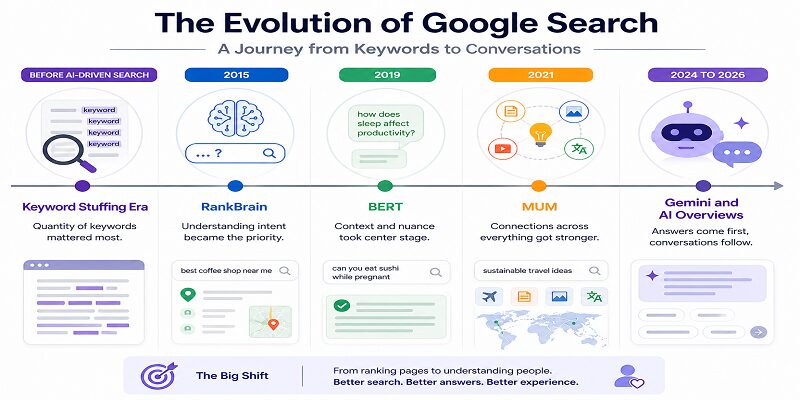
The big shift is easy to see. Search engines no longer just match words. They try to understand what the searcher actually wants. That means pages must be clear, helpful, and well structured.
For us, this changed everything. Good SEO is no longer about repeating a phrase as many times as possible. It is about answering the real question in a way both people and search systems can trust.
Why Does AI SEO Matter In 2026?
AI SEO matters in 2026 because search is no longer just about rankings, it is about visibility inside AI answers. Google AI Overviews now appear in a large share of searches, and many results never get clicked at all. That means the first page link is not always the main goal anymore. Being cited inside the answer can matter just as much.
Recent research shows how fast this shift is happening. According to SearchSignal’s 2026 research on AI search referrals and citations, AI Overviews are already changing how people discover content and interact with search results. Semrush’s AI SEO statistics report shows that AI tools are now part of daily SEO workflows for many professionals. And Seer Interactive’s 2026 CTR update suggests that click behavior can still shift depending on the query and how the result is shown. Put simply, artificial intelligence in SEO is no longer optional. It is part of the job now.
Zero-click searches have changed the goal. In the past, we focused mainly on getting the click. Now, we also need to earn the mention. If our content helps power the answer shown on the search page, we still build trust, brand awareness, and future traffic, even when the user does not click right away.
What used to matter most vs what matters now too
| What Used to Matter Most | What Matters Now Too |
| Ranking on page one | Being cited in AI answers |
| Getting the click | Showing up in AI Overviews |
| Publishing more content | Building brand trust through useful, clear content |
| Matching keywords closely | Writing for intent, context, and citation |
So when we think about winning in 2026, we need a wider view. Winning is not just ranking. Winning is also getting quoted, cited, and remembered inside AI-generated answers.
How Does AI SEO Actually Work? (The Core Components)
1. AI-Powered Keyword Research
AI-powered keyword research helps us look beyond search volume and focus on intent. That means we are not just asking how many people search for a term. We are asking what they really want, how competitive the topic is, and whether the keyword is worth targeting.
Tools like Semrush, Ahrefs, and Google Keyword Planner can help us spot patterns much faster than manual research alone. If you want a deeper breakdown of the process, our keyword research guide is a good place to start. These tools surface related questions, similar topics, and long-tail keywords that are easier to win. This is where seo for ai starts to matter. We are not only choosing keywords for people to find us. We are choosing them in a way that helps AI systems understand our content too.
For example, instead of targeting a broad term like AI SEO, AI tools may show us a better opportunity like best AI SEO tools for small business. That keyword is more specific, has clearer intent, and usually brings in people who are further along in the buying process.
In simple terms, AI helps us work smarter. We spend less time guessing and more time choosing keywords that can actually drive traffic, leads, and conversions.
2. AI Content Creation and Optimization
AI can help us plan and draft content, but it should never be the final voice on the page. It works well for content briefs, outlines, headings, first drafts, and idea generation. Tools like Surfer SEO, Frase, and MarketMuse can also help us improve structure and topic coverage while we write.
The real value comes when humans step in. We add experience, examples, opinions, and brand voice. That is what makes the content feel real and trustworthy. Without that layer, the page can sound flat or generic. It may look polished, but it will usually miss the depth readers want.
This is where Google’s E-E-A-T matters. If the content does not show experience, expertise, and trust, it will struggle to perform well over time. That is why we should never publish raw AI output without review. We need to edit hard, check facts, and make the piece sound like it came from someone who knows the topic.
3. On-Page SEO with AI
AI makes on-page SEO faster by spotting gaps we might miss. It can help improve meta titles, meta descriptions, headings, internal links, image alt text, and schema markup. Instead of manually checking every page line by line, we can use AI tools to flag missing terms, weak structure, or sections that need better clarity.
Tools like Surfer SEO, Clearscope, and NeuronWriter are especially useful here. They compare our content with top-ranking pages and suggest ways to make the page more complete and relevant. That does not mean we follow every suggestion blindly. It means we use the data to guide better decisions.
This is one of the easiest ways to see the value of AI SEO. Small changes, like tightening a heading or adding a missing internal link, can make a page much stronger. Our on-page SEO resource goes deeper into the elements that matter most.
AI helps us move faster, but we still need to think about the reader first. If the page is easier to scan, easier to understand, and easier for search engines to process, it has a better chance of ranking and being cited in AI answers.
4. Technical SEO Audits with AI
AI-driven technical audits help us find problems faster and prioritize what matters most. A crawler can scan a site, flag broken links, duplicate content, missing tags, indexing issues, and other technical problems. But the real advantage is prioritization. AI does not just dump a long list of issues on us. It can help us focus on the problems most likely to affect rankings.
Tools like Screaming Frog with ML support, Sitebulb, and DeepCrawl are useful for this kind of work. They help teams handle bigger sites without wasting hours on manual checks. That matters a lot when a website has hundreds or thousands of pages.
This is where AI saves real time. Instead of starting with every small error, we can start with the issues that are actually hurting performance. That might be pages with weak internal linking, broken indexing, or slow-loading templates.
A good technical audit should help us make decisions, not just collect data. AI is useful because it turns a long list of problems into a clear action plan. For businesses that want hands-on support, Techeasify’s SEO company in India page explains how we handle audits, fixes, and ongoing optimization.
5. AI and Link Building
AI makes link building more efficient, but it does not make it less important. Links still matter in 2026 because they help search engines judge trust, relevance, and authority. What AI changes is the research process. It helps us find better prospects faster, check competitor backlinks, and identify sites that fit our topic.
Tools like Ahrefs and Semrush Backlink Analytics can save a lot of time here. They make it easier to spot where competitors are getting links and where we might have a realistic outreach opportunity. That means less manual digging and more time spent on outreach that actually makes sense.
AI also helps us stay organized. It can sort prospects by relevance, authority, or likely fit, which makes campaigns easier to manage. But we still need human judgment. A good link is not just a link from a strong site. It is a link from a relevant site that makes sense for our audience.
So no, AI does not replace link building. It just makes the process smarter, faster, and more focused.
What Is Generative Engine Optimization (GEO)?
Generative Engine Optimization, or GEO, is the next step in SEO. Instead of focusing only on blue links, GEO helps us get cited inside AI-generated answers from tools like ChatGPT, Perplexity, and Google AI Overviews. It is also sometimes called AEO, which means Answer Engine Optimization, or LLM SEO. The names sound different, but the idea is the same. We want our content to be the source AI systems trust.
If you want a deeper breakdown, our guide to generative engine optimization explains the topic in more detail. GEO matters because search is becoming more conversational. People ask full questions now, and AI tools often answer before they show a list of links. That means our content has to be easy to understand, easy to quote, and easy to trust.
This is where ai in seo becomes more important. We are no longer writing only for people who scroll through search results. We are also writing for systems that summarize, compare, and cite content on behalf of the user.
Here are four GEO tactics that matter most:
- Write direct, quotable answers at the top of each section. AI systems can pull short, clear lines more easily.
- Use FAQ schema markup on major pages. This helps search engines understand question-and-answer content better.
- Build topical authority. Do not stop at one keyword. Cover the full subject with related pages and supporting content.
- Strengthen E-E-A-T signals. Add author bios, cite data, and include original research or first-hand insights.
In simple terms, GEO helps us stay visible in a search world where answers often come before clicks. It does not replace SEO.
Top AI SEO Tools You Should Know In 2026
The best AI SEO tools help us research faster, write smarter, and catch problems before they cost us traffic. We do not need every tool on the market. We need a few that fit the job.
| Tool | What it does |
| Semrush | All-in-one keyword research, competitor analysis, and site audits. |
| Ahrefs | Strong backlink analysis, keyword explorer, and content gap research. |
| Surfer SEO | NLP-based on-page optimization and content scoring. |
| Frase | AI brief generation, question research, and content optimization. |
| MarketMuse | Topical authority scoring and content planning. |
| Screaming Frog | Deep technical site crawls for large or complex websites. |
| Google Search Console | Ground-truth data for rankings, clicks, impressions, and indexing. |
| ChatGPT or Claude | Drafting support for outlines, FAQs, meta descriptions, and content briefs. |
If we want a deeper look at how to choose the right stack, our best AI tools for SEO guide is a helpful place to start.
No single tool does everything. The best AI SEO stack usually combines one research tool, one on-page tool, and one technical tool. Then we use Google Search Console to check what is really happening on the site.
That mix gives us speed without losing control. It also keeps our decisions grounded in real data, not just tool suggestions.
How To Build An AI SEO Strategy Step By Step
A good AI SEO strategy starts with clean basics, then builds toward visibility in AI answers. We do not need to do everything at once. We need a clear process that moves from audit to content to measurement.
- Audit your current SEO health. Start with Google Search Console and Screaming Frog to find the biggest issues first. Our Google Webmaster Tools guide is a helpful place to begin if you want to understand Search Console better. Look for pages with low impressions, indexing problems, broken links, or weak internal linking. Fixing technical issues early makes every other SEO effort work better.
- Define your topical clusters. Pick one core topic and build 8 to 12 related subtopics around it. This helps us create a stronger content structure and build topical authority over time. If you need help finding related topics, our People Also Search For guide can help surface the questions real users already care about.
- Research keywords with AI. Do not stop at search volume. Use AI tools to find intent, question patterns, and long-tail buyer keywords that are more realistic to rank for. This gives us better topics and less wasted effort. Our website traffic guide also shows how keyword choices connect to traffic growth.
- Create content with AI assistance. Let AI help with outlines, briefs, and first drafts, but always edit with your own expertise and voice. Add examples, opinions, and real experience so the content feels useful and trustworthy. That human layer is what makes the page strong.
- Optimize for AI citations. Use FAQPage schema where it fits, write direct answers near the top of sections, and keep your structure clean. The easier it is for AI systems to read your content, the more likely they are to cite it. Clear headings and short answers matter a lot here.
- Build authority links. Focus on relevant websites that make sense for your topic, not just any site with authority. AI can help us spot link gaps and outreach opportunities faster. But the links still need to be relevant and earned naturally.
- Measure AI visibility. Do not track rankings alone. Watch AI Overview mentions, branded search growth, clicks, impressions, and conversions in Google Search Console. That gives us a fuller picture of what is actually working.
Common AI SEO Mistakes To Avoid
AI SEO works best when we use AI as support, not as a shortcut. A lot of weak results come from simple mistakes that are easy to avoid once we know what to look for.
- Publishing raw AI content without editing. Google’s quality systems can spot thin, generic content fast. If the page has no original insight, it usually will not perform well for long.
- Ignoring E-E-A-T signals. Author bios, real experience, and clear expertise matter more than ever. People and search engines both want to know who is behind the content.
- Focusing only on rankings. Rankings still matter, but they are not the full picture anymore. If we ignore AI citations and branded search growth, we miss part of the real visibility story.
- Keyword stuffing in 2026. Stuffing the same phrase into every heading and paragraph makes the content harder to read and easier to ignore. AI-powered search systems are better at spotting that kind of writing.
- Using AI as a replacement for strategy. AI can help with ideas, drafts, and analysis, but it cannot decide what is best for the business. Strategy still has to come from people.
- Not updating older content. Search changes fast, and AI systems prefer pages that are fresh, accurate, and useful. A stale page can lose ground even if it once ranked well.
The biggest lesson is simple. AI SEO is not about doing more content faster. It is about doing better SEO with smarter tools and stronger judgment.
Who Benefits Most From AI SEO?
AI SEO helps almost any business, but some groups feel the impact faster than others. It saves time, improves decisions, and makes it easier to compete with bigger brands.
- Small businesses can level the playing field. AI helps them do more with fewer resources, so they can compete without a huge in-house SEO team.
- SaaS companies benefit from smarter keyword targeting and content planning. Their keywords are often competitive, so a data-driven approach matters a lot.
- Bloggers and content creators can scale faster without losing quality. AI helps with research, outlines, and editing, while the creator still brings the voice and insight.
- eCommerce stores can use AI for product descriptions, category pages, and technical audits at scale. That makes it easier to keep large sites organized and optimized.
- Agencies can deliver results more efficiently. AI-powered workflows help them research faster, spot opportunities sooner, and manage more client work without sacrificing quality.
The short version is simple. If SEO takes too much time, AI can help. If competition is high, AI can help even more. And if a team needs to move faster without cutting corners, AI SEO is a strong fit.
Frequently Asked Questions About AI SEO
What is AI SEO?
AI SEO is the use of artificial intelligence to make SEO faster, smarter, and more effective. It helps us improve rankings, find better keywords, optimize content, and get cited in AI-generated search answers.
Does Techeasify offer AI SEO services?
Yes, Techeasify offers AI-powered SEO services for businesses of all sizes. We handle everything from technical audits to content strategy, and we combine AI tools with human expertise to focus on real results.
Can AI SEO replace a human SEO expert?
No, it cannot replace a human SEO expert. AI can speed up research, audits, and drafting, but strategy, judgment, and brand voice still need a real person. The best results come from using both together.
How long does AI SEO take to show results?
Most businesses start seeing clear improvements within 3 to 6 months. Some technical fixes can help faster, sometimes within weeks. Larger content and authority gains usually take longer.
Is AI SEO expensive? What does it cost?
AI SEO can be affordable or premium, depending on the tools and support you choose. Some tools are free, like Google Search Console, while others may cost a monthly fee. Professional help from Techeasify is priced based on your goals and the size of your site.
Conclusion — Start Using AI SEO Today
AI SEO is not optional in 2026. It is how we stay visible, competitive, and useful in a search world that keeps changing. The teams that do best now are the ones that combine smart tools with real human judgment. They move faster, write better, and make content that both people and AI systems can trust.
If we want stronger rankings, more citations, and better traffic from search, we need to start treating AI SEO as part of the core strategy, not an extra. Techeasify can help with that. Whether we need a full SEO audit, a content plan built for 2026, or ongoing support, we can contact Techeasify here and talk through the right next step.