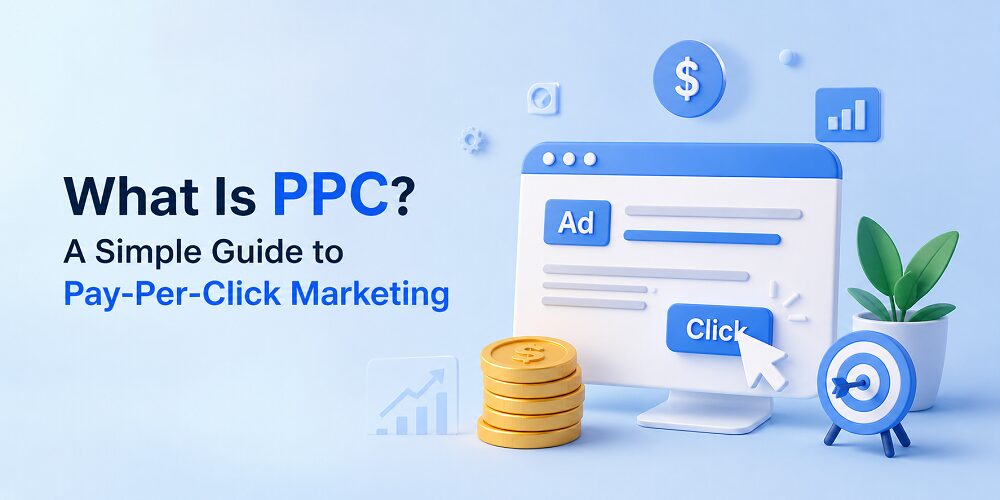
If you’ve ever searched on Google and seen ads at the top of the results page, you’ve already seen PPC in action.
PPC stands forPay-Per-Click. It’s one of the fastest ways to get your business in front of people who are already looking for what you offer.
You don’t have to wait months to get results, and you don’t have to guess whether the right people will see your business. You can show up when someone needs you most, and you only pay when they click.
In this guide, you’ll learn how PPC works, what it costs, and how to use it to grow your business in 2026. Whether you’re just getting started or want a better understanding of the basics, this guide will walk you through it.
Key Takeaways
- PPC (Pay-Per-Click) is a paid advertising model where you only pay when someone clicks on your ad.
- Google Ads is the most widely used PPC platform, but Meta, LinkedIn, and Bing also offer PPC advertising.
- PPC can bringquick traffic, while SEO usually takes more time to show results.
- Your cost per click depends on things likecompetition, keyword choice, and Quality Score.
- A well-run PPC campaign can deliver strong returns. According to Google’s Economic Impact Report, some businesses see₹2 in revenue for every ₹1 spent.
- PPC works best when it supportsSEO, not when it tries to replace it.
Of course, here’s a more natural and polished version:
What Is PPC?
PPC stands forPay-Per-Click advertising. It’s a type of online advertising where you pay each time someone clicks on your ad.
In simple terms, you are buying visits to your website instead of waiting for people to find you through SEO.
PPC Meaning
Think of it like renting a billboard, but with one big difference. You only pay when someone actually takes action, not just when they see it. You’re not paying for views alone. You’re paying for clicks that can lead to real results.
That’s what makes PPC so effective. You’re paying for traffic with intent, not just visibility.
A quick real-world example
Let’s say you run an online shoe store in India and create a Google Ad for the keyword“buy running shoes online.” Your ad appears at the top of Google when someone searches that term. If they click your ad, you pay ₹25 for that click.
Now imagine that same visitor buys a pair of shoes worth ₹2,500. That one click could turn into a strong return for your business. That’s PPC working well.
How Does Pay-Per-Click Advertising Actually Work?
PPC works through a fast automated process called anad auction. It happens in just a fraction of a second every time someone searches online.
Step 1: The advertiser creates an ad
First, you create an ad with a headline, description, and landing page URL. You also choose the keywords you want your ad to show for. For example, terms likeaffordable PPC services orbest running shoes.
Step 2: The auction happens in milliseconds
When someone types a search into Google, the platform runs an instant auction. Every advertiser bidding on that keyword is considered automatically.
Google looks at a few main things, including your bid and yourQuality Score. Quality Score is Google’s way of measuring how relevant your ad, keywords, and landing page are. It is usually scored from 1 to 10. A better score can help lower your cost per click.
Step 3: Your ad shows up, or it doesn’t
Google combines your bid and Quality Score to decide yourAd Rank. That score helps determine where your ad appears on the page.
You do not always need the highest bid to win the top spot. A more relevant ad with a better landing page can often outrank a bigger bidder.
Step 4: You pay only when someone clicks
If your ad appears and someone clicks it, you pay for that click. If nobody clicks, you do not pay. That is the basic idea behind PPC.
Types Of PPC Ads
PPC is not just about Google search ads. There are several types of pay-per-click ads, and each one serves a different purpose.
Some are best for reaching people who are ready to buy. Others help build awareness, promote products, or bring past visitors back to your site.
Search Ads (Google & Bing)
Search ads are the text ads you see at the top of search engine results pages. They look similar to organic results, but they are marked as sponsored.
These are the most common type of PPC ads because they reach people who are already searching for something specific. That makes them a strong choice for service businesses and lead generation.
Display Ads
Display ads are visual banner ads that appear on websites and apps across the web. They are usually better for brand awareness than for immediate sales.
For apparel brands, display ads can help keep your products in front of people while they browse other sites.
Shopping Ads
Shopping ads are a great fit for e-commerce. They show the product image, price, and store name right in the search results.
If you sell apparel online, these ads can be very effective because shoppers can see the product before they click.
Social Media Ads
Social media ads run on platforms like Facebook, Instagram, and LinkedIn. They let you target people by interests, behavior, age, and location.
This type of PPC works well for apparel brands because fashion often performs best when people discover it visually, not just through search.
Remarketing Ads
Remarketing ads are shown to people who have already visited your website or interacted with your brand. You may have noticed this when a product you viewed starts following you around online.
These ads often convert well because they reach people who already know your brand and may just need one more reminder.
Key PPC Terms You Need To Know
Before you launch your first campaign, it helps to understand a few basic PPC terms. These are the words you’ll see often in ad dashboards and reports.
- CPC (Cost Per Click): The amount you pay each time someone clicks your ad.
- CTR (Click-Through Rate): The percentage of people who see your ad and click on it. You can calculate it using this formula:(Clicks ÷ Impressions) × 100.
- Quality Score: Google’s rating of how relevant your ad and landing page are. It usually ranges from 1 to 10.
- Ad Rank: The score that helps decide where your ad appears in the auction.
- Impression: One time your ad is shown to someone.
- Conversion: When a visitor completes the action you want, such as making a purchase, filling out a form, or calling your business.
- ROAS (Return on Ad Spend): The revenue you earn for every rupee or dollar you spend on ads.
What Are The Benefits Of PPC Marketing?
There’s a reason so many businesses invest in PPC marketing. It gives you speed, control, and clear results.
Immediate traffic, unlike SEO
SEO is important, but it usually takes time to show results. In many cases, it can take months to rank well in organic search. PPC is different. Your ad can go live today and start bringing in traffic within hours.
That makes PPC a strong option when you need quick visibility for a product launch, a sale, or a new market.
Highly targeted reach
PPC lets you reach the right people at the right time. You can target by keyword, location, device, time of day, language, and audience behavior.
Instead of showing your message to everyone, you can focus on the people most likely to buy.
Full budget control
With PPC, you decide how much to spend. You can set daily and monthly budgets, choose your bids, and adjust your spending as you learn what works.
That means you can start small and grow over time. You do not need a huge budget to begin.
Measurable ROI
One of the biggest strengths of PPC is how easy it is to track. You can see clicks, impressions, conversions, and results clearly.
This helps you understand what is working and what needs improvement. You are not guessing, you are using real data.
Brand visibility, even without a click
Even if someone does not click your ad, they still see your brand at the top of the search results. That kind of visibility helps people remember your business.
Over time, that familiarity can build trust and make people more likely to click later.
How Much Does PPC Advertising Cost?
This is usually the first question business owners ask, and the honest answer is simple:it depends.
Average CPC by industry in 2026
PPC costs can vary a lot by industry. Some markets are competitive and expensive, while others are much more affordable.
A few common Google Ads CPC ranges look like this:
- Legal: $6 to $12
- Finance and Insurance: $5 to $10
- E-commerce: $0.50 to $2
- Education: $2 to $5
- Health and Wellness: $2 to $6
- Technology and SaaS: $3 to $8
For a broader look at current Google Ads benchmarks, WordStream’s 2025 Google Ads benchmarks are helpful. You can also compare industry-level CPC trends in this Google Ads cost per click guide.
In India, CPCs are often lower than in the US, which can make PPC a practical option for local businesses trying to reach nearby customers.
What affects your PPC cost?
Several things can change how much you pay per click:
- Keyword competition: Popular keywords usually cost more
- Quality Score: Better ads and landing pages can lower your CPC
- Industry: Competitive niches like legal and finance often cost more
- Ad relevance: Ads that match the search better usually perform more efficiently
- Timing and location: Peak hours and expensive locations can raise costs
How to think about budget if you are just starting out
If you are new to PPC, you do not need a huge budget to begin. A small business can often start with a modest monthly budget and still learn a lot.
For many beginners, a budget in the range of₹15,000 to ₹30,000 per month can be enough to test keywords, track performance, and see what brings real results.
The goal is not to spend as much as possible. It is to spend carefully, learn from the data, and grow the campaigns that work.
PPC Vs SEO: Which One Is Better?
This is one of the most common questions in digital marketing. The short answer is that both can be valuable. They just work in different ways.
If you want a deeper comparison, you can also read our SEO vs PPC guide. For a bigger picture view of how these channels fit into your overall strategy, the web marketing guide is also helpful.
PPC vs SEO at a glance
| Factor | PPC | SEO |
| Speed | Can bring results right away | Usually takes 3 to 6 months or more |
| Cost | You pay per click | It takes time, content, and effort |
| Traffic Type | Paid traffic | Organic traffic |
| Sustainability | Stops when your budget stops | Can keep growing over time |
| Trust | People often trust organic results more, but paid ads can still work well | Organic results usually feel more trusted |
| Targeting | Very precise targeting | Broader targeting, but still effective |
When to choose PPC
PPC is a good choice when you need traffic fast. It works well for product launches, limited-time offers, new markets, or testing a keyword before putting time into SEO.
If you want quick data and faster visibility, PPC is usually the better first step.
When to choose SEO
SEO is the better choice when you want long-term growth. It helps build authority, trust, and steady traffic over time.
If your goal is to reduce your dependence on paid traffic and create lasting visibility, SEO should be part of the plan.
Why smart businesses use both
The truth is, PPC and SEO work best together. They are not competitors. They support each other.
PPC gives you quick traffic and useful data. SEO helps you build a stronger presence over time. Together, they create a more balanced digital marketing strategy.
At Techeasify, we usually recommend using both when possible. That way, you can get short-term results and long-term growth at the same time.
How To Start A PPC Campaign: Step By Step
Ready to launch your first PPC campaign? The process is simpler than it looks when you break it into clear steps.
Step 1: Define your goal
Start by deciding what you want this campaign to do. Do you want more website visitors, phone calls, product sales, or lead form submissions?
Your goal will shape everything else, including your keywords, ad copy, and landing page.
Step 2: Choose your platform
For most businesses,Google Ads is the best place to start because it has the largest search volume.
If you run a B2B business,LinkedIn Ads can work well. If you sell to consumers,Meta ads on Facebook and Instagram are often a strong choice.
Step 3: Do keyword research
Use a tool like Google Keyword Planner to find the words and phrases your audience is searching for. If you want help with this part, our keyword research guide is a good place to start.
Try to mix different keyword types:
- Broad intent keywords, like “what is PPC,” for people who are still learning
- Commercial intent keywords, like “PPC services for small business,” for people who are closer to buying
Step 4: Write your ad copy
Your ad needs to be clear and useful. The headline should get attention. The description should explain your offer. The call to action should tell people what to do next.
If possible, include your main keyword naturally in the headline.
Example:
- Headline: Affordable PPC Management Services | Techeasify
- Description: Grow your business with targeted Google Ads. Expert PPC campaigns starting at ₹9,999/month. Free consultation.
Step 5: Set your budget and bids
Start small and stay realistic. Set a daily budget that you are comfortable testing with.
Once you start getting data, you can see what is working and slowly increase spending on the campaigns that perform well.
Step 6: Track and optimize
Tracking matters. Set up conversion tracking in Google Ads and connect it with Google Analytics if possible.
Then check your campaign regularly. Pause ads that are not performing well. Keep testing better versions. PPC works best when you keep improving it over time.
PPC is not something you launch and forget. The best results come from steady monitoring and small improvements.
Common PPC Mistakes To Avoid
Even smart marketers make these mistakes. The good news is, they are easy to avoid once you know what to look for.
- Sending traffic to your homepage instead of a dedicated landing page
A homepage is usually too broad. A focused landing page gives visitors a clear message and a clear next step. - Ignoring negative keywords
If you skip negative keywords, your ads can show for searches that have nothing to do with your offer. - Setting it and forgetting it
PPC needs regular checks. If you do not review performance, small problems can turn into wasted spend. - Not tracking conversions
If you cannot measure leads, sales, or calls, you cannot tell what is actually working. - Bidding on too many broad keywords too soon
Broad keywords can spend money fast. It is better to test carefully before you scale. - Writing generic ad copy
Your ad should match what the searcher wants. If it feels vague, people are less likely to click.
FAQ: People Also Ask About PPC
Q1: What is PPC in digital marketing?
PPC stands forPay-Per-Click. It is a type of paid advertising where you pay only when someone clicks your ad. Most people know it through Google Ads, but it also includes platforms like Meta, LinkedIn, and Pinterest.
Q2: How much should I spend on PPC as a beginner?
If you are a small business in India, starting with₹15,000 to ₹25,000 per month is a practical option. That gives you enough data to learn what is working without spending too much too soon. Once you find the campaigns that perform well, you can increase your budget.
Q3: What is a good CPC?
A goodCPC, or Cost Per Click, depends on your industry and the value of each customer to your business. For many service businesses in India, a CPC of₹10 to ₹50 is fairly common. But the real question is not just what you pay per click, it is whether those clicks turn into leads or sales. That is whereROAS becomes important.
Q4: Can Techeasify manage my PPC campaigns for me?
Yes, Techeasify can help with full PPC management. That includes keyword research, ad copy, campaign setup, monitoring, and reporting. Whether you are starting fresh or want to improve an existing campaign, the goal is to build ads that bring real results.
Q5: What is the difference between PPC and Google Ads?
Google Ads is a platform. PPC is the pricing model behind it. In simple terms, Google Ads uses the PPC model, which means you pay when someone clicks your ad. But PPC is not just for Google. It also applies to platforms like Facebook, Instagram, LinkedIn, and Bing.
Conclusion
So, what is PPC? It is one of the fastest and most measurable ways to advertise your business online. It helps you reach people who are already searching for what you offer, and it gives you clear data so you can see what is working.
That makes PPC a smart choice for small businesses, growing brands, and anyone who wants more control over their marketing. The key is to start with a clear goal, choose the right keywords, write ads that speak to your audience, and keep improving the campaign over time.
If you want help with that, Techeasify can support you with PPC management, keyword research, ad copy, campaign setup, and performance tracking. We build campaigns around real business goals, not guesswork, so you can spend smarter and get better results. If you’d like to talk about your PPC goals,reach out to Techeasify and we’ll help you figure out the next step.