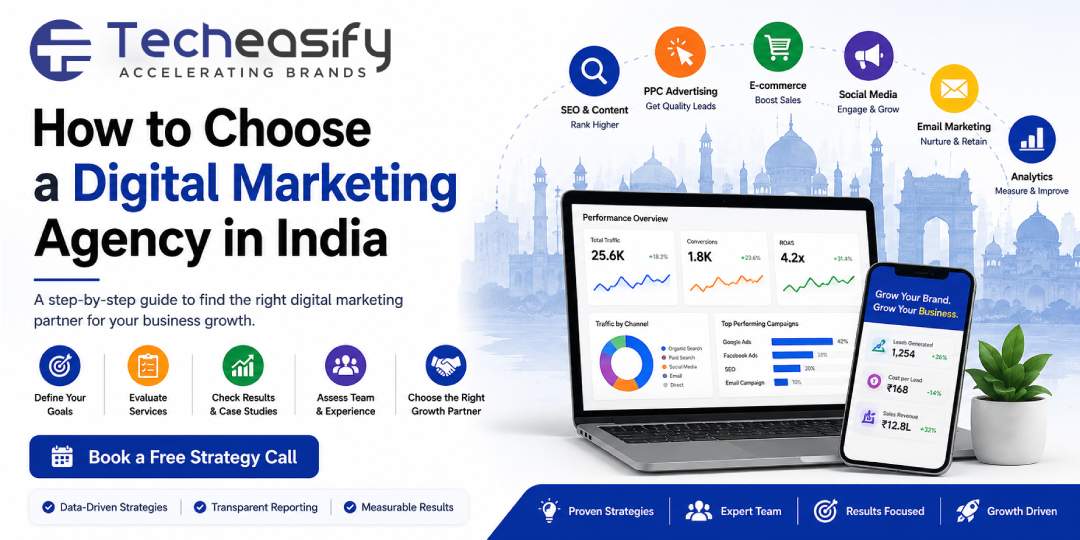
Comparing agencies by price, client logos, years in business, or a long service list can lead you in the wrong direction. The right partner for you depends on your goals, audience, business model, budget, internal team, target market, and reporting needs.
When you compare digital marketing agencies in India, look past the sales deck. An ecommerce founder, a B2B SaaS marketer, and a local service business need different plans. Use this buyer’s process to make a practical choice.
Key Takeaways for Choosing Digital Marketing Agencies in India
Choose an agency based on business fit, not the biggest promise.
- Start with clear goals, not a list of services.
- Check experience with your industry, audience, and sales model.
- Compare the channels you need now, not every service offered.
- Look for connected SEO, PPC, content, email, social, and analytics work.
- Review case studies for revenue, leads, conversion rate, ROAS, or CAC.
- Confirm reporting, account ownership, communication, and scalability.
- Avoid guarantees for rankings, leads, revenue, or returns.
What Does a Digital Marketing Agency Do for Your Business?
A digital marketing agency helps you attract, convert, and retain customers online. You don’t need every service. You need the services that solve your current growth problem.
An agency may handle SEO, PPC, social media, content, email, ecommerce campaigns, conversion optimization, branding, website development, and analytics. A local service company may need lead generation through search. An online retailer may need product SEO, Shopping ads, retargeting, and retention emails.
When Should You Hire a Digital Marketing Agency?
Hire an agency when your growth has stalled and your internal team can’t fix the issue alone. Another tool or junior hire won’t solve poor tracking, weak strategy, or disconnected channels.
Common signs include flat organic traffic, unprofitable ads, inconsistent ecommerce sales, weak B2B lead quality, and expansion into a new Indian or international market. For example, a growing D2C brand may have strong traffic but poor conversion tracking. An agency can connect analytics, paid media, landing pages, and retention activity.
How to Choose a Digital Marketing Agency in India in 10 Practical Steps
The best way to choose is to compare strategy fit, relevant experience, service expertise, reporting, communication, pricing, and scalability. Ask each shortlisted agency for evidence, not broad claims.

1. Define Your Business Goals Before You Contact Agencies
Pick one primary goal, supporting goals, a time frame, and how you’ll measure progress. Brand awareness, qualified leads, ecommerce revenue, CAC, ROAS, and market expansion need different plans.
2. Identify the Services You Actually Need
Don’t buy every service in a standard package. If qualified search traffic is your priority, SEO and PPC may matter more than daily social posts.
Explore an agency’s approach to search engine optimization services if organic growth is central to your plan.
3. Check Industry, Audience, and Business Model Experience
An ecommerce fashion brand, B2B SaaS firm, manufacturer, and local clinic have different sales cycles. Ask about similar products, buyers, markets, and company sizes.
Experience in Mumbai, Bengaluru, Delhi, or Ahmedabad can help. Relevance matters more than the agency’s city.
4. Evaluate the Proposed Strategy
Ask whether the agency researches competitors, defines buyer personas, maps the customer journey, sets KPIs, and tests campaigns. They should explain why each channel fits your business.
For B2B, search intent should connect to landing pages, CRM data, lead qualification, and sales follow-up.
5. Look for Connected Channels
SEO, PPC, email, social media, and analytics shouldn’t operate in separate boxes. A useful journey might move from SEO content to lead capture, email nurturing, remarketing, and conversion.
Ask how teams share audience insights, creative test results, and attribution data. One partner can make sense when you need integrated SEO and PPC work.
6. Review Case Studies for Business Results
Use a simple sequence: problem, strategy, execution, measurement, and result. Prioritize revenue, qualified leads, pipeline, conversion rate, ROAS, CAC, and organic traffic over followers.
Ask what changed, how long it took, what budget was involved, and which outcome the agency can directly connect to its work.
7. Assess Reporting, Analytics, and Conversion Tracking
A useful report covers work completed, traffic, leads, sales, ad spend, ROAS, conversion rates, insights, and next actions. Clicks alone aren’t a business result.
Ask who owns ad accounts, analytics, pixels, tags, dashboards, and first-party data. A report that connects clicks to qualified pipeline is more useful than one that only lists impressions.

8. Understand Pricing, Deliverables, and Contract Terms
Indian retainers can range from about ₹25,000 to ₹5,00,000 or more per month. Scope, competition, ad spend, content volume, catalog size, and target market drive the number.
| Item | What is included | Why it matters |
|---|---|---|
| Ad spend | Usually separate from fees | Prevents budget confusion |
| Content and landing pages | Set quantity and revisions | Defines output |
| Reporting and meetings | Frequency and format | Sets accountability |
| Setup, taxes, renewal | All added charges and exit terms | Avoids surprises |
9. Check Whether the Agency Can Scale With You
Ask what changes when ad spend rises, your catalog grows, or you enter new regions. The agency should explain capacity for multilingual campaigns, marketplaces, automation, and expanded reporting.
An ecommerce brand may add hundreds of products. A B2B company may add several decision-makers and longer nurture paths.
10. Meet the Delivery Team Before Signing
The sales team may not run your account. Meet the account manager and ask who owns strategy, SEO, paid media, creative, development, analytics, and communication.
Confirm meeting frequency, response times, approvals, escalation paths, backup coverage, and a sample first-90-day plan.
Full-Service Digital Marketing or a Specialist Agency: Which Fits You?
Neither model is automatically better. Choose a full-service agency when your channels need close coordination. Choose a specialist when one deep capability is the priority.
| Area | Full-service agency | Specialist agency |
|---|---|---|
| Channels | Several connected channels | One or two core channels |
| Strategy | Integrated planning | Deep channel focus |
| Ecommerce support | Often broader | Depends on specialty |
| Reporting | Combined dashboard | Channel-specific depth |
| Cost | More complex scope | Narrower scope |
| Best fit | Growing multi-channel brand | Technical SEO or paid-search need |
A D2C brand running Google Ads, Meta Ads, email, and marketplace activity may prefer one connected team. A SaaS business with a broken technical SEO foundation may first need a specialist.
How Should You Compare SEO, PPC, and Performance Marketing?
SEO supports long-term organic visibility. PPC can bring targeted traffic quickly. Performance marketing focuses on measurable outcomes such as leads, sales, revenue, ROAS, and CAC.
Results depend on your offer, tracking, website, budget, competition, and sales follow-up. A combined strategy often works better than a single channel. SEO can build demand capture while PPC tests high-intent terms and offers.
How Do You Evaluate an Ecommerce Marketing Agency?
An ecommerce agency should understand the path from product discovery to checkout and repeat purchase. Check product and category page optimization, Google Shopping, feed management, paid social, retargeting, email, analytics, and conversion rate optimization.
If you sell through your website and marketplaces, ask how the agency will coordinate product data, marketplace campaigns, paid acquisition, and retention. A good plan doesn’t treat repeat purchases as an afterthought.
How Do You Evaluate a B2B Lead Generation Agency?
The right B2B agency focuses on qualified pipeline, not lead volume. It should understand your ideal customer profile, buyer personas, search intent, LinkedIn, landing pages, forms, CRM integration, lead scoring, and sales handoff.
Twenty sales-qualified leads can be more valuable than 200 irrelevant inquiries. Ask how offline conversion tracking connects marketing activity to real opportunities.
Do You Need Branding Services or Performance Marketing?
Branding shapes positioning, messaging, visual identity, website experience, and content consistency. Performance marketing focuses on leads, sales, ROAS, CAC, and ongoing creative testing.
A startup entering a crowded category may need clearer positioning first. An established brand with strong messaging may need acquisition-focused campaigns. Both can work together when the message and the offer support each other.
How Much Does a Digital Marketing Agency Cost in India?
Many small and growing businesses spend about ₹25,000 to ₹1,50,000 per month. Larger multi-channel programs often range from ₹1,50,000 to ₹5,00,000 or more. Starter, project-based, freelancer, and enterprise pricing can fall outside these ranges.
| Pricing model | What it covers | Main question to check |
|---|---|---|
| Monthly retainer | Defined recurring scope | What deliverables are fixed? |
| Project fee | Website, audit, or launch | What happens after delivery? |
| Percentage of spend | Paid media management | Is there a minimum fee? |
| Hybrid model | Retainer plus spend fee | Are incentives fair and clear? |
What Red Flags Should You Watch for Before Hiring an Agency?
Watch for guaranteed number-one rankings, fixed ROAS promises, vague strategy, vanity metrics, missing tracking, weak reports, extremely low pricing, long lock-ins, no relevant experience, unclear subcontracting, hidden fees, poor communication, or restricted account access.
A trustworthy agency explains assumptions, risks, measurement limits, and what it needs from your team.
You should own your accounts and data. The agency should provide transparent scope, realistic expectations, and clear cancellation terms.
What Questions Should You Ask Before Hiring?
- Have you worked with a business like mine?
- Which channels do you recommend and why?
- What KPIs will you track?
- How do you define a qualified lead?
- Which SEO methods do you use?
- Who manages paid media?
- How do channels share data?
- Who owns the accounts?
- Who will manage my account?
- Which tools do you use?
- What is included each month?
- What is excluded?
- How often will you report?
- What is the contract length?
- What can I expect in the first three to six months?
Compare the clarity of each answer, not only the sales pitch.
How Can You Compare Agencies With a Weighted Scorecard?
Score each agency from 1 to 5 against the same evidence. Multiply the score by the weight, then discuss any weak area before you decide.
| Category | Weight |
|---|---|
| Strategy fit | 20% |
| Relevant experience | 15% |
| Service expertise | 15% |
| Channel integration | 10% |
| Reporting and analytics | 10% |
| Case studies | 10% |
| Communication | 5% |
| Scalability | 5% |
| Pricing and value | 10% |
The highest score helps, but the agency must also fit your working style and business model.
How Do You Compare Two Agencies and Make the Final Decision?
Choose the agency that fits your goals, audience, channels, team needs, measurement standards, budget, and growth plan. Don’t choose the biggest or cheapest provider by default.
Compare proposals side by side. Verify references, confirm the delivery team, review account access, agree on first-90-day priorities, and document success metrics before work begins.
Why Consider TechEasify as Your Digital Marketing Partner?
TechEasify is a digital marketing and web development agency in India. Its capabilities may include SEO, PPC, performance marketing, ecommerce marketing, social media marketing, website development, conversion-focused marketing, and ecommerce marketplace management.
Assess any partner on strategy, execution, measurement, and scalability. The best fit is the one that can explain how its work connects to your commercial goals.
Frequently Asked Questions About Digital Marketing Agencies in India
How do you choose a digital marketing agency in India?
Define your goals, compare relevant experience, review strategy and reporting, confirm account ownership, and check pricing against deliverables.
What does an agency typically cost in India?
Small and growing businesses may pay ₹25,000 to ₹1,50,000 monthly. Larger programs often require ₹1,50,000 to ₹5,00,000 or more.
Does an ecommerce business need full-service support?
Not always. You may need a specialist if one channel is the problem. Full-service support helps when ads, product SEO, retention, and analytics need coordination.
Can one agency manage SEO, PPC, and ecommerce marketing?
Yes, if it has capable specialists and a shared reporting process. Ask how teams coordinate campaigns and data.
What should you ask before hiring?
Ask about strategy, KPIs, relevant experience, delivery team, reporting, ownership, exclusions, contract terms, and realistic first-quarter expectations.
Make the Right Agency Choice
The strongest digital marketing agencies in India don’t win your business with guarantees. They show clear thinking, relevant experience, measurable reporting, transparent pricing, reliable communication, account ownership, and room to scale.
Your agency should fit the business you have now and the one you plan to build next. Book a free strategy call to discuss your goals and assess the right marketing approach.