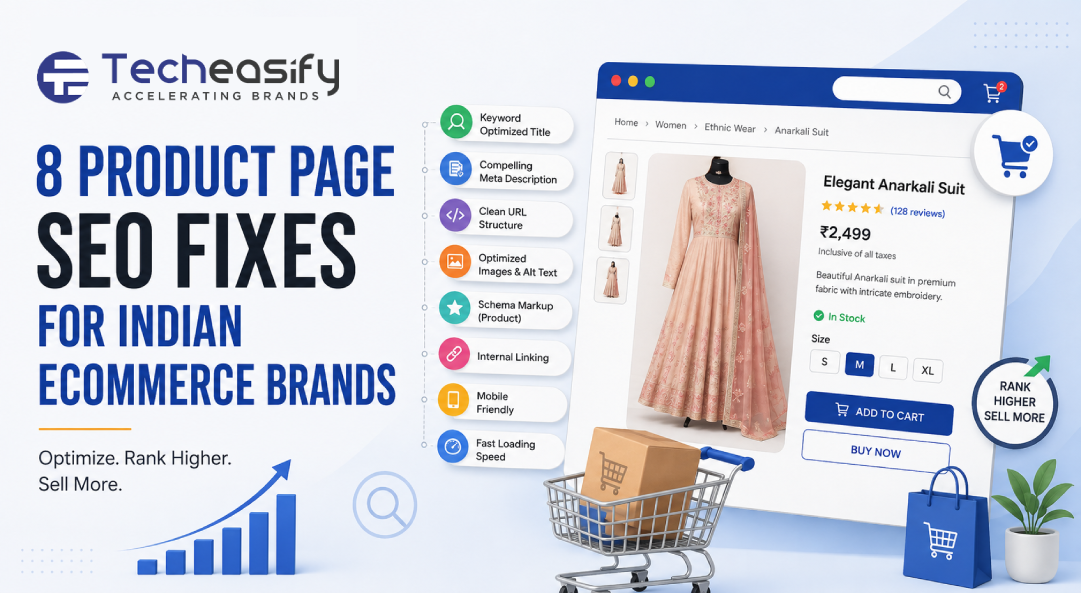
Your product pages do the selling. Yet most Indian ecommerce brands spend all their SEO budget on the homepage and blog, then wonder why product pages never rank.
Here is the reality. India’s ecommerce market is expected to reach around USD 159 billion in 2026, and most of that shopping happens on mobile. Ad costs keep rising. Organic product page traffic is one of the few channels that gets cheaper over time, not more expensive.
The good news? Most product page problems are fixable in weeks. Whether you handle it in-house or hire e-commerce product page SEO services, these eight fixes deliver the biggest impact for Indian online stores.
Quick answer: The most important product page SEO fixes for Indian ecommerce brands are unique title tags, original product descriptions, product schema markup, fast mobile load speed, optimized images with alt text, customer reviews, internal linking from category pages, and smart handling of out-of-stock products.
1. Fix Duplicate Titles and Meta Descriptions
This is the most common on-page SEO failure in Indian ecommerce. Stores with 500+ SKUs often run one template for every page. Google sees hundreds of near-identical titles and ranks none of them well.
What to do:
- Write unique titles in this format: Product Name + Key Attribute + Brand. Example: “Banarasi Silk Saree with Zari Border | Red | YourBrand”
- Keep titles under 60 characters so they display fully
- Add buying triggers to meta descriptions: free shipping, COD available, easy returns
- Include long-tail terms Indian buyers actually search, like “under 2000” or “for wedding”
A meta description does not directly affect rankings. But it decides whether the shopper clicks your result or Flipkart’s.
2. Stop Copying Manufacturer and Marketplace Descriptions
If your product description also appears on Amazon, Meesho, and 40 other reseller sites, Google has no reason to rank your version. Duplicate descriptions are the silent killer of product page optimization in India, where most D2C brands also sell on marketplaces.
What to do:
- Rewrite descriptions in your brand voice, at least 150 to 300 words
- Answer real buyer questions: fabric care, sizing for Indian body types, delivery time to Tier-2 cities
- Add a short “why buy from us” line with your USP
- Keep your website copy different from your marketplace listings
This one fix separates brands that rank from brands that don’t.
3. Add Product Schema Markup
Schema markup is code that tells Google your price, stock status, ratings, and delivery details. It powers the star ratings and price tags you see in search results. Yet most Indian stores skip it entirely.
Pages with valid Product structured data qualify for rich results in Google Search and Google Shopping. They also feed AI Overviews, ChatGPT, and Perplexity, which pull structured facts when recommending products.
What to do:
- Add Product, Offer, and AggregateRating schema to every product page
- Include price in INR, availability, and review count
- Add BreadcrumbList schema so Google understands your category structure
- Test pages with Google’s Rich Results Test after setup
If your store runs on Shopify, most themes handle basic schema. A Shopify development partner can extend it for reviews, offers, and FAQ markup.
4. Speed Up Your Mobile Product Pages
The majority of Indian ecommerce sales now happen on mobile, often on mid-range phones with patchy 4G. A product page that takes six seconds to load loses the sale before the buyer sees the price.
What to do:
- Test your top 10 product pages on PageSpeed Insights, mobile tab first
- Compress product images to WebP format
- Remove unused apps, popups, and tracking scripts that slow the page
- Aim for Largest Contentful Paint under 2.5 seconds
Page speed is both a ranking factor and a conversion factor. It is the rare fix that improves SEO and sales at the same time. If your theme is the bottleneck, a professional web development team can rebuild templates without breaking your design.
5. Optimize Images and Alt Text
Google Images drives real traffic for fashion, jewellery, home decor, and handicrafts. These are exactly the categories where Indian brands are strongest. Most stores upload images named “IMG_4587.jpg” and lose that entire channel.
What to do:
- Rename files descriptively before upload: “blue-chanderi-kurta-set-front.webp”
- Write alt text that describes the product naturally, with one keyword where it fits
- Show 4 to 6 images per product: front, back, fabric close-up, and in-use shots
- Compress every image; quality stays, load time drops
6. Add Reviews and User-Generated Content
Reviews are fresh, keyword-rich content Google reads on every crawl. They also build the trust Indian shoppers need before paying online instead of choosing COD. Buyers write in the exact words other buyers search, like “good for gifting” or “true to size.”
What to do:
- Send automated review requests 7 to 10 days after delivery
- Allow photo reviews; they lift conversion more than text alone
- Reply to negative reviews publicly and politely
- Mark up reviews with schema so stars show in search results
7. Build Internal Links from Category and Blog Pages
Product pages sit deep in your site. Without internal links pointing at them, Google treats them as low priority. Strong on-page SEO includes the links flowing into the page, not just what sits on it.
What to do:
- Add “related products” and “customers also bought” blocks on every product page
- Link from blog posts to specific products, not just the homepage
- Write short intro text on category pages that links to bestsellers
- Fix orphan pages that have zero internal links
This is where an experienced SEO company adds real value. Internal link structure is invisible to shoppers but decisive for rankings.
8. Handle Out-of-Stock Products Properly
Indian ecommerce inventory moves fast. Festival stock sells out. Sizes vanish. Most stores either delete the page (a 404 that kills rankings) or leave a dead end that frustrates buyers.
What to do:
- Keep the page live if the product returns; add a “notify me” option
- Redirect permanently discontinued products to the closest alternative
- Show similar in-stock products on every out-of-stock page
- Never let a ranking page return a 404
A page that took 12 months to rank should never die because one SKU sold out.
Product Page SEO Fixes at a Glance
| # | Fix | Effort | Impact |
|---|---|---|---|
| 1 | Unique titles and metas | Low | High |
| 2 | Original descriptions | Medium | High |
| 3 | Product schema | Low | High |
| 4 | Mobile page speed | Medium | High |
| 5 | Image optimization | Low | Medium |
| 6 | Reviews and UGC | Medium | High |
| 7 | Internal linking | Low | Medium |
| 8 | Out-of-stock handling | Low | Medium |
FAQs
What are e-commerce product page SEO services?
These are specialized services that optimize individual product pages for search engines. They cover title tags, descriptions, schema markup, image SEO, page speed, and internal linking. The goal is to rank product pages for buying-intent keywords and convert that traffic into orders.
How do I choose SEO service providers in India for my online store?
Look for providers with real ecommerce case studies, not just blog SEO work. Ask how they handle schema, faceted navigation, and out-of-stock pages. Demand transparent monthly reporting tied to revenue, not just rankings.
How long does product page SEO take to show results?
Most stores see movement in 8 to 12 weeks for long-tail keywords. Competitive terms take 4 to 6 months. Technical fixes like schema and speed often show impact faster.
Does product page SEO help with AI search like ChatGPT and Google AI Overviews?
Yes. AI tools pull from structured data, reviews, and clear product descriptions. Pages with strong schema and original content get cited more often in AI answers.
Get Your Product Pages Ranking
These eight fixes are not theory. They are the exact gaps we find in almost every Indian online store audit. Fix them and you compete with marketplaces on Google instead of renting traffic from ads forever.
TechEasify helps Indian ecommerce brands with complete digital marketing and e-commerce SEO, from product page audits to full online store optimization.
Want to know which of these eight fixes your store needs most? Get a Free Website Audit today. We’ll show you exactly what’s holding your product pages back.