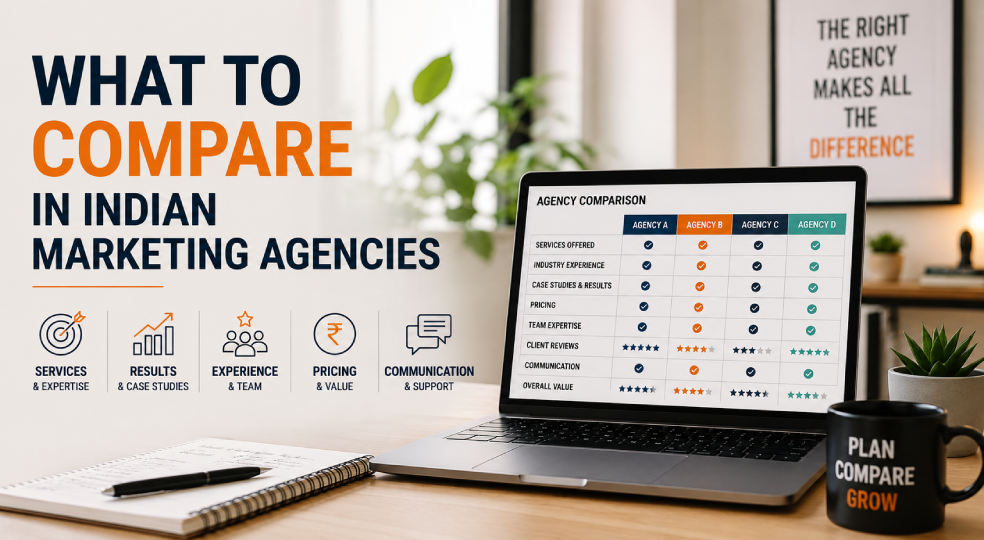
Most businesses compare in digital marketing agencies the wrong way. They look at portfolios, client logos, and price sheets. Those things matter, but they don’t tell you if an agency can actually grow your business.India’s digital ad market crossed ₹99,000 crore in 2025, growing over 11% year on year (Economic Times). More brands are spending more money online. That also means more agencies are competing for your budget, and many of them look identical on the surface.If you’re an e-commerce founder or a B2B marketing leader, you need a clear way to tell digital marketing agencies before you sign a contract. This guide breaks down the exact factors to compare across branding, SEO, ads, and reporting, so you pick a partner that fits your goals, not just your budget.
Compare full-service capability against your actual channel needs. Don’t pay for services you won’t use.
Branding and performance marketing are different skills. Confirm the agency does both well, or ask who handles which.
Ask for case studies from your industry, with real numbers attached, not just logos.
Insist on a sample report before you sign. Vague reporting usually means vague results later.
Match the agency’s pricing model to your budget stage. A ₹30,000 retainer buys different work than a ₹3 lakh one.
1. Full-Service Digital Marketing vs. Single-Channel Focus
Some agencies only run ads. Others only do SEO. A full-service digital marketing agency handles SEO, paid ads, content, email, and analytics under one roof.Full-service works best when you want one team to own your entire funnel. Single-channel agencies work best when you already have an in-house team and need a specialist to fill one gap.Ask each agency to list exactly what’s included. A long service menu on a website doesn’t guarantee real expertise in every item on it.
2. Branding Services and Creative Strategy
Branding and performance marketing pull in different directions. Branding builds long-term recognition and trust. Performance marketing drives short-term clicks and sales.Strong branding services cover positioning, visual identity, messaging, and brand guidelines. Ask to see brand work tied to a business outcome, like higher repeat purchase rates or better ad conversion after a rebrand.If an agency only shows logo designs with no results attached, treat that as a gap, not a strength.
3. SEO, PPC, and Email Marketing Integration
Channels work better together than apart. SEO, PPC, and email marketing should share the same keyword data, customer insights, and conversion goals, not run as separate silos with separate strategies.Ask how the agency connects these three channels. A good answer includes shared reporting, shared audience data, and a single point of contact who sees the whole picture. Our SEO company in India page breaks down what integrated SEO delivery should look like in practice.If SEO, PPC, and email sit with three different teams that never talk, your budget is working against itself.
4. Performance Marketing and Paid Ads Expertise
Performance marketing covers Google Ads, Meta Ads, and other paid channels where you pay for measurable results. India’s digital ad spend is rising fast, and Google Ads costs in metro cities have climbed with it, so ad account expertise matters more than ever.Check who actually manages your ad account. Ask for a past campaign’s cost per lead, return on ad spend, and how the agency adjusted budgets mid-campaign. Our Facebook Ads agency in India page shows how we structure and report paid social campaigns for Indian brands.Also confirm who owns the ad account and the data inside it. You should keep that access, not the agency.
5. E-commerce Marketing Experience
E-commerce marketing has its own rules. It needs product feed management, cart recovery flows, marketplace ad strategy, and seasonal sale planning.India’s e-retail market crossed $65 billion in 2025, growing close to 20% (Moneycontrol). That growth brings more competition for the same shoppers, so an agency without real e-commerce experience will struggle to keep your cost per sale down.Ask for revenue numbers, not just traffic numbers. A good e-commerce partner tracks average order value, repeat purchase rate, and return on ad spend by product category.
6. B2B Lead Generation Capability
B2B lead generation looks nothing like e-commerce marketing. Sales cycles are longer, decision-makers are harder to reach, and a single lead can be worth lakhs in revenue.Ask how the agency defines a qualified lead and how it hands leads to your sales team. Strong B2B agencies track pipeline value and closed deals, not just form fills. Weak ones stop measuring at the lead form and call that a win.
7. Case Studies and Proof of Results
Case studies separate agencies that talk well from agencies that deliver. Ask for 3 to 5 case studies from businesses close to your size, industry, or business model.Push for named metrics: organic traffic growth, cost per lead, revenue attributed to a channel, or ROAS improvement over a set period. If an agency can’t attach numbers to a case study, the result probably wasn’t strong enough to measure.
8. Reporting, Analytics, and Transparency
Reporting tells you whether your money is working. Ask each agency for a sample client report before you sign anything.Good reports show business outcomes: leads, cost per lead, ranking movement, and revenue by channel. Weak reports only show impressions and reach, numbers that look busy but don’t tell you if you made money.Also ask how often reports arrive and whether you get dashboard access or just a monthly PDF.
9. Pricing Models and Contract Terms
Indian agencies price work in a few common ways: monthly retainers, project fees, performance-based fees, or hourly consulting. None of these is automatically better. It depends on your goals.Ask exactly what’s included in the quoted price and what counts as extra. Ask if ad spend is marked up. Ask about the minimum contract length and what happens if you want to exit early.A retainer that looks cheap upfront can cost more later if half your requests fall outside the “included” list.
Quick Comparison Snapshot
Factor
What to Ask
Red Flag
Service scope
Which channels are truly in-house?
Vague “we do everything” answers
Branding
Show a brand project tied to a result
Only logo samples, no outcomes
SEO/PPC/Email
How do these channels share data?
Separate teams, no shared reporting
Ecommerce fit
Revenue and ROAS by product line
Only traffic or impression numbers
B2B fit
How are leads qualified and handed off?
Stops measuring at the lead form
Reporting
Can I see a sample report now?
No sample, “trust us” answers
Pricing
What’s included vs. billed extra?
Guaranteed rankings, unclear scope
Red Flags to Watch For Before You Sign
A few warning signs show up again and again when businesses in India pick the wrong marketing partner.
Guaranteed rankings or guaranteed leads. No agency controls Google’s algorithm or a buyer’s decision.
No named account owner. If you only ever talk to a salesperson, ask who does the actual work.
No sample report available. This usually means reporting is an afterthought, not a system.
Pricing far below market rate. Very low fees often mean outsourced, low-quality delivery.
No case studies close to your business type. Generic portfolios hide a lack of relevant experience.
What should I compare first when evaluating digital marketing agencies in India?
Start with your goals, not the agency’s service list. Decide if you need brand building, lead generation, ecommerce sales growth, or all three. Then check which agencies have real, proven experience in that exact area.
Is a full-service agency better than a specialist agency?
Not always. A full-service digital marketing agency works well when you want one team managing your whole funnel. A specialist agency works better if you already have in-house support and need deep expertise in one channel, like SEO or paid ads.
How do I know if an agency’s case studies are real?
Ask for named metrics tied to a time period, like “30% organic traffic growth in 6 months.” Ask if you can speak to the client directly. Vague claims with no numbers or no client contact are a warning sign.
What’s a reasonable budget for a small business hiring a digital marketing agency in India?
Budgets vary by scope and city, but many small and mid-size businesses start with a monthly retainer covering SEO, social media, and paid ads together, then scale up as results come in. Ask each agency to map its pricing tier to your specific goals.
Should branding and performance marketing come from the same agency?
It’s not required, but it helps. When one team handles both, your brand voice and your paid campaigns stay consistent, and you avoid two vendors giving conflicting advice.
Choose an Agency That Proves Its Work
Comparing digital marketing agencies in India comes down to one habit: ask for proof, not promises. Proof shows up in sample reports, named case studies, clear pricing, and a team you can actually talk to.If you’re weighing your options right now, Techeasify can show you exactly where your current marketing stands and what a full-service plan would look like for your business.Get a Free Consultation and see how our team approaches branding, SEO, PPC, and reporting for Indian e-commerce and B2B brands.