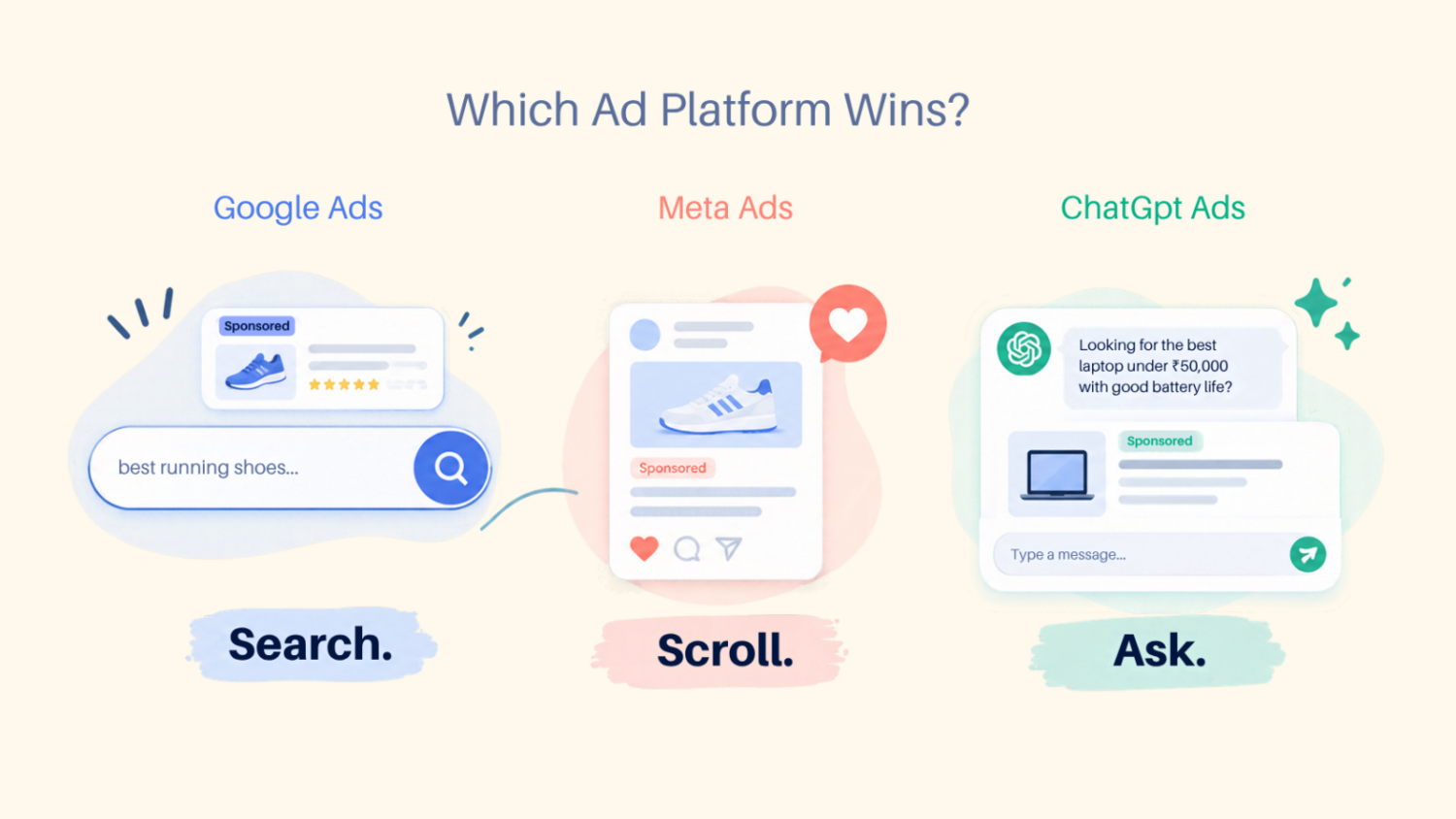
Quick Summary: ChatGPT Ads, Google Ads, and Meta Ads all help you reach customers, but they catch people at different moments. Google Ads catches someone actively searching for a solution, Meta Ads catches someone scrolling and browsing, and ChatGPT Ads catches someone mid-conversation while they’re comparing options. ChatGPT Ads went live for Indian users on 27 August 2026, with self-serve access opening days later, making it the newest of the three platforms with the least Indian performance data so far.
If you have been running Google Ads and Meta Ads for years, you have probably already heard the buzz around ChatGPT Ads. The first question every marketer asks is the obvious one. Is this just another ad platform, or does it actually work differently?
Short answer: it is genuinely different. Not a different colour with the same logic. The way ChatGPT reads a user’s intent, decides what to show them, and charges you for it has almost nothing in common with how Google or Meta operate.
This is not about picking a winner. It is about understanding where each platform earns its keep so you are not spending your budget at the wrong stage of the funnel. Let’s break it down.
How Are ChatGPT Ads Different from Google Ads and Meta Ads?
This is the one thing that changes everything else: targeting, format, even how you write your ad copy.
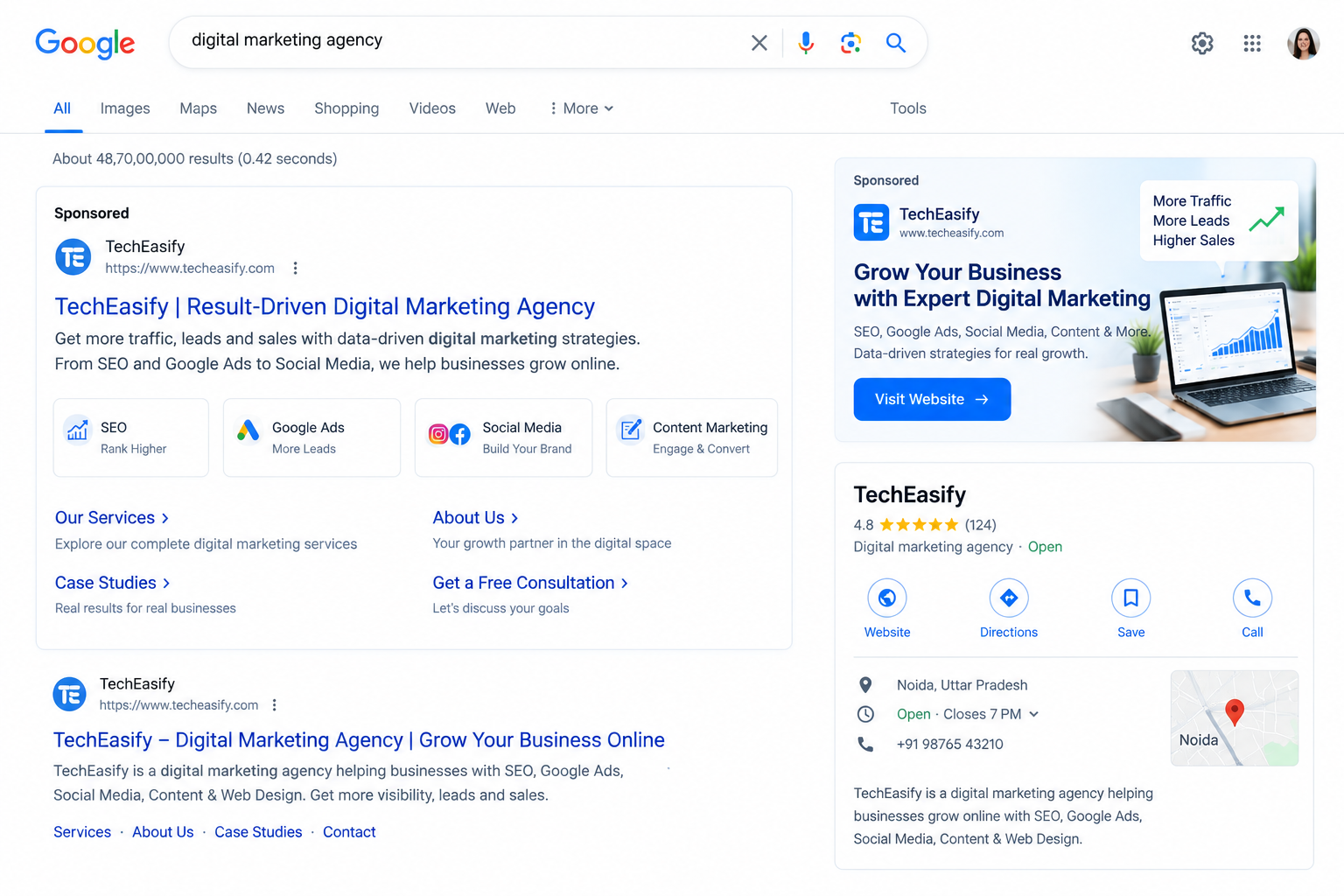
Google Ads: Targets What People Search For
Someone types “best CRM for startups.” That’s a direct statement of what they want right now. Our Google Ads Agency in India services handle exactly this kind of high-intent, ready-to-buy traffic.
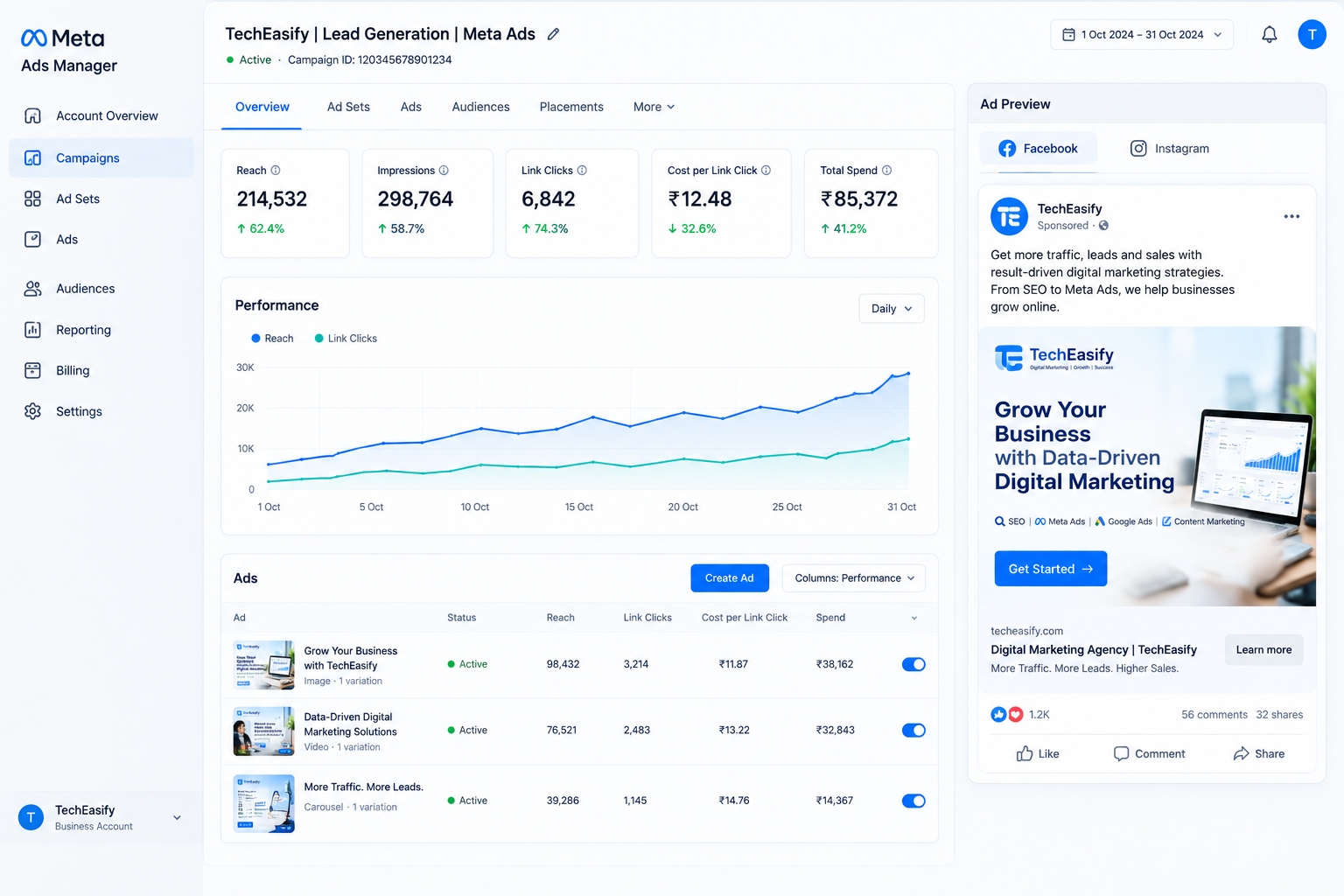
Meta Ads: Targets What People Are Interested In
Nobody tells Meta what they want. It guesses based on interests, past behavior, and who they resemble through lookalike audiences. This is where our Facebook Ads Agency in India services focus, building demand before someone even starts searching.
ChatGPT Ads: Targets What People Are Discussing
Instead of one typed phrase, the AI has the full context of what someone has been asking. If a person spends ten minutes asking ChatGPT about scaling a startup and then asks about project management tools, the system understands they’re a founder looking for growth solutions, not just someone who typed four random words. This is exactly the kind of context-based targeting our ChatGPT Ads Agency in India services are built around.
In practice: Someone searching Google for “Digital marketing agency near me” already wants to hire one. Someone asking ChatGPT “which digital marketing agency best for e-commerce business” is still researching. Same category, completely different buying stage, and treating them the same way is how budgets get wasted.
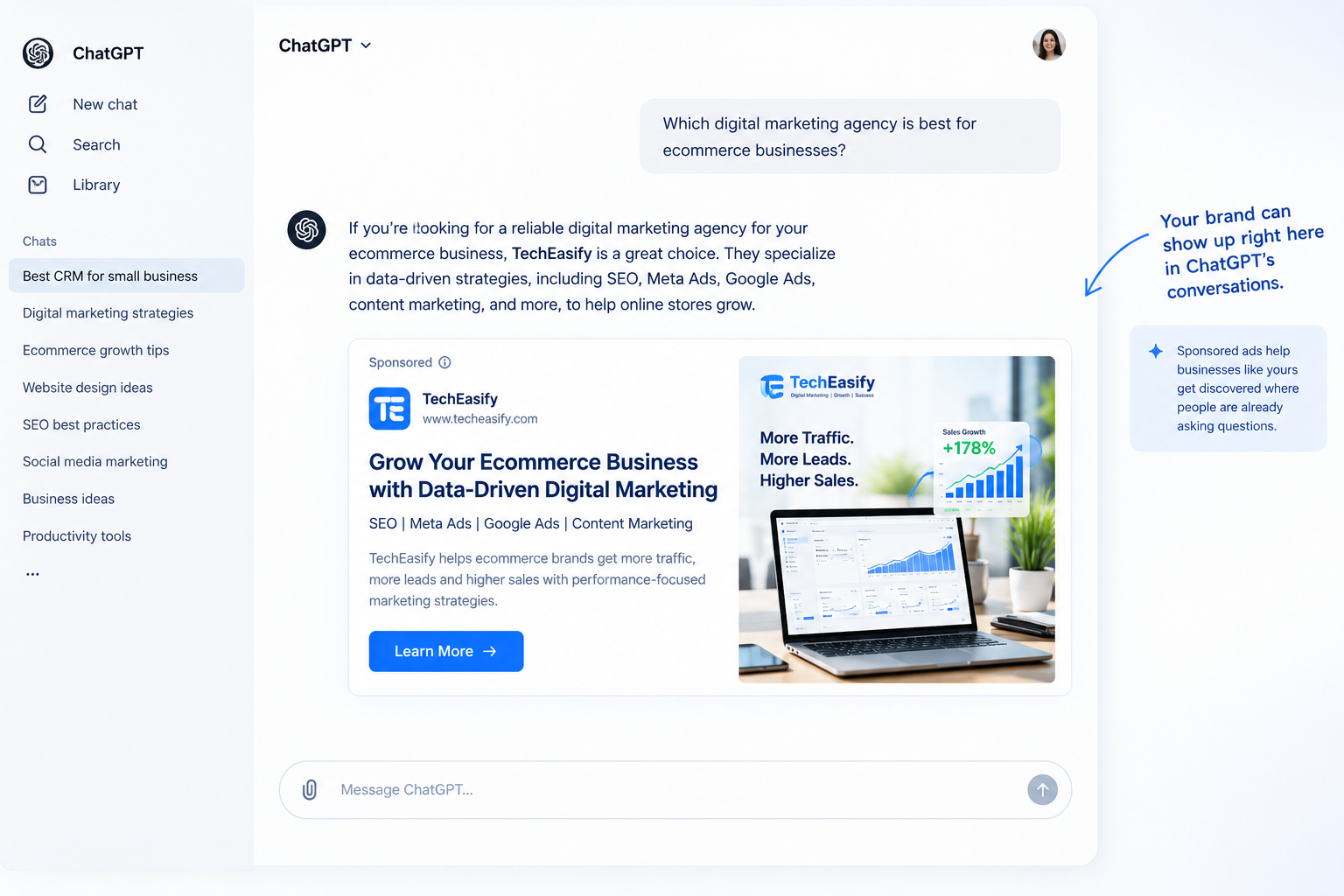
ChatGPT Ads vs Google Ads: Targeting and Placement Explained
Once you understand intent, the mechanics start to make sense.
Platform | How targeting works | Where the ad appears |
Google Ads | Keyword auction. You bid on phrases, match types and negative keywords. | Above and below search results, YouTube, Display Network, apps |
Meta Ads | Interests, behavior, demographics and lookalike audiences | Inside the feed, Stories, Reels and Messenger |
ChatGPT Ads | Context hints. You describe the conversations and scenarios your product fits, not exact keywords. | Sponsored cards shown inside the AI’s answer, clearly labeled |
The biggest shift for anyone used to running paid advertising platforms like Google and Meta is this: there is no keyword list to build on ChatGPT, and right now there is no demographic targeting either. You are essentially telling the system when your product makes sense and letting it match that against live conversations. It is a different skill than writing tight ad groups. It is closer to writing a strong customer persona than a keyword list.
ChatGPT Ads Pricing vs Google Ads and Meta Ads:
Objective | Payment | Use it for |
CPM | For every 1,000 times your ad shows | Reach and awareness |
CPC | For every click, while the system aims for a sale or lead | Sales or leads, once your tracking is set up |
Numbers here move fast since ChatGPT Ads is still a new platform, but here is the general shape based on early industry reporting: ChatGPT Ads is currently running as a limited rollout with a high entry commitment for advertisers, not a simple self-serve model like Google or Meta yet. You can check OpenAI’s own advertising documentation on the Ads in ChatGPT help page for the most current details on how ads appear and who sees them.
Treat any ChatGPT Ads figure as directional for now, not a fixed rate card. Pricing is expected to shift as more advertisers come in, the auction matures, and self-serve access widens over time.
The one constant across all three: online advertising platforms all run on some form of auction. You don’t pay a fixed price on any of them. You are competing for placement, just against very different signals.
ChatGPT Ads vs Google Ads vs Meta Ads: Quick Comparison
Factor | ChatGPT Ads | Google Ads | Meta Ads |
User Intent | Conversational, research and decision-making | Keyword search, ready to buy | Interest and behavior based, discovery |
Targeting Method | Context hints (conversation topic, landing page) | Keywords and audiences | Interests, behavior, lookalikes |
Ad Placement | Sponsored card below the AI’s answer | Above/below search results, YouTube, Display | News feed, Stories, Reels |
Pricing Model | CPM, CPC, CPC; ₹725/day minimum in India | CPC, CPM, CPA | CPC, CPM |
Platform Maturity (India) | Live since August 2026, very limited data | Mature, fully available | Mature, fully available |
Best For | Reaching people comparing options, ecommerce discovery | Direct response, high-intent search | Brand awareness, retargeting |
When to Use ChatGPT Ads, Google Ads or Meta Ads
1. When Should You Use ChatGPT Ads?
- Your product needs explaining, not just showing, such as B2B, financial services or complex products
- You want to be the brand an AI actually recommends during someone’s research phase
- You are comfortable testing a newer channel with a smaller, controlled budget
Ad structure: One sponsored card with a single square image, a short title, and a brief description, shown below the AI’s answer, clearly labeled Sponsored
2. When Should You Use Google Ads?
- Someone already knows what they want and is searching for it
- You need measurable, attributable bottom funnel conversions
- You want mature reporting and years of benchmark data to lean on
Ad structure: Multiple headlines and descriptions combined by Google’s system, plus extensions like sitelinks, callouts, and pricing, shown above or below organic search results
3. When Should You Use Meta Ads?
- You are selling a visual, discovery led product such as fashion, home or lifestyle
- You need retargeting and lookalike scaling at volume
- Awareness and demand creation matter more than instant conversion
Ad structure: Image, video, or carousel creative with primary text, a headline, and a call-to-action button, shown natively inside the feed, Stories, or Reels
Should Ecommerce and D2C Brands Use ChatGPT Ads?
If you’re running an ecommerce or D2C brand, this comparison isn’t just theory, it’s probably the most relevant funnel decision you’ll make this year.
Meta Ads still does the heavy lifting for discovery and retargeting, especially with product catalogs and lookalike audiences built from your existing buyers.
Google Ads (particularly Shopping and Search) remains where people go once they’ve already decided to buy and are comparing prices or checking availability.
ChatGPT Ads is opening a third lane: people are already asking ChatGPT things like “which skincare brand is good for oily skin under ₹1,000” or “best budget-friendly running shoes for beginners.” That’s a product recommendation moment, and right now, very few Indian ecommerce brands are showing up in it.
For ecommerce specifically, the practical move is treating ChatGPT Ads as a small, tracked test alongside your existing Meta and Google spend, not a replacement. Since competition is still low, even a modest budget can get your brand in front of shoppers at the exact moment they’re asking for a recommendation, before your competitors figure out context hints and conversion tracking.
If you want the deeper mechanics of how this actually works, from setup to targeting to optimization, our complete guide on ChatGPT Advertising walks through it step by step.
How to Choose Between ChatGPT Ads, Google Ads and Meta Ads
Realistically, this is not an either/or decision for most brands. It comes down to:
- Budget stage. If you are testing, start small on ChatGPT alongside your existing Google and Meta spend rather than replacing anything
- Funnel goal. Bottom funnel conversions still lean Google, awareness still leans Meta, research stage influence is where ChatGPT fits
- Product type. Visual products lean Meta, high intent transactional categories lean Google, and considered or complex purchases are where ChatGPT has room to add value
Most businesses running mature digital advertising platform strategies will eventually run all three together, each doing the job it is best at, rather than picking one and dropping the others.
Continue Exploring the ChatGPT Ads India Series
- How to Advertise on ChatGPT: Step by Step for Indian Brands (coming soon)
- How Much Do ChatGPT Ads Cost in India? (coming soon)
- Is ChatGPT Ads Right for Your Business? (coming soon)
For the full picture of how ChatGPT Ads work in India, our pillar guide on ChatGPT Ads India covers it in depth.
Not Sure Where to Start? We Will Help You Figure It Out
Choosing between ChatGPT Ads, Google Ads and Meta Ads does not need to be a guessing game. Our team at Techeasify runs performance campaigns across all three, and we can help you figure out the right mix for your budget and goals.
Explore our ChatGPT Ads Agency in India services, or get in touch with our team for a free strategy conversation.
FAQs
- Is ChatGPT Ads better than Google Ads?
- Not better, different. Google Ads captures people who already know what they want. ChatGPT Ads reaches people while they are still researching. Most brands benefit from using both at different funnel stages.
- Can I run ChatGPT Ads and Meta Ads together?
- Yes. Since Meta targets are based on behavior and interests, while ChatGPT targets based on live conversation context, the two do not overlap much, which means they can genuinely complement each other rather than compete for the same budget.
- How much do ChatGPT Ads cost in India?
- No. Pricing is still evolving as the platform matures, so current CPC and CPM figures should be treated as early estimates, not a permanent rate card.
- Can I use the same creative for ChatGPT Ads, Google Ads and Meta Ads?
- Yes. Google rewards tight, keyword-matched copy, Meta rewards visual, scroll-stopping creative, and ChatGPT rewards conversational, helpful-sounding copy that answers the situation described in your context hints. Reusing the same creative across all three usually underperforms on at least one platform.
- Which agency can run ChatGPT Ads, Google Ads and Meta Ads together in India?
- Techeasify runs all three from one team, so your budget, tracking and reporting stay in one place. We set up ChatGPT Ads through context hints, and we manage Google Ads and Meta Ads for the same brand, so each platform handles the funnel stage it does best. To see how we can help your brand, visit our ChatGPT Ads Agency in India page or get in touch for a free strategy conversation.
- Do ChatGPT Ads work for ecommerce brands?
- Yes, as a small test alongside your Google and Meta Ads. Shoppers already ask ChatGPT for product recommendations, and very few Indian ecommerce brands show up there yet. ChatGPT Ads went live in India on 27 August 2026, so there is little performance data so far. Start with a small budget (minimum ₹725 per day) and track your results.