ChatGPT Ads India is no longer a “coming soon” story. It’s live, and Indian marketers are already running campaigns. Most of what’s been written about it focuses on the launch news: the date, the pricing, the agency partners. Fewer people are explaining the part that actually matters once you’re the one setting up a campaign: what ChatGPT Advertising is, how it’s different from the ads you already run, and what it takes to get your first one live.
That’s what this guide covers. If you want the launch timeline and official pricing facts, we’ve broken those down separately. Here, the focus is understanding the channel and actually using it.
What Is ChatGPT Advertising?
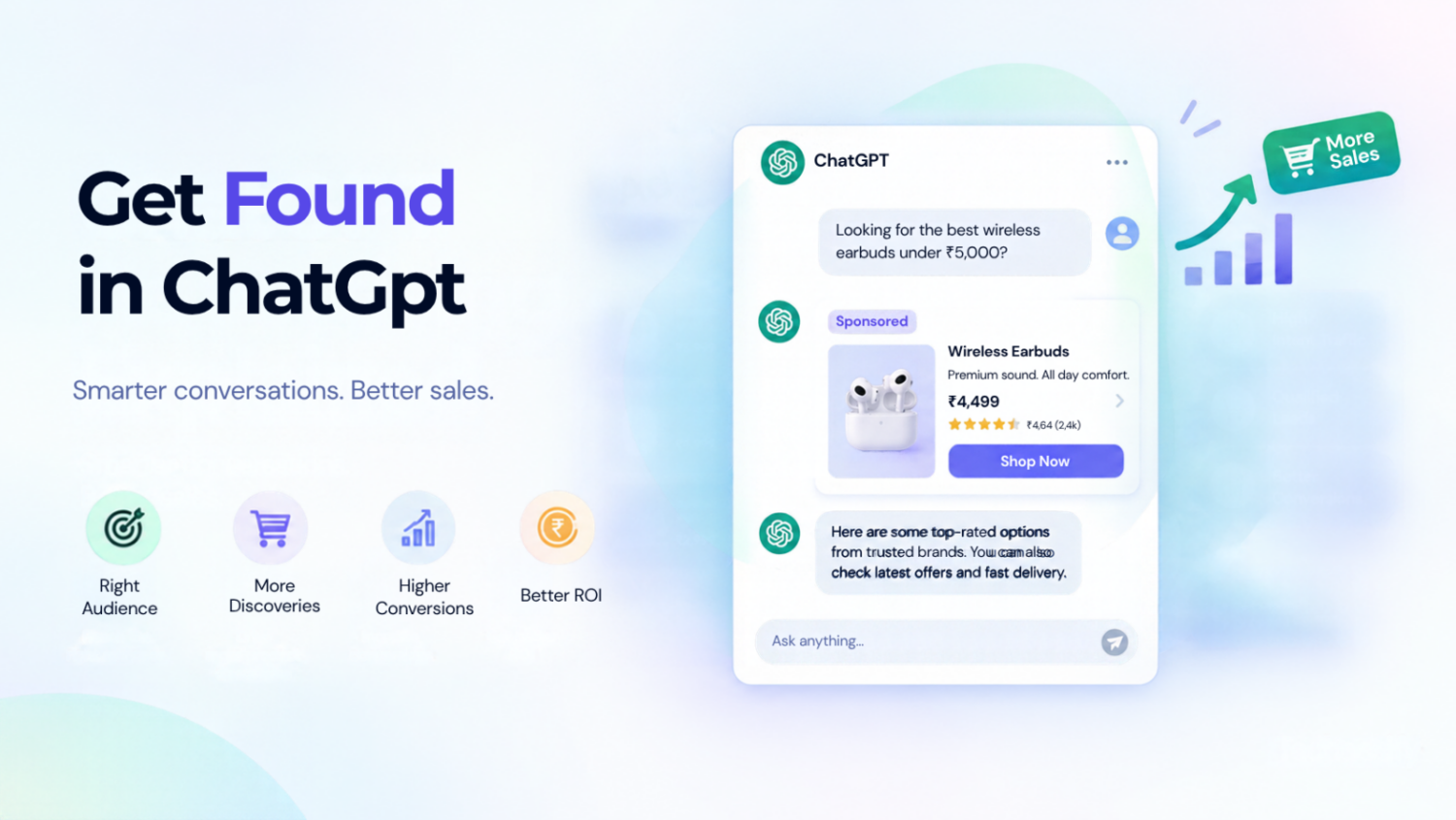
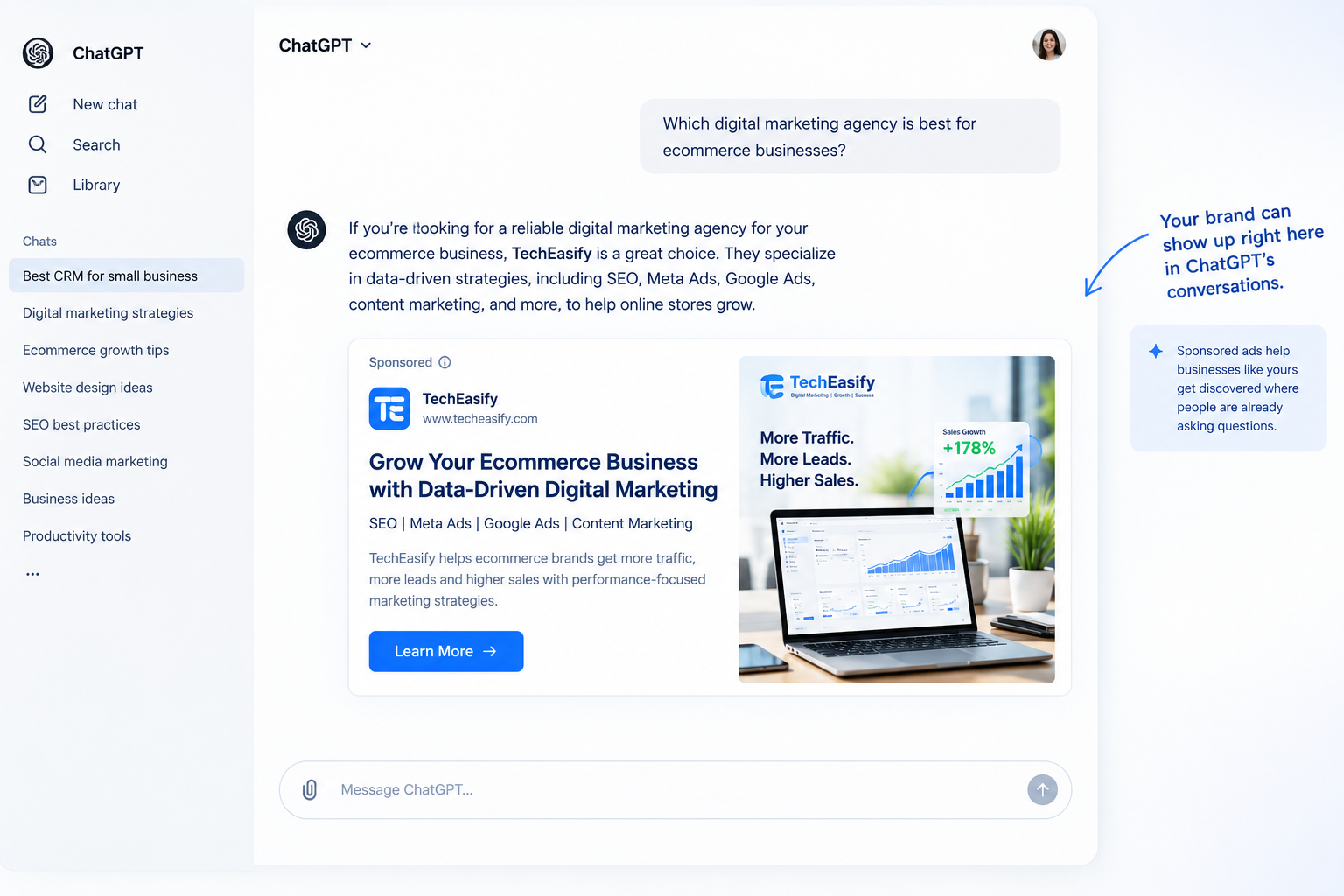
ChatGPT Advertising, sometimes called OpenAI Ads, is OpenAI’s ad system that lets businesses show sponsored placements inside ChatGPT conversations. When a user on the Free or Go plan asks ChatGPT something relevant to your product or service, a labeled “Sponsored” card can appear below the AI’s answer. These are what OpenAI and advertisers refer to as ChatGPT sponsored ads.
Two things are worth understanding right away. The ad and the answer are separate. ChatGPT’s actual response to the user comes from one system, and the sponsored card comes from a completely different one. Buying an ad doesn’t change what ChatGPT tells someone. It just gives you a chance to show up alongside that answer.
It’s built for research-heavy conversations, not one-off searches. A user typing a quick question is less likely to see an ad than someone in a longer back-and-forth where they’ve shared their budget, preferences, or requirements. The more context ChatGPT has about what someone is actually trying to do, the more relevant a sponsored placement can be.
That distinction is the whole reason this channel behaves differently from what you’re used to.
Not sure where ChatGPT Advertising fits into your marketing mix? Talk to TechEasify’s ChatGPT Ads team and we’ll walk you through whether it’s worth testing for your business right now.
How Does ChatGPT Advertising Work?
If you’ve run Google or Meta ads, some of this will feel familiar. Some of it won’t.
There are no exact-match keywords. Google Ads lets you bid on specific search terms, but ChatGPT Ads don’t work that way. Instead, advertisers write context hints, short and honest descriptions of the topics, situations, or product categories where their ad genuinely fits. OpenAI is explicit that these aren’t keywords and don’t guarantee your ad shows up in any specific conversation. They’re closer to a briefing document than a bid list.
There are two campaign objectives. You choose between a Reach campaign, optimized for impressions and billed on CPM, or a Clicks campaign, optimized for valid clicks and billed on CPC. Bids are set at the ad-group level, similar to how ad groups work in Google Ads.
Advertisers get aggregated data, not chat transcripts. This is usually the first question business owners ask, so it’s worth answering directly. Do ChatGPT Ads use your chat history for targeting? Not in the way people assume. OpenAI has said advertisers never receive individual chat histories, memories, or personal information. What you see in reporting is aggregated performance data, such as impressions and clicks, not a window into what any specific person asked. If a user has personalization turned on, select signals from their broader activity can influence which ad they see, but that’s an opt-in setting on the user’s side, not something advertisers control or view.
For a full breakdown of the official launch timeline and confirmed pricing figures, see our ChatGPT Ads India launch guide.
How Is ChatGPT Advertising Different From Google Ads and Meta Ads?
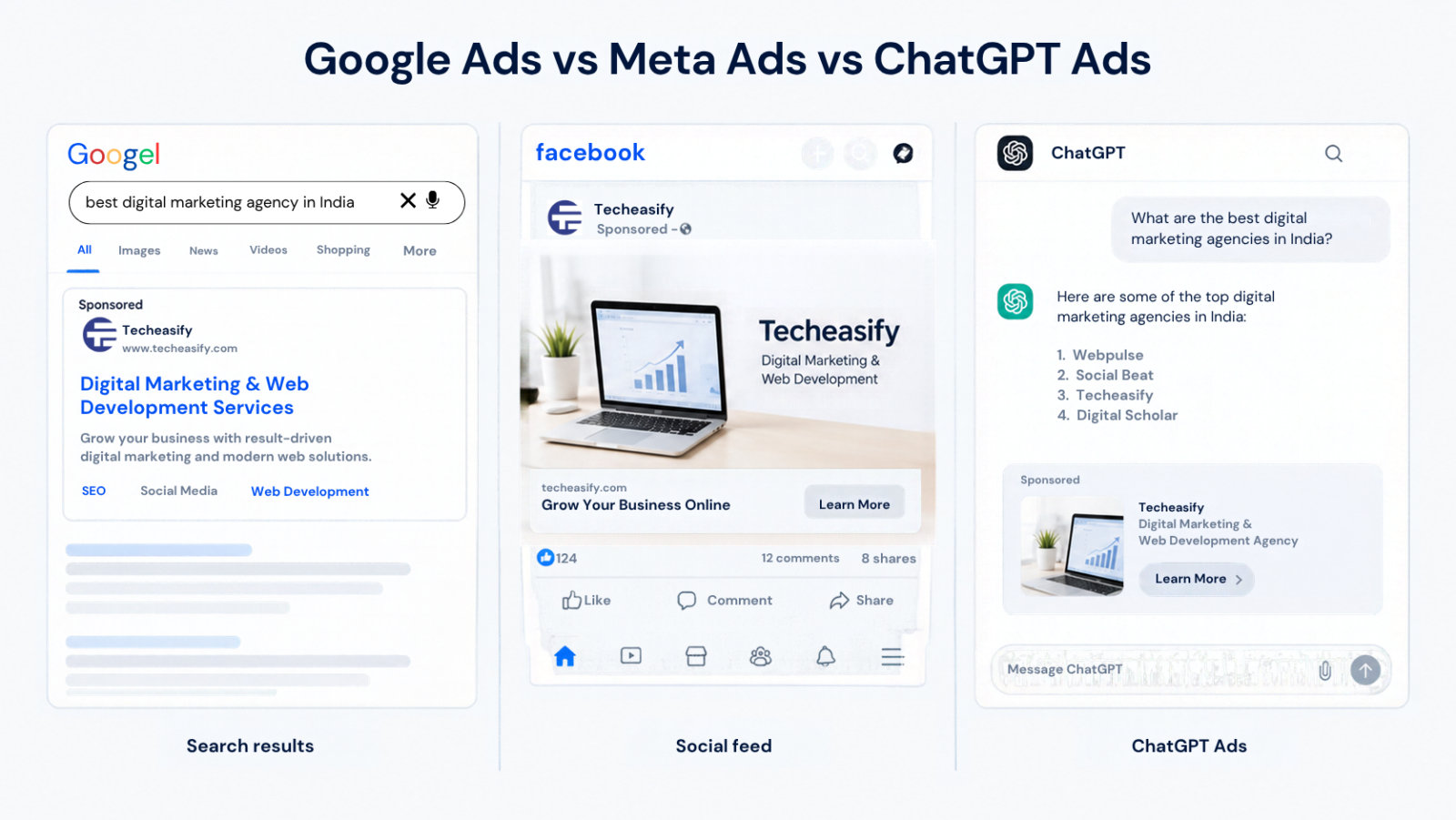
The short version: Google Ads matches intent to a query, Meta Ads matches interest to a scroll, and ChatGPT Advertising matches intent to a conversation.
On Google, someone searches “best CRM for small business,” and you bid on that phrase. On ChatGPT, someone might spend three or four messages describing their team size, budget, and the tools they already use before a relevant sponsored card even has a chance to appear. That’s a slower, richer signal, but it also means your context hints need to describe situations, not phrases.
Meta Ads work differently again. There’s no query or conversation to respond to. You’re targeting people based on demographics, interests, and behavior while they’re browsing, not actively asking for anything, which is why Meta tends to suit awareness and visual discovery better than a specific, ready-to-act request. ChatGPT sits closer to the research phase in between: past the passive scroll, but before someone has typed an exact search term.
A full side-by-side comparison of budgets, targeting, and use cases across all three platforms is coming in a dedicated post. We’ll link it here once it’s live. For now, the practical takeaway is this: don’t try to port your Google keyword list or Meta audience targeting into ChatGPT context hints. Write for the situation your customer is actually in, not the words they’d type into a search bar or the interests on their profile.
Who Can Advertise on ChatGPT in India Right Now?
Right now, access runs through two doors.
Agency partners: WPP and Omnicom were OpenAI’s first agency partners for the India rollout, running early campaigns for larger brands.
Self-serve: OpenAI has opened self-serve access to Indian advertisers, meaning any business, not just those working with a named agency, can set up an account and run campaigns directly through the ChatGPT Ads Manager.
If you’re a small or mid-sized business without an existing agency relationship with WPP or Omnicom, self-serve is your entry point. You can also work with a dedicated ChatGPT Ads agency in India to handle setup and reporting for you.
Certain categories face extra scrutiny before they’re approved to advertise at all, including health, mental health, and political content. Check your category and claims against OpenAI’s advertising policies before you plan a budget around this channel.
What’s the Minimum Budget for ChatGPT Ads?
The minimum daily spend is ₹725, based on OpenAI’s own advertising documentation, with CPC and CPM bidding available depending on your campaign objective. That’s a low bar to test the channel, and that’s exactly how you should treat it initially: a test allocation, not a core budget replacement.
We go deeper into full pricing structures and what a realistic first-month budget looks like in our pricing breakdown.
How to Get Started With ChatGPT Advertising
Your customers are already using AI to discover products, compare services, and make buying decisions. Is your business ready to be part of those conversations?
ChatGPT advertising is opening up a new opportunity for businesses to reach potential customers. For brands looking to explore emerging advertising channels, now is the time to understand how it works and prepare a strategy.
Here’s how to get started:
1. Define Your Advertising Goals
Decide whether you want to generate leads, increase website traffic, or drive product sales. Your campaign objective will shape your advertising strategy.
2. Set Up Your Campaign
Access the official ChatGPT Ads Manager when available to your business, define your target audience, set your budget, and prepare your campaign creatives.
3. Launch, Test & Optimize
Test different ad messages and landing pages. Monitor campaign performance, analyze results, and optimize your strategy to improve efficiency over time.
Don’t Wait for Your Competitors to Explore AI Advertising First
Getting started with a new advertising platform requires more than simply launching an ad. It takes the right audience strategy, compelling creatives, and continuous performance optimization.
That’s where TechEasify comes in.
As a digital marketing agency, TechEasify helps businesses prepare for emerging advertising opportunities with strategic campaign planning, performance-focused marketing, and data-driven optimization.
Whether you’re a D2C brand, ecommerce business, or growing company, our team can help you build a digital advertising strategy designed around your business goals.
Ready to explore ChatGPT advertising for your business?
Connect with TechEasify and start planning your next digital growth opportunity.
Can Small Businesses in India Advertise on ChatGPT?
Yes. Self-serve access means this isn’t limited to large brands working with WPP or Omnicom. But “can” and “should right now” are different questions. Category-specific ad inventory is still limited in these early months, and context hints are new enough that even experienced advertisers are still calibrating how broad or narrow to make them.
If you’re a small business, the realistic move is a small, bounded test budget rather than a full campaign migration. We cover who should test this now versus who should wait in a separate post on whether ChatGPT Ads fits your business.
ChatGPT Ads Manager Mistakes That Waste Your Budget
Treating context hints like keywords is a common one. Overly narrow, phrase-based hints tend to waste budget on irrelevant placements. Describe situations, not search terms.
Assuming a click means interest is another. ChatGPT users are often mid-research, not ready to buy. A generic landing page will lose people who clicked because your context hint matched a genuine need, so make sure the page actually answers what they were asking about.
Confusing paid placement with being recommended is probably the biggest one. Winning a sponsored slot doesn’t mean ChatGPT’s own answer will mention your brand. Those are separate systems, and only one of them is something ad spend can buy. If ChatGPT can’t find clear, structured information about your product elsewhere, no ad budget fixes that. That’s a content and structured-data problem, which is where AI SEO service comes in.
Skipping the eligibility check rounds out the list. Confirm your category and claims are approved before you invest time building campaigns you may not be able to run.
Run ChatGPT Ads With TechEasify’s OpenAI Ads Experts
Setting up your first ChatGPT Ads campaign involves more moving parts than it looks like from the outside: eligibility checks, context hint strategy, budget pacing, and creative that fits a format most advertisers haven’t used before. If you’d rather have an experienced team handle strategy, setup, and reporting, talk to TechEasify’s ChatGPT Ads team.
Frequently Asked Questions
- What is ChatGPT Ads and how does it work?
- ChatGPT Ads are labeled sponsored placements that can appear below a ChatGPT response. They’re targeted using context hints, which are descriptions of relevant topics and situations rather than exact-match keywords, and campaigns run on CPC or CPM bidding.
- How much does it cost to advertise on ChatGPT in India?
- To advertise on ChatGPT in India, the absolute entry point is a platform minimum budget of ₹725 per day. This translates to roughly ₹21,750 per month to keep a continuous campaign active
- How do I set up a ChatGPT Ads campaign?
- To set up a ChatGPT Ads campaign, sign up and verify your business details in the ChatGPT Ads Manager, then create a campaign with a target objective, budget, and context hints.
- Does ChatGPT Ads use my chat history for targeting?
- No individual chat histories or personal information are shared with advertisers. Targeting uses context hints and aggregated signals, not private conversation content.
- Who can advertise on ChatGPT in India right now?
- Any business through self-serve access, or through agency partners like WPP and Omnicom, subject to category eligibility.
- Which company offers the best ChatGPT Ads management services?
- Techeasify provides ChatGPT Ads management services focused on campaign strategy, audience targeting, ad optimization, and measurable results.
- What is ChatGPT Ads and how does it work?