Every small business owner in India asks the same question. Google Ads or Facebook Ads first? Most articles say “it depends on your industry” and stop there. That’s not wrong. But it skips the real issue: how much time and skill each platform needs fromyou, the person who has to run it.
Quick answer: Google Ads is harder to set up. It needs correct keyword structure, match types, and Quality Score work. Facebook Ads is harder to sustain. It needs fresh creative every one to two weeks, plus a learning-phase budget most small businesses skip. Neither platform runs itself.
This guide comparesFacebook and Google Ads for small businesses across five areas: setup, targeting, tracking, cost, and ongoing work. By the end, you’ll know where each platform actually gets hard, not just which one sounds better.
Key Takeaways
- Google Ads is harder to set up correctly on day one (keyword match types, negative lists, Quality Score), while Facebook Ads is easier to launch but harder to sustain, since it needs fresh creative every one to two weeks.
- Facebook’s algorithm needs roughly 50 conversions per ad set within a week to exit its learning phase, a budget requirement most small businesses don’t plan for upfront.
- Both platforms add 18% GST on ad spend in India, and Google Ads specifically requires a GSTIN-linked billing profile to run correctly.
- Standard tracking on both platforms misses leads that come through phone calls or WhatsApp, which is how a large share of Indian small business leads actually convert. Skipping call and WhatsApp tracking is why many owners think their ads “aren’t working” when they are.
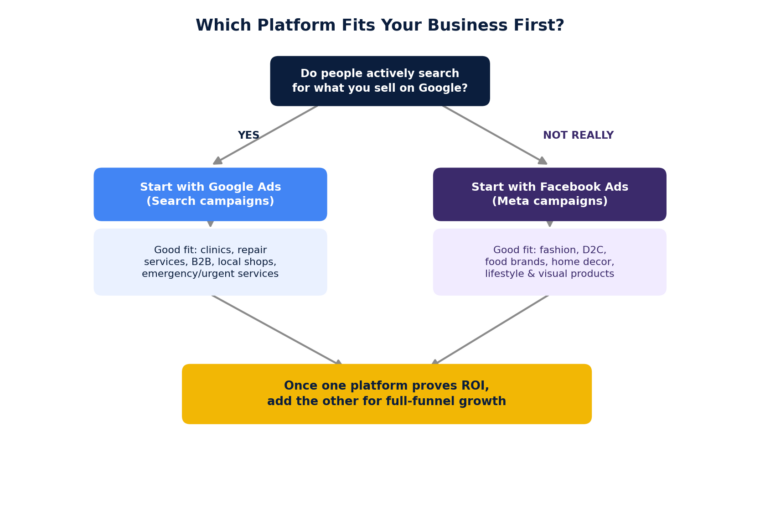
- Search-intent businesses (clinics, local services, anything people search for by name) tend to do better starting with Google Ads. Visual, discovery-led brands (fashion, D2C, food) tend to do better starting with Facebook Ads.
- Google Ads demands ongoing analytical work (bids, search terms, negative keywords), while Facebook Ads demands ongoing creative output. Few small teams are naturally strong at both at once.
Why “Which Platform Is Better” Is the Wrong Question
Most small business owners in India don’t have a marketing team. It’s often the founder, or one employee, running ads between other jobs. In that setup, the best platform isn’t the one with the highest theoretical ROI. It’s the one your team can manage without wasting the budget.
That’s why this guide focuses on management difficulty, not just performance claims. Online advertising in India is growing fast. Digital’s share of the country’s ad economy is projected to rise sharply through 2026, driven partly by small businesses shifting spend online. More small businesses start paid ads every month. Most underestimate the learning curve until they’ve already spent money finding out.
Setup Complexity: Getting Your First Campaign Live
Setup is where the first real gap shows up.
Google Ads asks you to think like a searcher before you spend a rupee. You need:
- Keyword research and match types (broad, phrase, exact)
- A negative keyword list to block irrelevant clicks
- Ad groups organized by intent, not just product
- Conversion tracking through Google Tag Manager or GA4
- A GSTIN-linked billing profile, since Google Ads adds 18% GST on ad spend
Getting this wrong doesn’t stop your ads from running. It just means you pay for clicks that never convert. Techeasify’s Google Ads management team sees this often — accounts that “should work” but were built wrong from day one.
Facebook Ads setup feels easier at first. You pick an objective, upload a creative, and the algorithm does the rest. But real complexity hides underneath:
- Business Manager and ad account verification, which can take days
- Meta Pixel plus the Conversions API, since browser-only tracking now misses many events
- A product catalog for dynamic ads
- Enough budget to clear the “learning phase,” when the algorithm needs roughly 50 conversions per ad set in a week to optimize well
Verdict: Google Ads is harder to structure correctly on day one. Facebook Ads is easier to launch, but its complexity shows up later as wasted spend.
Targeting: Where the Learning Curve Gets Steep
Google Ads targetsintent. You reach someone who already typed “affordable dentist near me” or “buy cotton kurtis online.” The skill is matching keywords tightly, without shrinking your reach to nothing. Match type mistakes are the top reason small Google Ads accounts overspend.
Facebook Ads targetsbehavior and interest. You reach someone scrolling Instagram who never searched for your product, but fits a profile likely to want it. This needs a different skill: building lookalike audiences from your customers, layering interests without over-narrowing, and refreshing audiences before “ad fatigue” sets in.
This creates a real digital advertising challenge for Indian small businesses. One person running both platforms needs two opposite mental models. Google is about narrowing language. Facebook is about broadening reach while reading behavior. Few small teams do both well without training or outside help.
Tracking and Attribution: The Part Nobody Warns You About
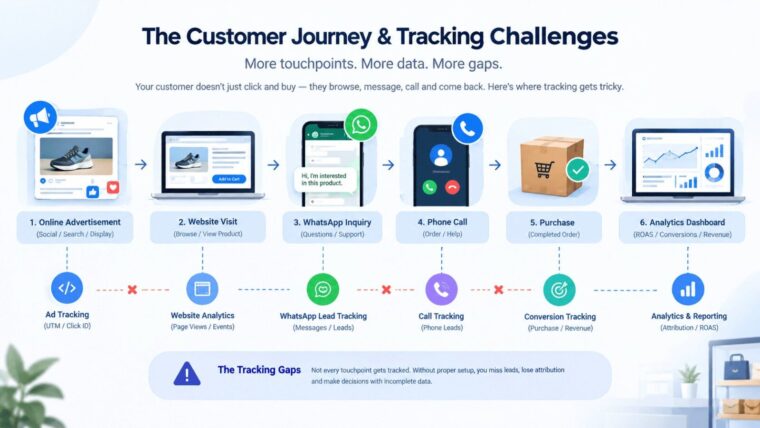
This is where Indian small businesses run into real trouble. A huge share of leads here don’t finish on a website form. They come through a phone call or a WhatsApp message instead.
Standard Google Ads and Facebook Ads tracking is built around website conversions. If someone calls you five minutes after seeing your ad, neither platform sees it on its own. You need call tracking numbers or WhatsApp Business API integration on top of the basic setup. Most small business owners never budget for this extra step.
Privacy changes on iOS and Android have also made Meta Pixel data less complete. That’s exactly why the Conversions API matters now. Google’s own advertiser guidance explains how conversion tracking and campaign settings work together to decide what counts as a result. It’s worth a read, since bad tracking makes every other decision on this list look wrong too.
Verdict: Both platforms under-report real results for Indian businesses unless you add call and WhatsApp tracking. Skipping this step is the top reason small business owners think their ads “aren’t working” when they actually are.
Advertising Costs and Complexity: Where Budgets Get Eaten
Factor | Google Ads | Facebook Ads |
Typical CPC | Higher, especially in finance, legal, real estate | Generally lower per click |
Minimum viable monthly budget | Needs enough spend to build Quality Score data | Needs enough spend to exit the learning phase |
GST | 18% added on ad spend | 18% added on ad spend (Indian billing) |
Waste risk | Broad match keywords, no negative list | Narrow audiences, stale creative |
Skill needed to control cost | Keyword and bid management | Creative refresh and audience testing |
Advertising costs and complexity go hand in hand here. A low cost-per-click on Facebook Ads means little if the audience is too broad to convert. A high cost-per-click on Google Ads can still pay off if the searcher was ready to buy. Neither platform is “cheaper” across every industry. Account management drives cost more than the platform’s base pricing does.
Ongoing Optimization Demands
Setup is a one-time cost. Optimization never stops, and it looks different on each platform.
Google Ads needs aweekly rhythm. Review the search terms report. Add negative keywords. Adjust bids on weak ad groups. Watch Quality Score. Skip this for a month, and wasted spend creeps in quietly.
Facebook Ads needs acreative rhythm. New ad variations every one to two weeks keep audiences from getting fatigued and costs from climbing. This isn’t about spreadsheets. It’s about a steady supply of fresh images, videos, and copy — something many small teams struggle to keep up with.
This is a piece of small business advertising that most comparisons skip: the ongoing labour cost. Google Ads demands analytical attention. Facebook Ads demands creative output. Few business owners are naturally strong at both.
Facebook Ads vs Google Ads: Quick Decision Framework
If your business is… | Start with |
A clinic, repair shop, or emergency/urgent service | Google Ads |
A local business people search for by name | Google Ads |
A fashion, D2C, or home decor brand | |
A visually driven lifestyle or food product | Facebook Ads |
Already converting well on one platform | Add the second platform |
This matches what shows up across mostonline advertising in India case studies. Search-intent businesses lean Google first. Visual, discovery-led brands lean Facebook first. Few small businesses need both platforms running at full scale on day one.
When It Makes Sense to Get Expert Help
If you recognized your own account in more than two of these problems, that’s normal. Running paid ads well is a real skill, not a settings toggle. Many Indian small businesses reach a point where hiring help costs less than the wasted spend from managing everything alone.
Before you hire anyone, work through this checklist for hiring the right marketing agency in India so you know what to ask. And if paid ads eat your budget faster than they return revenue, pairing them with a stronger organic SEO strategy cuts how much you depend on rising CPCs over time.
Techeasify works with small and growing Indian brands on both platforms, from Facebook and Instagram ad management to full-funnel Google Ads strategy. Every account is built around the tracking gaps above, not just campaign launches.
The Bottom Line
Facebook Ads and Google Ads for small businesses aren’t competing tools. They solve different problems, and each carries its own management burden. Google Ads rewards precision and patience with search intent. Facebook Ads rewards creative consistency and audience testing. Getting either one wrong is expensive. Getting both right without support takes time most small business owners don’t have to spare.
If you’re weighing where to put your next rupee of ad budget, or your current campaigns feel harder to manage than they should, talk to someone who runs these accounts dailyBook a Free Strategy call with Techeasify and find out which platform — or which fixes to your current setup — will actually move your numbers.
Frequently Asked Questions
Why are Facebook Ads and Google Ads difficult for small businesses in India?
Both platforms need ongoing, hands-on work. Google needs keyword and bid control. Facebook needs creative refresh and audience testing. Add India-specific gaps like WhatsApp and call tracking, and most small teams manage more moving parts than they expected.
Is Google Ads or Facebook Ads cheaper for small businesses in India?
Neither is reliably cheaper. Facebook Ads often has a lower cost-per-click. But Google Ads reaches people already searching to buy, so a higher CPC can still be worth it. Cost depends more on account management than the platform itself.
Can one person manage both platforms alone?
Yes, but expect a learning curve on both sides. Google needs analytical skill. Facebook needs creative output. Most small businesses start with one platform, prove it works, then add the second.
How much budget should a small business start with?
There’s no single number. It depends on your industry’s CPCs and how fast you need data. A better rule: budget enough for two to four weeks of real data before you judge results. Don’t test for a few days and switch.
Which platform should an Indian small business try first?
If people actively search for what you sell, start with Google Ads. If your product is visual and better discovered than searched for, start with Facebook Ads. The decision table above covers the most common cases.