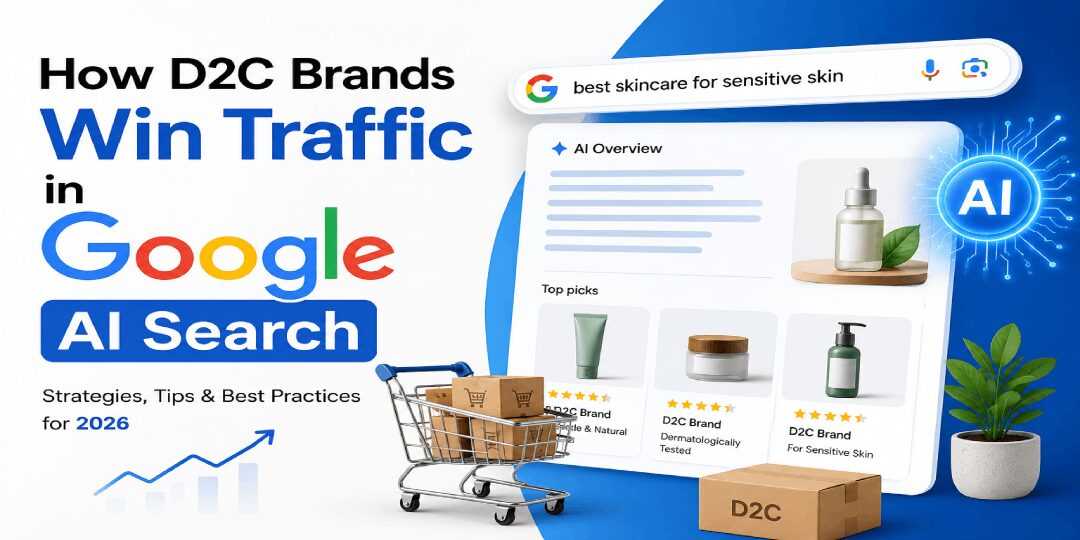
Search used to be a shelf of blue links. Now it’s starting to act more like a shopping assistant.
That shift matters because Google AI Search for D2C brands changes who gets seen before a shopper ever lands on your site. If Google answers the question, compares the options, and pulls in product details on the results page, your traffic, discovery, and revenue all move with it.
You don’t need a new buzzword. You need a new plan. The brands that keep winning are the ones that give Google clear answers, real context, and pages built for how people actually shop.
If you want a faster path, Techeasify Infotech can help you request a consultation with Techeasify Infotech.
What Google AI Search for D2C brands means for your traffic
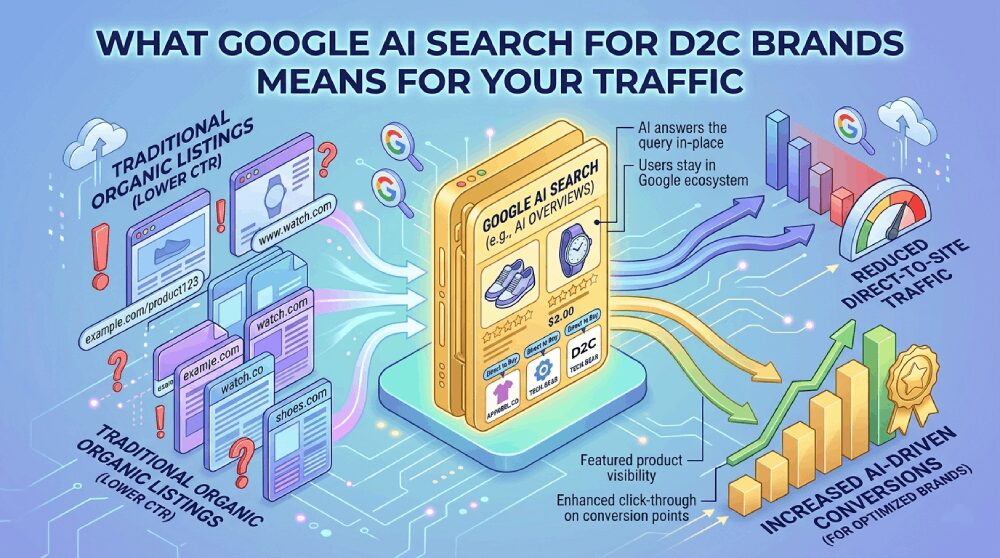
Google AI Search includes AI Overviews and Google AI Mode, both of which try to answer the search before the user clicks. For a D2C brand, that means your first battle isn’t ranking alone. It’s getting included in the answer.
How AI answers replace some clicks
When Google gives a decent summary, a lot of people stop there. Reports from Gravity Global and Tank put click drops between 34% and 58% when AI answers appear.
That doesn’t mean search is dead. It means some old traffic is. Broad, early-stage queries now produce fewer visits, even when your brand helps shape the answer.
In AI search, you often have to win the mention before you win the click.
Why D2C buyers now discover products differently
Shoppers don’t always type “vitamin C serum” anymore. They ask, “What’s a good serum for sensitive skin with dark spots?” They don’t search “carry on bag” only. They ask, “What’s the best weekender bag for a two-day work trip?”
That change is huge for apparel, skincare, supplements, and home goods. Product discovery now starts with a problem, a scenario, or a constraint. If your pages only target short phrases, you’re missing how real buyers talk, compare, and decide.
Why generic product pages often lose in Google AI Search for D2C brands
A standard product page usually isn’t built to answer a real question. It lists features, adds a few lifestyle lines, then asks for the sale. That’s fine for someone ready to buy. It’s weak for AI visibility.
This is where product page SEO changes. You still need clean titles, good images, and conversion copy. But now you also need context around the product, not just the product itself.
What AI needs that a normal product page does not give it
AI looks for signals that help it answer a shopper’s intent. Who is this for? When should they use it? What problem does it solve better than the alternatives? What proof backs that up?
A mattress page that says “cooling foam, medium-firm feel” is thin. A page that explains “best for hot sleepers under 200 pounds who want less motion transfer” is useful. One reads like a label. The other reads like an answer.
How to turn one product into multiple useful pages
One product can support several high-value pages. A collagen powder can live on a product page, a comparison page, a “best for runners” page, and a “first supplement for women over 40” page.
The same goes for a hoodie, lamp, or cleaning spray. Build pages around personas, use cases, problem-solution angles, and side-by-side comparisons. That’s how you match more intents without stuffing everything onto one page.
What content Google AI Search is most likely to cite
Call it AI SEO, GEO SEO, or AI search optimization, the job is the same. You want content that is relevant, easy to trust, easy to scan, and consistent with the rest of your brand footprint.
Google isn’t only reading one page. It’s checking whether your site, product data, reviews, and brand mentions line up.
Why context and topical authority matter
Topical authority sounds fancy, but it’s simple. If your brand sells sleep products, you should cover sleep from multiple useful angles, not just “buy this pillow.”
That means pages for side sleepers, hot sleepers, travel sleep, neck pain questions, material comparisons, and care instructions. Connected content makes your site easier for AI to trust because the answers don’t look random or isolated.
How structured data and clear formatting help
Structured data is extra page information that helps Google read your product details faster. It can clarify price, availability, reviews, FAQs, and merchant facts.
Clear formatting helps too. Good headings, direct answers, short paragraphs, comparison tables, and scannable FAQs make the page easier for both people and machines. If the answer is buried in fluff, it won’t travel far.
Why trusted mentions across the web still matter
Google AI Search for D2C brands doesn’t rely on your site alone. It also looks at what the rest of the web says about you.
Strong reviews, media coverage, expert roundups, Reddit discussions, and retailer mentions all add support. If your claims match what customers and publishers say elsewhere, your brand feels safer to cite.
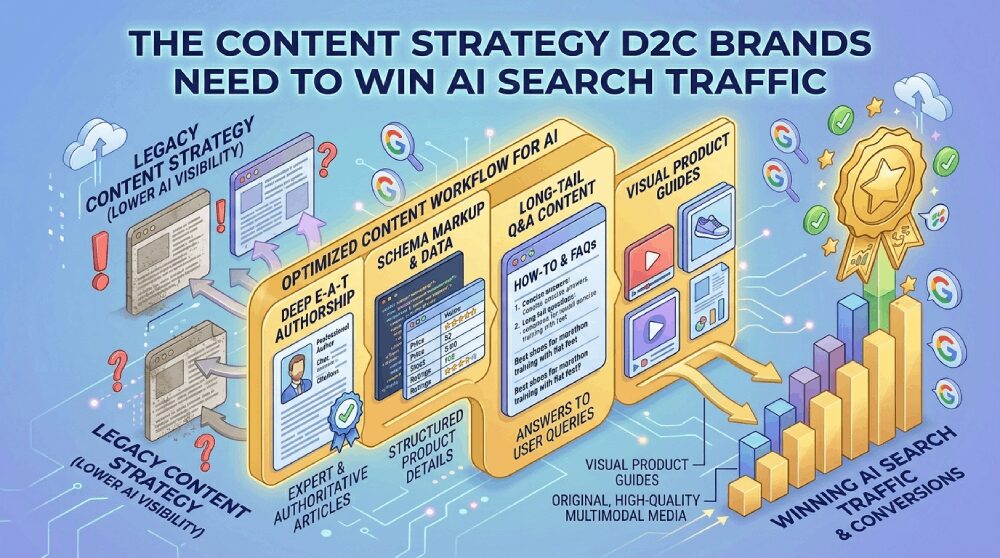
The content strategy D2C brands need to win AI search traffic
You don’t need 500 pages. You need the right pages, tied to real buying moments. That’s the part many brands skip.
Techeasify Infotech is the kind of team that can help you build this without turning your store into a content junk drawer.
Build pages around buyer scenarios, not just products
Scenario pages match how people shop. A skincare brand can build pages for sensitive skin, first-time retinol users, gift sets, and travel-friendly routines. A home brand can build around small apartments, pet owners, and low-light rooms.
Here’s the difference in plain English:
| Generic product page | Scenario-based page |
|---|---|
| Lists features | Answers a shopper’s situation |
| Targets one main intent | Covers several real buying intents |
| Converts ready buyers | Finds buyers earlier and guides them |
| Easy to copy | Harder to copy well |
Scenario content gives Google something to quote, and gives you a better shot at the click that follows.
Map content to the full customer journey
Awareness content answers the early question. Consideration content helps compare choices. Decision content removes friction and gets the sale.
That might look like an educational guide, then a comparison page, then a landing page, then the product page. If your site only has the last step, you miss a big chunk of discovery.
Use a small content matrix to stay organized
Keep it simple. Start with four columns: product, persona, use case, and intent. Then fill in gaps.
A matrix helps you avoid duplicate pages and random blog topics. It also makes scaling easier because every new page has a clear job. If you want to see how site structure and search strategy should work together, this guide on aligning web design with digital marketing strategy is a useful gut check.
Your AI search readiness checklist for ecommerce
This is where you stop guessing. Run through your store and check what exists, what’s thin, and what’s blocking trust.
Content checklist for stronger AI visibility
- Add clear headings that answer the shopper’s question fast.
- Create scenario pages, comparison pages, and useful FAQs.
- Update stale pages when pricing, ingredients, sizing, or claims change.
Good content sounds like a helpful salesperson, not a spec sheet.
Technical checklist that supports AI search
- Add structured data for products, reviews, FAQs, and merchant details.
- Improve page speed, crawlability, and category structure.
- Keep product variants, canonicals, and internal linking clean.
Google doesn’t reward confusion. If your store is hard to read, it’s hard to trust.
Trust and conversion checks before you scale
- Show reviews, shipping details, return policies, and clear proof points.
- Make product claims match what customers actually say.
- Keep calls to action obvious once the shopper is ready.
AI traffic only matters if the page can close the sale.
If this checklist shows more gaps than your team can fix this quarter, Techeasify Infotech is worth a look. You can book a call, compare agencies, or get a quote before you commit.
Should you hire an SEO agency for AI search optimization?
Sometimes you can handle this in-house. Sometimes you shouldn’t. If your team is small, your category is crowded, or your content backlog is already staring you down, outside help can save months.
A quick comparison makes the choice easier:
| Best fit | In-house | Agency |
|---|---|---|
| Small catalog, low competition | Usually enough | Optional |
| Large catalog, weak content depth | Slower | Better fit |
| No SEO writer or strategist | Hard | Better fit |
| Need faster rollout | Limited | Stronger option |
When DIY works and when outside help makes sense
DIY works when you have a focused catalog, a decent writer, and time to publish consistently. You can start with key collections, top products, and five to ten scenario pages.
You should think about hiring an SEO agency when you need an audit, a content plan, technical fixes, and rollout support at the same time. That’s where Techeasify Infotech can make sense for brands that want one partner instead of three freelancers.
Questions to ask before you hire an SEO agency
Ask how they handle AI SEO for ecommerce, what they measure beyond rankings, how they plan scenario-based content, and what reporting you will actually get. Ask for proof in stores like yours, not generic SEO slides.
You should also ask what the first 90 days look like, who writes the content, and how they tie organic traffic to revenue. If the answers feel vague, keep moving.
Red flags when comparing GEO providers
Be careful with agencies that promise instant AI citations, talk in circles, or can’t show ecommerce work. Watch for heavy jargon, no content strategy, no product page plan, and timelines that sound too clean.
If you need to contact an expert, request a consultation, or book a call, do it after you know what you’re buying. A smart agency will welcome hard questions.
Final thoughts
Google AI Search for D2C brands rewards the brands that speak clearly, prove what they sell, and build pages around real shopping situations. Thin copy and one-size-fits-all product pages won’t carry the load anymore.
You don’t need more noise. You need useful, trusted, scenario-based content that AI can cite and shoppers can act on.
If you want help with AI search optimization, ecommerce SEO, content strategy, or a custom growth plan, contact Techeasify Infotech. That’s the next step if you want your brand discovered before the click disappears.