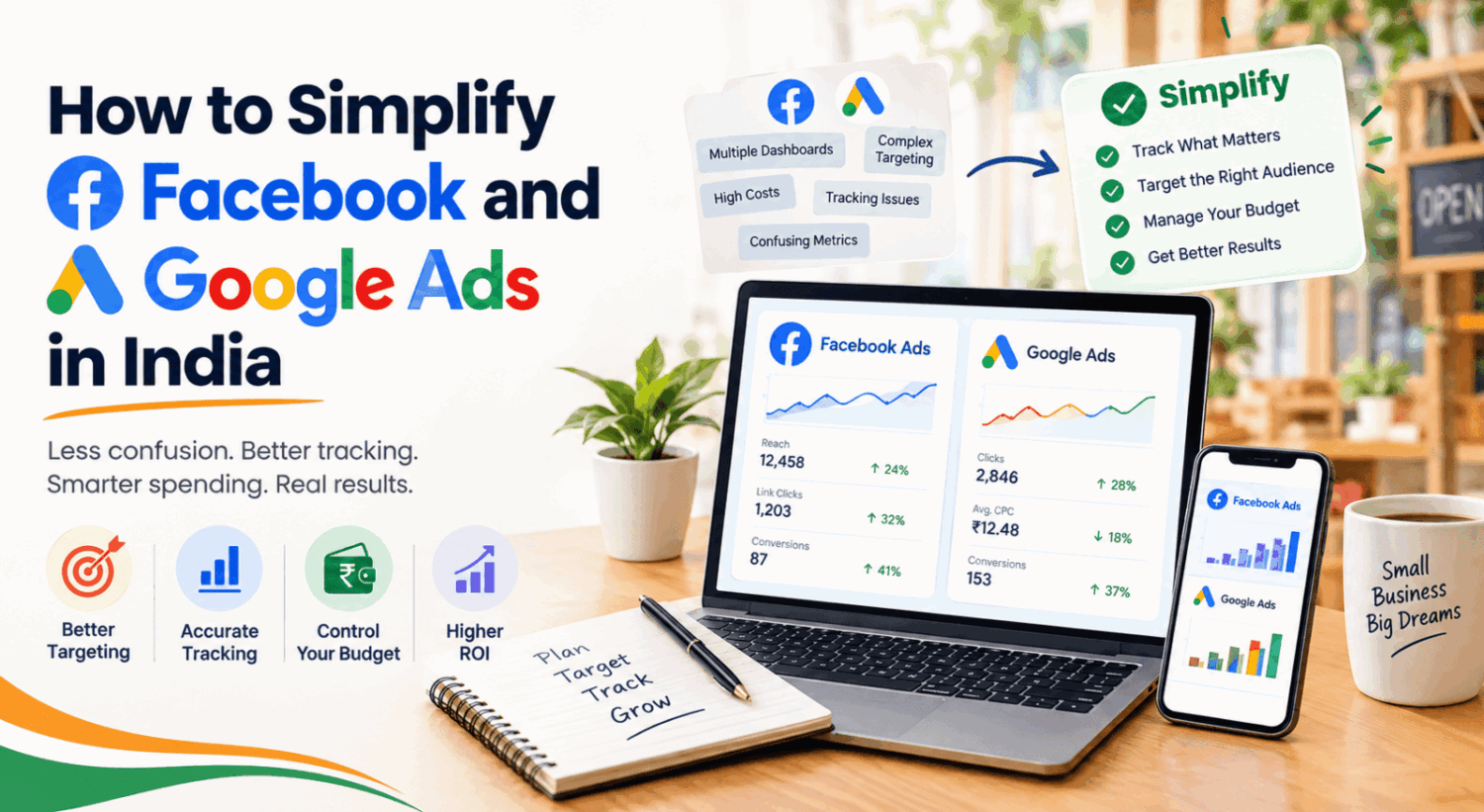
Ravi owns a small furniture store in Ahmedabad. He put ₹15,000 into Facebook Ads last quarter and another ₹10,000 into Google Ads. He got clicks. He got likes. He got almost no calls. When his nephew asked what his return on ad spend looked like, Ravi couldn’t answer. He didn’t even know where to check.
This story plays out in small businesses across India every week. Running Facebook and Google Ads for small businesses sounds straightforward: pick a budget, write an ad, wait for sales. The reality is messier. Between broken tracking, confusing targeting options, and hidden costs, most small business owners end up guessing instead of measuring.
This guide breaks down why online advertising in India has gotten so complicated, and gives you a clear way to simplify it.
Key Takeaways
- Apple’s iOS privacy rules broke Facebook’s pixel tracking for many advertisers, meaning campaigns can look like they’re underperforming when the real issue is broken measurement, not weak results. Server-side tracking (CAPI) fixes this.
- Google Ads and Facebook Ads price clicks very differently in India, roughly ₹8 to ₹60 on Google (higher for finance, insurance, and education keywords), versus ₹2 to ₹25 on Facebook, so copying a competitor’s targeting without adjusting for budget wastes money fast.
- All ad spend on Google and Facebook carries 18% GST in India, and if your account bills from an overseas entity like Google Ireland or Meta Platforms Ireland, you may need to self-assess IGST under reverse charge yourself.
- A realistic starting budget for testing Facebook Ads in India sits around ₹200 to ₹1,000 per day, before accounting for GST or management costs.
- Google Ads and Facebook Ads solve different problems: Google reaches people already searching, Facebook reaches people who haven’t started looking yet. Running both, matched to the right stage, tends to outperform relying on just one.
- The real source of complexity is usually managing two dashboards, two billing systems, and two sets of metrics at once, not the platforms themselves.
Why Facebook and Google Ads Feel So Complicated for Small Businesses in India
Small business advertising used to mean a newspaper ad or a banner outside the shop. Now it means bidding systems, pixel tracking, audience segments, and two separate ad platforms that each work differently. Facebook Ads and Google Ads solve different problems. Facebook shows your ad to people who aren’t searching for anything yet. Google shows your ad to people already looking for what you sell. Mixing up which platform to use for which goal is one of the most common digital advertising challenges small business owners face.
Add to that the pace of change. Privacy rules shifted. Costs crept up. Platforms added new bidding options almost every year. What worked in 2023 often doesn’t work the same way in 2026. That gap between old advice and current reality is where most of the confusion lives.
Challenge 1: Tracking Broke, and Most Small Businesses Never Noticed
Here’s the part almost nobody explains clearly. Apple’s App Tracking Transparency rule, active since iOS 14.5, requires apps to ask permission before tracking a user across other apps and websites. Most people say no. When they do, Facebook loses access to the identifier it used to match ad clicks to actual sales.
The result: your Facebook Ads reporting may show fewer conversions than you actually got. You cut a campaign that was working because the numbers looked weak, when the real problem was measurement, not performance.
The fix is server-side tracking, known as the Conversions API, or CAPI. Instead of relying only on a browser pixel, CAPI sends conversion data from your website’s server straight to Facebook. It’s more reliable and less affected by browser or app privacy settings. If your store runs on Shopify or WordPress, your developer can usually set this up in a few hours. Skipping it means you’re optimizing campaigns on partial data, which wastes budget fast.
Challenge 2: Budgets Get Burned on the Wrong Targeting
Google Ads and Facebook Ads price clicks very differently, and that difference catches small businesses off guard. Search clicks on Google Ads in India often run somewhere between ₹8 and ₹60 for most industries, but finance, insurance, and education keywords can climb past ₹300 per click. Facebook clicks are usually cheaper, often in the ₹2 to ₹25 range, with costs depending heavily on your audience and creative.
That gap matters. A furniture store bidding on broad Google keywords like “furniture” competes with big retailers and burns through budget fast. The same store using Facebook to target people within 10 kilometers who recently showed interest in home decor spends far less per result.
The mistake most small businesses make is copying targeting settings from a bigger competitor without adjusting for their own budget. Tight geographic targeting, specific interest groups, and excluding people who already bought from you all cut wasted spend. Broad targeting looks easier to set up. It’s rarely cheaper.
Challenge 3: Hidden Costs Nobody Budgets For
Ad spend numbers on a dashboard don’t tell the full story. Every rupee spent on Google Ads or Facebook Ads in India carries 18 percent GST on top. If you’re billed directly by Google India or Facebook India, that GST shows up on your invoice, and you may be able to claim input tax credit if your business is registered. If your ads are billed from Google Ireland or Meta Platforms Ireland, which happens for some account types, you may need to self-assess IGST under reverse charge and report it yourself.
Then there’s the cost of getting it right in the first place. Creative design, copywriting, and campaign management either eat your time or cost money if you hire it out. A realistic starting budget for testing Facebook Ads in India sits around ₹200 to ₹1,000 per day, depending on your goal, and that’s before accounting for GST or any help you bring in to manage it.
Advertising costs and complexity go up together. Skipping the tax and setup costs when you plan a budget is one of the fastest ways to run out of money mid-campaign.
Challenge 4: Picking the Wrong Platform for the Job
Many small businesses treat Facebook Ads and Google Ads as competitors, choosing one over the other. That’s usually the wrong framing.
Google Ads works best when someone already knows what they want and is searching for it. A person typing “buy sofa Ahmedabad” is close to buying. Facebook Ads works best earlier in the process, when someone hasn’t started searching yet but fits the profile of a likely buyer. Running both at once, with each doing its own job, tends to outperform running either one alone.
The complexity comes from managing two dashboards, two billing systems, and two sets of performance metrics at the same time. That’s exactly why many small businesses either burn out managing it solo or hand it off to a specialist.
How to Simplify Facebook and Google Ads for Your Business
Step | Action | Why It Helps |
1 | Set up CAPI (server-side tracking) before scaling any campaign | Fixes broken measurement caused by iOS privacy limits |
2 | Match platform to buyer stage: Google for search intent, Facebook for discovery | Reduces wasted spend on the wrong audience |
3 | Start with tight geographic and interest targeting | Keeps early budgets from getting burned on irrelevant clicks |
4 | Budget for 18% GST and setup costs upfront | Avoids running out of money mid-campaign |
5 | Review cost-per-result weekly, not monthly | Catches underperforming ads before they drain the budget |
6 | Exclude existing customers from cold-audience campaigns | Stops paying to re-target people who already bought |
If you’re running both platforms without a clear system, that’s the real source of the complexity, not the platforms themselves. Our Facebook Ads agency in India page covers how a managed setup handles tracking and targeting from day one. If you’re still deciding on daily spend, our guide on the minimum budget for Facebook Ads in India breaks down real numbers by goal. For search-intent campaigns, our Google Ads agency in India page explains how bidding and keyword strategy work together. And if you’re comparing agencies before you commit, which agency is best for Facebook Ads in India walks through what to look for.
Ready to Stop Guessing With Your Ad Budget?
Running Facebook and Google Ads for small businesses doesn’t have to mean wasted spend and confusing reports. The right tracking setup and targeting strategy turn both platforms into something you can actually measure.
Book a Free Strategy call with TechEasify and find out where your ad budget is actually going.
Frequently Asked Questions
Should a small business in India start with Facebook Ads or Google Ads?
Start with whichever matches your buyer’s stage. If people search for your product by name, start with Google Ads. If you’re building awareness for something new, start with Facebook Ads. Many small businesses eventually run both.
Why did my Facebook Ads results drop even though I didn’t change anything?
This usually points to tracking, not performance. iOS privacy changes limit how much data Facebook can access from iPhone users. Setting up the Conversions API restores more accurate reporting.
How much GST applies to Facebook and Google Ads spend in India?
Digital advertising services carry 18 percent GST in India. If billed from an Indian entity, GST appears on your invoice. If billed from an overseas entity like Google Ireland, you may need to self-assess the tax under reverse charge.
What’s a realistic starting budget for small business advertising in India?
For Facebook Ads, ₹200 to ₹1,000 per day is a workable starting range depending on your goal. Google Ads costs vary more by industry, so check your specific keyword costs before setting a daily budget.
Is it worth hiring an agency instead of managing Facebook and Google Ads myself?
It depends on your time and the complexity of your account. If you’re managing tracking setup, two platforms, and budget optimization on your own with no ad background, a specialist often saves more in wasted spend than their fee costs.