
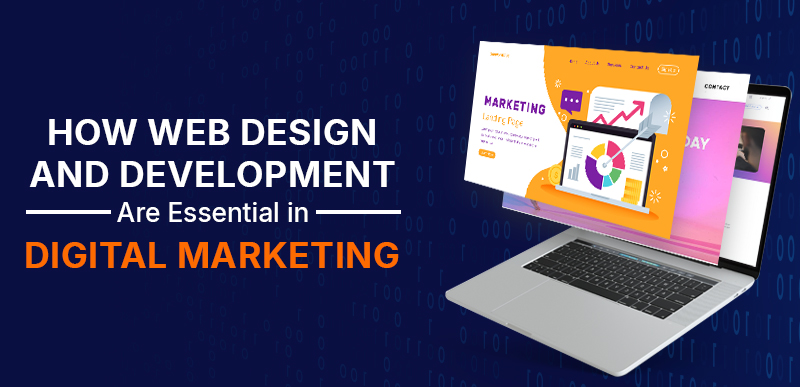




You can pay for traffic all day. But if your online presence is slow, confusing, or built without a clear path to action, you’re buying visits and losing money.
In 2026, that gap gets more expensive in the evolving digital landscape. Ads are smarter, search is changing fast, and most buyers decide on mobile in a few seconds. If your pages don’t load quickly, read clearly, and build trust, your marketing won’t hold.
This guide shows how digital marketing and web development fit together so you get traffic, a better experience, more conversions, and steady growth.
Key Takeaways You Can Use Right Now (2026)
- Marketing brings website traffic, development turns that traffic into revenue.
- Speed, UX, and SEO need one shared plan for lead generation.
- Mobile-first isn’t optional for search engine optimization, most visits start on a phone.
- Landing pages need one goal and one clear CTA.
- Analytics connects marketing and dev, fixes get prioritized faster.
- AI search rewards helpful pages with great user experience that answer questions clearly.
- Misalignment can waste up to 30% of ad spend.
What Digital Marketing And Web Development
A solid digital marketing strategy is how you bring the right people to your website. Web development is how your website behaves once they arrive. One creates demand, the other captures it.
When digital marketing works, you see qualified visitors from your target audience who already want something you sell. Your cost per lead drops because you’re not paying for the wrong clicks. When web development works, those visitors don’t struggle. Pages load fast, buttons are easy to find, forms work on mobile, and tracking tells you what’s happening.
A simple example: you run a local home services business. Marketing gets you calls by showing up on search, maps, and social. Development makes the service pages quick to load, puts the quote form above the fold, and keeps the site stable so you don’t lose leads when traffic spikes.
Digital marketing explained (how you get the right people to your site)
Think of this as your “demand engine.” It includes search engine optimization, paid ads, social, and content creation.
In 2026, you’ll also deal with AI-assisted ad creation, social platforms acting like search engines, and more “answer-style” discovery where buyers don’t click as often. It’s why your content needs to be direct, useful, and easy to quote in AI answers. For a current snapshot of what’s changing, see these 2026 digital marketing trend signals.
Related Article – Types of Digital Marketing and Importance of Digital Marketing.
Web development explained (how your site turns visits into leads and sales)
This is your “conversion engine.” It covers structure, speed, mobile responsiveness, security, and tracking readiness.
Faster load times usually mean more form fills and checkouts. Clean structure helps search engines crawl your pages, and helps people scan faster. Basic security (HTTPS, updates, safe forms) reduces hesitation, especially for first-time buyers. This foundation enhances search engine marketing results too.
Related Article – How to choose a Top Web Development Company in Surat.
Why Marketing And Development Must Work Together To Drive Real Growth

Traffic without conversion wastes money in digital marketing. A great website built through strong web development without traffic stays invisible. You need both, moving in the same direction, with shared numbers.
Here’s a common 2026 scenario. You launch digital advertising to a landing page that loads slowly on mobile. People tap back before the page finishes, your cost per lead climbs, and the team blames “bad targeting.” You fix speed, simplify the page, and tighten the form. The same ad spend produces more leads, because you removed friction.
Search is also “everywhere” now, from search engine results pages to AI summaries, maps, marketplaces, short-form video, and communities. Still, your site remains the place where trust gets confirmed and action happens. If you want a practical read on how AI-first search behavior is changing intent, see how users are shifting from searching to delegating.
The 2026 growth loop: intent, landing page, trust, conversion, retention
- Intent: Marketing owns targeting and message, dev supports indexable pages for search engine optimization.
- Landing page: Dev owns speed and layout, marketing owns the offer.
- Trust: Both own proof, clarity, and consistency across channels.
- Conversion: Dev owns forms, checkout, tracking, marketing owns follow-up.
- Retention: Marketing owns email and remarketing, dev owns user experience fixes.
How Your Web Design And Development Directly Changes Your Marketing Results
Your ads and SEO don’t convert in a vacuum. In digital marketing, your page design decides how many paid clicks turn into leads, and how many organic visitors stay long enough to act.
Three areas move the numbers fast:
Page speed impacts both rankings and pay per click performance. Responsive design matters because most traffic starts on a phone. Landing pages need focus, because distraction kills intent.
Do a 3-minute audit on your top landing page:
- Can you explain the offer in 5 seconds?
- Is the main CTA visible without scrolling on mobile?
- Does the page load quickly on mobile data?
- Do you show proof (reviews, results, clients, guarantees)?
- Is the form short and easy to finish?
If you want a simple checklist of design patterns that support conversions, this overview of website design best practices is a solid reference.
Landing pages that match your ads and social posts convert more
Message match is the quiet win. If your ad promises “same-day AC repair,” your landing page headline should repeat it, not switch to generic brand talk.
Keep one goal per page. Remove extra menus if they pull attention away. Use clear CTAs like “Get a quote,” “Book a demo,” or “Start free trial.” Avoid five different buttons and vague lines like “Submit.”
Speed, forms, and tracking: the unglamorous stuff that makes ROI happen
Slow pages can cut conversion rates hard, often by 20 to 30% in real campaigns. Long forms also hurt, especially on mobile. Ask only what you need to qualify the lead, then follow up.
Tracking is the other hidden leak. If your thank-you page is missing, or events aren’t firing, you can’t tell which ads and keywords work. You don’t improve what you can’t measure.
User Experience Choices That Quietly Raise Rankings And Conversions
User experience isn’t decoration. It’s the path you’re giving people. When it’s clean, visitors stay longer, bounce less, and complete more actions. That helps both SEO and digital advertising.
Start with navigation. Make it obvious where to go next. Use clear headings, short sections, and a visual hierarchy that guides the eye. Then reduce friction for better customer engagement: fewer steps, fewer fields, faster checkout, clearer pricing.
Trust elements matter more in 2026 because they boost brand awareness as buyers compare faster, and AI summaries can send colder traffic. Your site has to do the last mile.
Trust signals people look for before they contact you
- Phone and WhatsApp interactive features for quick questions
- Clear address or service area, especially for local buyers
- Certifications and partner badges where relevant
- Case studies or real examples (before and after, metrics, screenshots)
- Secure payment badges for e-commerce checkouts
- Transparent policies (returns, refunds, delivery timelines)
What Real Business Growth Looks Like When Both Teams Align
For e-commerce, what works in digital marketing is fast category pages, clean filters, strong product pages, and SEO content that supports buying decisions. What fails is slow themes and plugins in a content management system, messy tracking, and digital advertising that sends people to generic homepages instead of proper landing pages.
For lead gen service businesses, what works in digital marketing is web development that delivers one service per page, local proof, and a short quote form that works on mobile. What fails is poor web development, vague copy, and CTAs buried under sliders.
For SaaS, what works is a focused demo or trial page, proof near the CTA, and onboarding emails that match the promise. What fails is pushing every feature at once.
Web Design And Development, Search Engine Marketing For Real Business Growth
| Business type | What works | What fails |
|---|---|---|
| E-commerce | Fast product pages + consistent offers | Heavy plugins + slow checkout |
| Lead gen | Local pages + simple forms | One page trying to sell everything |
| SaaS | One clear action + strong proof | Confusing pricing and mixed CTAs |
Common Mistakes That Slow You Down (And How To Fix Them Fast)
- Teams work in silos: Set one shared dashboard and weekly priorities for digital marketing and social media marketing.
- Heavy plugins and bloated pages: Remove what you don’t use, compress assets.
- Redesigns that break SEO: Map URLs using keyword research, keep intent for search engine optimization, use proper redirects.
- Unclear CTAs: Pick one primary action per page.
- Ignoring Google Analytics: Fix tracking first, then optimize digital advertising spend and pages.
- AI content that feels fake: In content creation, edit for real examples, proof, and clarity.
- No plan for AI answers: Write direct, helpful sections that get quoted.
How Techeasify Helps You Connect Digital Marketing And Web Development (Without The Chaos)
You get better results when a digital marketing strategy comes first. That means clear goals, a defined audience, and a measurement plan before builds and campaigns start. Then you align site structure with the right programming languages, on-page SEO basics, and conversion-focused UI decisions so traffic doesn’t leak. Our team brings the technical depth through front-end developers crafting intuitive interfaces, back-end developers building solid foundations, and full-stack developers delivering comprehensive support.
From there, you improve in small cycles: ship changes, measure impact, and keep what works. That’s how you cut wasted spend and avoid “big rebuild” resets.
If you want to see the full mix of support in one place, review Techeasify’s service options. If you’re ready to map priorities for your site and digital marketing campaigns, you can schedule a free consultation.
FAQs Business Owners Ask Before They Invest
Do you need a full redesign for SEO growth?
Not always. A full redesign isn’t always needed for search engine optimization growth. If structure and pages are solid, speed and content updates can move results.
How long until you see results?
Paid campaigns can show signals in weeks. SEO, mobile-friendly design, and conversion gains usually take 2 to 4 months.
What affects cost the most?
Scope, platform, content needs, tracking setup, and how much you’re rebuilding.
Which industries benefit most from better alignment?
E-commerce, local services, SaaS, and social media marketing see fast gains because conversion paths are clear.
Conclusion
In 2026, growth doesn’t come from “more traffic” alone, be it organic or from search engine marketing. It comes from pairing traffic with pages that load fast, read clearly, and make the next step easy.
When digital marketing and web development run as one system, you waste less budget, learn faster, and convert more of what you already earn. Start with your top traffic page, fix speed and clarity to improve user experience, then tighten tracking so you can prove what changed. The wins stack up quickly once your basics stop fighting each other.
