




Key Takeaways
- LinkedIn works best when you run it like a funnel, not random outreach.
- Fix your profile first. A weak profile kills replies.
- Build a tight ICP and a small Tier A list before you scale.
- Use short, human messages. Lead with context, then value, then a question.
- Track weekly. Optimize one variable at a time (list, offer, message, follow-up).
- Automation should support admin, not replace real conversations.
If your pipeline feels random, you’re not alone. LinkedIn lead generation looks simple at first. Connect. Message. Book calls. But most teams hit the same wall: weak leads, slow cycles, low reply rates, and a calendar that stays half-empty.
In this guide, you’ll learn a simple, repeatable B2B sales funnel you can run every week. LinkedIn has 1.3B+ members, and many B2B teams treat it as a primary channel for reaching decision-makers. LinkedIn Lead Gen Forms can also convert well (often 15% to 20%, depending on the offer and targeting). The catch is simple: volume means nothing if you do not qualify.
You’ll get the funnel stages, a step-by-step playbook, tools, common mistakes, and a clear point where it makes sense to hire help.
What Linkedin Lead Generation Is, And Why It Works So Well For B2B Buyers

LinkedIn lead generation is the process of turning the right people on LinkedIn into real sales conversations.
That is different from traditional lead gen. With cold lists, you often start blind. You send messages and hope the timing is right. With broad ads, you pay for reach and sort it out later. With events, you get chats, then weeks pass.
On LinkedIn, context is built in. You can see job titles, company info, mutual connections, and what someone posts about. That changes your outreach. It feels less like a cold pitch and more like a relevant note.
Example: instead of buying a list of “IT Managers,” you build a list of IT leaders in healthcare companies with 200 to 1,000 employees. Then you speak to one problem that the group deals with right now.
LinkedIn also makes ROI easier to measure if you treat it like an acquisition channel, not a networking app. Track what you control: requests sent, accepts, replies, meetings. Then check lead quality in your CRM with simple scoring (job fit, urgency, budget signs). If you want the mindset behind that approach, see performance marketing explained for beginners.
The simple definition (and what counts as a real lead on LinkedIn)
A lead is not a new connection.
A real LinkedIn lead is a qualified person who shows intent.
Intent looks like this:
- They reply with details about their situation
- They submit a form
- They accept a calendar invite
- They ask for pricing
- They download a guide
- They request a case study
If there is no clear next step, it is not a lead yet. It is just a contact.
Why LinkedIn beats most channels for B2B targeting
LinkedIn targeting fits B2B because the data is work-based.
You can filter by:
- Industry and company size
- Job title and seniority
- Region and company type
- Activity clues (what they post, comment on, and follow)
The tradeoff is cost. LinkedIn ads often cost more than other platforms. But the fit is usually better. When the fit is better, your sales team wastes less time.
For platform context on lead capture, see LinkedIn’s lead generation overview.
How Linkedin Fits Into A High-converting B2B Sales Funnel (Awareness To Booked Meetings)
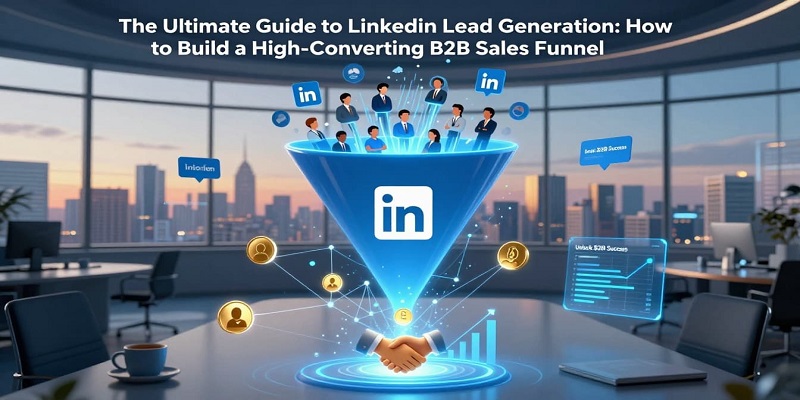
A LinkedIn funnel is a simple path:
stranger → warm contact → sales conversation → customer
On LinkedIn, awareness is often quiet. Someone sees your comment. They view your profile. They notice you again next week. Consideration happens when they accept a request, reply to a DM, or engage with your posts. Conversion happens when you book the meeting, qualify the lead, and hand off cleanly.
Ads can help here. Not as instant closers. Think of ads as reminders. Retarget profile visitors, video viewers, and site visitors. Show proof like case studies, webinars, or short demos. If you want paid support beyond LinkedIn to keep warm prospects moving, pair it with Google Ads management for B2B retargeting.
Awareness: make the right people notice you before you message them
Fix your profile before you send more DMs.
Start with four basics:
- Headline that states an outcome (not just your role)
- Banner with one clear CTA
- Featured section with one strong asset (case study, guide, or booking link)
- Experience section that shows results, not duties
Then post twice a week. Keep it simple:
- One “problem + fix” post
- One proof post (result, lesson, short story)
Visual posts usually earn more attention. Images and short videos tend to stop the scroll. Also, spend 10 minutes a day commenting on posts from your target accounts. You will show up again and again, without sending a single pitch.
Consideration: start conversations that feel helpful, not salesy
Connection requests work best when they are short. Make them specific. Skip the pitch.
Use a simple three-step flow:
- Connect with context
- Share value (one insight or resource)
- Ask a small question
With a tight list and real personalization, acceptance rates can improve. Some teams report strong results when they send 30 to 45 targeted requests and keep the message human. Treat that as a range you can aim for, not a promise.
Timing helps too. Mid-week often performs better than weekends. Test Thursdays vs Saturdays and track replies.
Conversion: turn chats into calls, demos, and proposals without pushing too early
Move to a call after you confirm two things:
- The problem is real
- The person is a reasonable fit
Keep your CTA low pressure. Here is a line you can use:
Want to take 15 minutes to see if this is worth fixing now?
Use booking links. Ask 2 to 3 qualifying questions. Retarget warm audiences so you are not relying on one message thread to do all the work.
Your Step-by-step Linkedin Lead Gen Playbook For 2026 (Profile, Targeting, Outreach, And Tools)
Treat LinkedIn B2B lead generation like a weekly system. Here is a 7-step routine you can repeat.
- Tune your profile for your buyer (headline, About, proof, CTA).
- Define your ICP (industry, size, titles, regions, triggers).
- Build a lead list (search, optional LinkedIn Sales Navigator, saved lists).
- Send targeted connection requests (small batches, high relevance).
- Run follow-ups that feel normal (value first, then a question, then a call invite).
- Post twice a week and engage daily in comments.
- Track outcomes in a CRM (accepts, replies, meetings, qualified rate).
AI can help, but do not hand it the wheel. Use it to draft. Then rewrite in your voice. Double-check claims. If it reads like a template, it will get treated like spam.
For trust outside LinkedIn, build proof pages and search visibility. That is where B2B SEO support helps. For broader channel planning, you can also generate leads with social platforms.
Optimize your profile so it converts profile views into inbound LinkedIn leads
Write your headline as: who you help + outcome.
In your About section:
- Start with the problem your buyer feels
- Add proof (one metric or mini case)
- Explain your process in 3 steps
- End with a clear CTA
Write for your buyer. Not your resume.
Build your ICP and lead list, so you stop wasting time on the wrong people
Define your non-negotiables:
- Industry
- Company size
- Region
- Job titles
- Buying triggers (hiring, funding, tool change, growth push)
Start small. Build a Tier A list of 50 to 100 accounts. Get messaging working there first. Then expand.
Track fit in a CRM or spreadsheet. Score leads so “busy” does not replace “qualified.”
Outreach that converts without spamming (plus follow-ups that feel normal)
Use this message recipe:
- Relevant hook tied to their role
- Quick value in one sentence
- Easy question (yes/no or short answer)
Follow-up cadence example:
- Day 2: short insight or quick win
- Day 6: relevant resource (no hard pitch)
- Day 12: direct question about priority and timing
Do not pitch in message one. Do not copy-paste generic templates. People can tell.
LinkedIn lead generation tools: when automation helps, and when it hurts
LinkedIn lead generation tools can save time. They can also damage your brand fast.
The safe middle looks like this:
- Automate admin tasks (tagging, reminders, list building)
- Keep messaging and qualification human
- Stay compliant and respect LinkedIn limits
If you are comparing best LinkedIn automation tools or B2B lead generation software, focus on safety, control, and clean CRM logging.
Mistakes that quietly kill results (and how you fix them fast)
- Targeting too broad: pick one ICP slice for 2 to 4 weeks.
- Weak offer: lead with one clear outcome, not features.
- No proof: add one metric, quote, or mini case.
- Too many links: ask a question first. Share links after they engage.
- Not tracking replies: review numbers weekly and adjust fast.
- Stopping after one follow-up: many replies come in touch with two or three.
When To Hire Linkedin Lead Generation Services, And Why Techeasify Can Be Your Growth Partner
You should consider LinkedIn lead generation services when you already have product-market fit and you need steady meetings, not occasional wins. It also makes sense when you do not have time for daily prospecting, or when you want better targeting and reporting with professional LinkedIn management.
A strong LinkedIn lead generation agency will help you:
- Tighten positioning
- Run an ICP workshop
- Build lists
- Deliver LinkedIn outreach services
- Report weekly on what matters (sent, accepts, replies, meetings, qualified rate)
Many teams also add LinkedIn advertising services and multi-channel nurture. For example, full-funnel Meta support can help you stay in front of warm prospects.
If you want to hire LinkedIn marketing expert support, start with a short consultation so the plan fits your sales cycle. Book a consultation with TechEasify.
What you should expect from a high-quality LinkedIn lead generation agency
Expect clear message testing, lead rules, and simple CRM integration. Expect weekly reporting and iteration. Lead Gen Forms can drive volume, but your process still needs to filter for quality.
Why choose TechEasify for LinkedIn B2B lead generation
You get a funnel plan built around your ICP, your offer, and your sales team’s capacity. You also get clear reporting and a multi-channel view that supports LinkedIn plus search, ads, and SEO. Discover how TechEasify helps B2B companies scale.
FAQS That Buyers Ask Before They Invest In Linkedin Lead Gen
How much does LinkedIn lead generation cost?
It depends on your targeting, offer, whether you use ads, and how much personalization you need. Costs usually change most based on lead quality goals, not lead volume.
How long until you see results from LinkedIn lead generation?
You can often see early signals in 2 to 3 weeks (accepts and replies). Consistent meetings commonly take 4 to 8 weeks, depending on your niche and follow-up process.
Is LinkedIn better than cold email for B2B lead generation?
LinkedIn gives you more context and trust signals, while cold email can scale faster. Many B2B teams use both, with LinkedIn supporting warmer, higher-fit conversations.
Do you need a LinkedIn Sales Navigator?
Not always. It helps when you need tighter filters, saved account lists, and faster list building, but you can start with standard LinkedIn search.
Conclusion
LinkedIn lead generation works when you treat it like a funnel. Build awareness first (profile and content). Move into consideration (targeted connection requests and helpful DMs). Convert with simple qualification and a clear meeting task.
If you want consistent, qualified meetings without living in your inbox, book a consult and get a LinkedIn funnel plan you can run every week.
