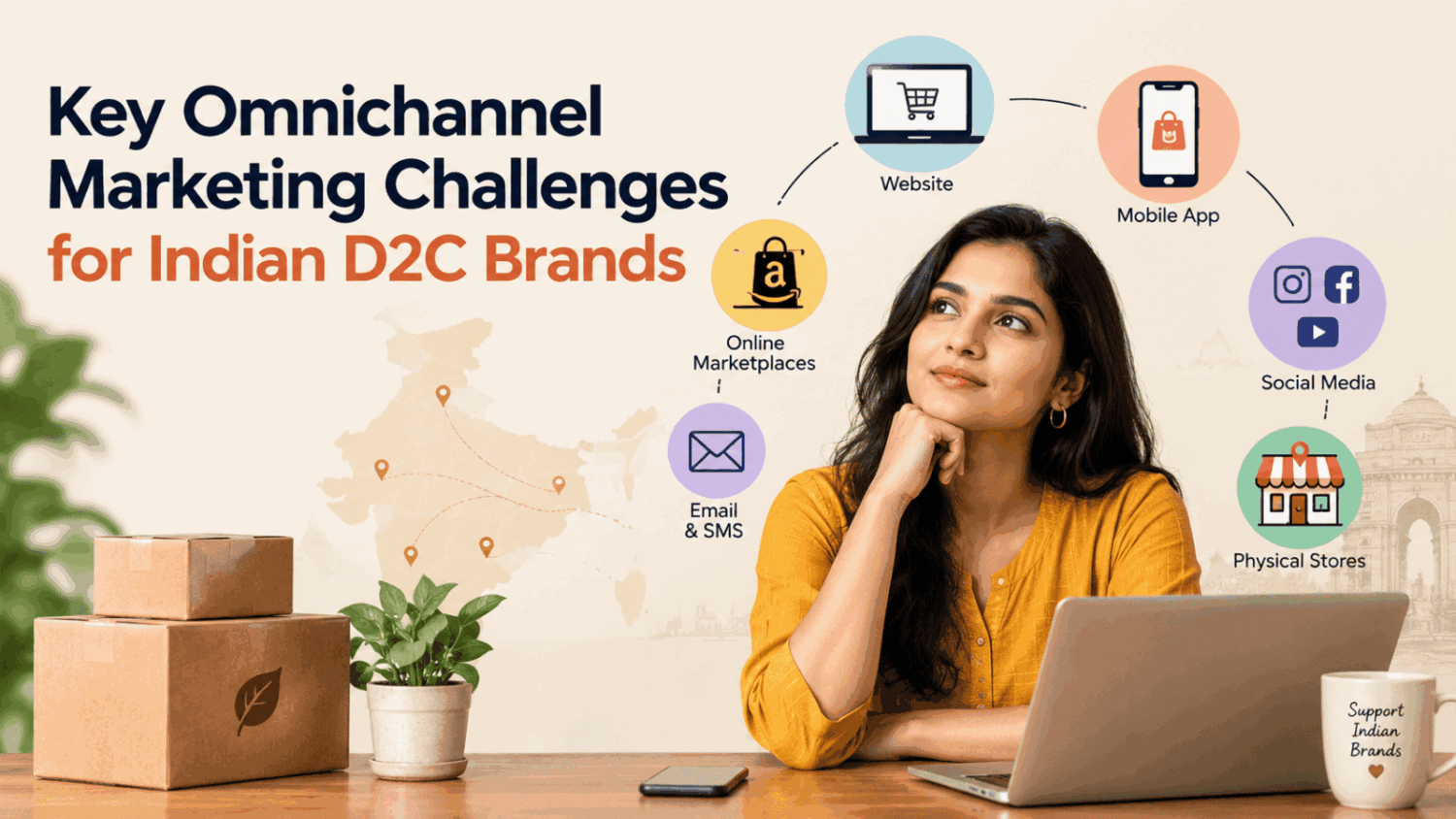
A customer finds your brand on Instagram. She checks reviews on your website. She asks a question on WhatsApp. She finally buys after an email reminder. That is one sale, but four channels. Now multiply that by thousands of customers a month.
This is the daily reality for scaling Indian D2C brands. Good digital marketing channel management is no longer optional. It is the difference between a brand that grows in a straight line and one that leaks revenue between platforms.
India’s D2C sector is growing fast. D2C sales are expanding roughly three times quicker than marketplace sales, says a McKinsey-backed industry report. More brands means more channels. More channels means more room for things to break down.
This guide is built as a learning resource. It breaks down the real barriers that make simultaneous channel management hard for Indian D2C brands. Then it lays out a practical way to fix them.
Key Takeaways
- Indian D2C brands run marketing across 5 to 8 channels on average. Think website, marketplaces, WhatsApp, Meta, Google, email, SMS, and quick commerce apps.
- The biggest omnichannel marketing barrier is not a lack of channels. It is disconnected data, tools, and teams.
- Fixing marketing channel integration protects customer experience, retention, and ad spend efficiency.
- A clear framework (below) can help D2C brand marketing leaders coordinate campaigns without adding headcount.
Why Channel Management Feels Harder for Indian D2C Brands Right Now
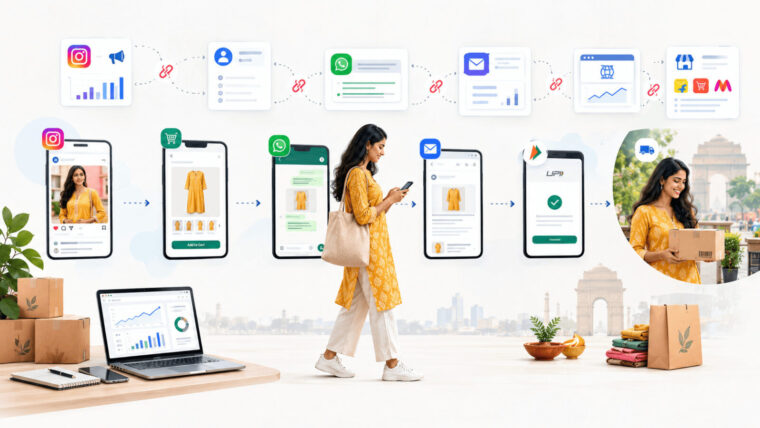
Three years ago, most D2C brands ran a website, an Instagram page, and a few Google ads. Today, the same brand may sell on its own site, three marketplaces, and a quick commerce app. It may run WhatsApp as a full sales channel, not just support. It may need Hindi, Tamil, or Bengali creative for tier-2 and tier-3 buyers.
Customer acquisition costs keep rising. Attention spans keep shrinking. Buyers now expect the same offer, tone, and order status on every channel. This is why Indian e-commerce marketing feels harder than it did two years ago. Meeting that expectation is what omnichannel marketing should solve. But most internal systems were never built for it.
8 Core Omnichannel Marketing Challenges Facing Indian D2C Brands
Here are the barriers that show up most often when D2C brands try to run coordinated campaigns across channels. Each one points back to a gap in day-to-day digital marketing channel management, not a lack of effort from the team.
1. Customer Data Lives in Separate Silos
The ads team sees clicks. The website team sees sessions. The support team sees complaints. The CRM sees purchase history. Nobody sees the full picture at once.
This is the root of most digital marketing channel management failures. Picture a customer who just complained about a late delivery. An hour later, she gets a promotional upsell email anyway. That one mismatch can undo months of trust-building.
Fix: Build one shared view of the customer. Pull purchase history, campaign activity, and support notes into a single dashboard. Check it daily.
2. Brand Messaging Breaks Across Touchpoints
A discount shown on the website is not always the one mentioned on WhatsApp. A product description on Instagram may not match the marketplace listing. Customers notice these gaps fast. They read them as a sign the brand can’t be trusted.
Consistent messaging depends on tight coordination between paid, organic, and social media efforts. When these run as separate projects instead of one campaign, mismatches are almost guaranteed.
Fix: Use one campaign brief and one offer calendar across every channel. No channel should publish an offer that isn’t logged centrally first.
3. WhatsApp Adds Operational Complexity
WhatsApp is now central to Indian D2C. Order confirmations, COD verification, cart recovery, and support all happen there. Yet many brands still manage it by hand. It has no link to order data or campaign history.
This turns a high-engagement channel into a bottleneck. A support agent may reply to a query with no idea the same customer is mid-way through a cart-recovery flow. The messages overlap. The buyer gets confused.
Fix: Connect WhatsApp workflows to your order management system so support, marketing, and delivery updates never collide.
4. Regional Diversity Breaks One-Size-Fits-All Campaigns
Tier-2 and tier-3 markets are driving a large share of new D2C growth in India. But buyer behaviour changes sharply by region. Some cities prefer Cash on Delivery. Others respond better to prepaid discounts. Language preference alone can double or halve engagement on the same creative.
Treating India as one market is one of the most common D2C brand marketing mistakes at scale. A campaign that performs in Mumbai will not automatically perform in Kanpur.
Fix: Segment campaigns by region, language, and payment preference rather than running one national creative everywhere.
5. Attribution Gets Murky Across Multiple Touchpoints
Modern buying journeys rarely stay on one channel. A customer sees a reel, checks Google, asks a question on WhatsApp, and buys after an email nudge. Last-click attribution credits only that final email. It hides everything that led up to it.
This is a core problem in marketing channel integration. Brands that trust last-click data alone often cut budget in the wrong place. A channel like organic search may be quietly assisting most of those sales.
Fix: Track assisted conversions and lifetime value, not just the last click, before reallocating ad spend between channels.
6. Marketing Tools Don’t Talk to Each Other
Ads platforms, CRM software, WhatsApp tools, and email systems often run as separate logins. No data is shared between them. Teams end up exporting spreadsheets by hand just to compare performance. This eats hours every week and invites errors.
This tool sprawl is the everyday face of poor multi-channel campaign management. It slows decisions down. During festive sales, when speed matters most, it can make quick coordination almost impossible.
Fix: Prioritise tools that integrate with each other over tools that only look impressive individually.
7. Team Silos Slow Down Coordinated Campaigns
Even with the right tools, campaigns stall when teams plan alone. Performance marketing, the email and retention team, and logistics often work in separate lanes. Say marketing announces a flash sale without warning the fulfilment team. Stockouts and delivery delays follow. Those delays often generate more support tickets than the sale generated in revenue.
Fix: Run one shared campaign calendar across marketing, support, and operations so every team sees the same launch dates and volume expectations.
8. Balancing Spend Across Rising CAC and New Channels
Customer acquisition costs keep climbing on Meta and Google. At the same time, new channels are opening up, like quick commerce and AI-powered shopping assistants. Each one needs its own strategy and its own budget rules. Spreading spend too thin, without data to back it, wastes money fast.
Fix: Test new channels with a small, fixed budget and clear success metrics before shifting significant spend away from proven ones.
Building a Stronger Digital Marketing Channel Management Framework
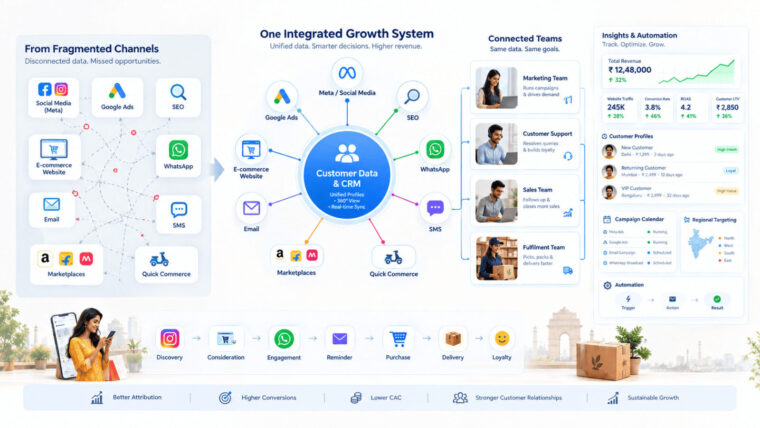
Fixing these challenges doesn’t require a complete rebuild. It requires a few consistent habits:
- Centralise customer data first. Every other fix depends on this. Even a basic shared spreadsheet updated daily is better than eight disconnected dashboards.
- Map the customer journey, not the channel list. Plan campaigns around how a buyer actually moves from discovery to purchase, instead of planning each channel in isolation.
- Automate the repetitive parts. WhatsApp reminders, abandoned cart flows, and reorder nudges should run on rules, not manual effort, freeing your team for strategy.
- Localise by region and language. Segment your top three to five markets first, then expand instead of localising everything at once.
- Track full-funnel attribution. Give assisted channels, like SEO and email, credit for the conversions they influence, not just the ones they close.
- Review coordination weekly, not quarterly. A short weekly sync across marketing, support, and fulfilment catches messaging mismatches before customers do.
None of these steps need a large in-house team overnight. Most scaling D2C brands start small. They fix one or two high-impact gaps first, usually data visibility and WhatsApp automation. Then they tackle the rest.
Final Thoughts
Omnichannel marketing challenges rarely come from having too many channels. They come from channels that operate without a shared source of truth. Indian D2C brands that fix data visibility, WhatsApp workflows, regional targeting, and team coordination tend to see the biggest gains. Retention improves. Ad spend goes further. And this often happens before a single extra rupee is spent on new campaigns.
Buyer behaviour backs this up. Customers who engage across multiple channels are more valuable and more loyal than single-channel shoppers. That’s according to long-running Harvard Business Review research on omnichannel retail.
Getting channel management right is rarely about buying more tools. It is about building better habits between the tools, teams, and data you already have. Indian e-commerce marketing keeps adding new channels every year. Brands with strong coordination habits will keep pulling ahead of brands still working in silos.
Struggling to Coordinate Your D2C Brand’s Marketing Channels?
TechEasify works with scaling e-commerce and D2C brands across India. We connect fragmented campaigns, from paid ads and SEO to WhatsApp, email, and marketplace management, into one coordinated growth engine. If your channels aren’t talking to each other, we can help fix that.
Frequently Asked Questions
What is digital marketing channel management?
Digital marketing channel management is the practice of planning, running, and measuring campaigns across platforms like a website, social media, WhatsApp, and email. It treats these as one connected system, not separate, disconnected efforts. Strong multi-channel campaign management ties every platform back to one shared customer data view.
Why do Indian D2C brands struggle with omnichannel marketing?
Most brands add channels faster than they add the systems to connect them. Disconnected customer data, regional diversity, and manual WhatsApp management are the most common causes.
What is the difference between multichannel and omnichannel marketing?
Multichannel marketing means being present on several platforms. Omnichannel marketing means those platforms share data and deliver one connected, consistent experience to the customer.
How does WhatsApp fit into an Indian D2C omnichannel strategy?
WhatsApp now handles order updates, COD verification, cart recovery, and support for many Indian D2C brands. Connecting it to order and CRM data keeps it from becoming a disconnected side channel.
How can a D2C brand improve marketing channel integration without a big budget?
Start with one shared customer data view and one shared campaign calendar. These two fixes solve most coordination problems before any new software purchase is needed.