At Techeasify Infotech, the team has been watching Query Fan-Out move from SEO jargon to a fundamental shift in search technology. Driven by the evolution of Large Language Models, Google no longer treats every input as a single, static lookup. These advanced Large Language Models allow the system to analyze the nuance behind each prompt to better understand user Search Intent.
When you use Google AI Mode, the engine often initiates Query Fan-Out to ensure the results are comprehensive. One prompt can trigger several hidden searches, pull useful passages from different sources, and blend them into a coherent response within AI Overviews. For business owners, marketers, and SEO teams, this evolution changes how content gets found, cited, or bypassed. The shift starts with how Google fans a query out behind the scenes to deliver a more synthesized experience.
Understanding Query Fan-Out: Google now breaks down single user prompts into 8 to 12 synthetic sub-queries to capture the full breadth of search intent.
Topic Authority Over Keywords: Ranking for a single phrase is less important than building comprehensive topic clusters that answer the core question and all related sub-questions.
Passage-Level Optimization: AI search engines frequently pull specific paragraphs, tables, or facts from a page rather than the whole document; therefore, content must be concise and easy to extract.
Structural Necessity: Semantic relationships, clear internal linking, and accurate schema markup are essential for helping AI search systems map your content and verify entity authority.
What Query Fan-Out Means in Google AI Search
Query Fan-Out is Google’s way of splitting a single search into multiple related sub-queries to provide a comprehensive AI-generated answer. Conductor’s explanation of query fan-out describes the same pattern in plain English. The primary difference from traditional search is that Google is no longer simply matching a single phrase to one page. Instead, it uses query decomposition to break down the search, ensuring it satisfies the full user intent behind that phrase.
This quick comparison makes the shift easier to see.
Traditional Search
Query Fan-Out
One query goes in
One query expands into several sub-queries
Retrieval leans on direct page matches
Retrieval checks multiple user intent and sub-intent angles
Results are mostly blue links
Results can become one merged AI answer
One strong page may win
A strong topic cluster has a better shot
That is why AI search optimization looks more like holistic topic coverage than simple keyword chasing.
A simple example of one query becoming many
Take a search like “best SEO strategy for a small business.” Through query decomposition, Google may break that input into smaller sub-queries regarding budget, local SEO, content marketing, technical fixes, and the role of paid ads. These sub-queries can be processed simultaneously, even though the user typed only one sentence.
A simple visual of one search branching into several hidden sub-queries.
Why Google uses query fan-out
People rarely search with perfect precision. They often leave out necessary context, mix multiple objectives, or ask broad questions. Query Fan-Out allows Google to fill in the blanks by applying query decomposition to analyze the core user intent behind a search.
This technology helps the search engine identify various sub-intents that the user might not have explicitly stated. By addressing these hidden needs, Query Fan-Out ensures that AI answers provide sufficient context across multiple angles to sound complete and offer genuine value.
How Google Query Fan-Out works behind the scenes
Google started talking more openly about this approach with AI Mode after Google I/O 2025. By I/O 2026, the company was framing Search more directly as AI Search, which fits how these answers are built. The workflow typically follows a clear path: the system detects user intent, performs a fan-out into multiple sub-queries, retrieves data from the web and Knowledge Graph, and finally completes the synthesis of a comprehensive answer.
From one search to 8 to 12 related sub-queries
For many broad or messy searches, Google AI Mode performs complex information retrieval by creating 8 to 12 synthetic queries, and sometimes up to 16 for more complex topics. These lookups run in parallel rather than one after another. The system can pull from the live web, the Knowledge Graph, Shopping, News, and other indexed sources at the same time.
That parallel retrieval is the key. It lets Google address the budget angle, the comparison angle, and the how-to angle in one pass, ensuring the final output covers the user intent comprehensively.
How AI Mode turns results into one answer
AI Mode uses advanced natural language processing to weigh those results, remove overlap, and perform response synthesis to blend them into one coherent answer. This process relies on generating these synthetic queries to ensure that every facet of the user request is addressed with high-quality data.
The final response may pull a strong paragraph from one page, a table from another, and product or entity details from somewhere else. In many cases, visibility comes from a passage, not a whole page. For SEO, the message is blunt. Ranking for the original query no longer guarantees visibility. Ahrefs-based tracking cited in March 2026 industry coverage put AI Overviews on 48 percent of queries, up from 34.5 percent in December 2025. More AI answers mean more hidden sub-queries are deciding exactly what content gets surfaced to the user.
Why Query Fan-Out changes SEO strategy
The target is no longer one obvious keyword. The hidden searches under the main prompt may include pricing, comparisons, risks, local intent, or freshness. Some teams call this AI Search SEO, while others refer to it as Generative Engine Optimization or Answer Engine Optimization. The labels vary, but the work remains the same.
This table shows the practical shift.
SEO Before AI Search
SEO After AI Search
Focus on one target keyword
Focus on full topic clusters and semantic relationships
One page tries to do everything
Pillar pages connect to supporting pages
Internal links are often an afterthought
Internal links map the full topic structure
Rankings are the main metric
Rankings, CTR, AI Visibility, and passage visibility all matter
From keyword targeting to topic coverage
Thin pages built around exact match terms are weaker in this model. Google wants pages that answer the main search intent quickly, then support it with related details. A strong page on small business SEO should cover budget ranges, local intent, content cadence, technical fixes, and when outside help makes sense.
Semrush’s overview of query fan-out reaches the same conclusion. The side questions matter because the system is already asking them behind the scenes.
What this means for entities, schema, and internal links
Clear entities help Google understand the who, what, and where of a page. You can improve how Google interprets your content by using Structured Data to highlight specific entity attributes and clarify the semantic relationships between different pieces of information. While schema does not rescue weak content, it makes strong content easier for search engines to process.
Internal links do quiet, useful work here. A site that offers AI-powered SEO growth strategies should make that topic easy to map with service pages, supporting articles, and descriptive anchors. When the semantic relationships are messy, fan-out retrieval has a harder time seeing how the pieces connect.
Why topical authority matters more than ever
Topical authority is not about publishing 50 weak posts. It is about consistent, connected coverage that answers the main question and the nearby questions too. Techeasify Infotech often sees stronger visibility when one solid pillar page is supported by focused topic clusters and clean internal links.
Expert insight: Query Fan-Out often favors the page that answers one hidden sub-question best, even if that page was never built around a high-volume keyword.
That is why building long-term topical authority through comprehensive content beats scattered publishing.
How to optimize content for Query Fan-Out and AI Search
Optimizing for query fan-out is straightforward. Build pages around real questions, make answers easy for algorithms to extract, and maintain a clean topic structure that Google can follow.
Build topic clusters around real user questions
Your content strategy should mirror how Google branches search intent. A consistent process keeps your production grounded.
Pick one core page for the broad topic.
Conduct a thorough content gap analysis using data from Search Console, sales calls, support chats, and SERP suggestions to identify missing angles and unique search opportunities.
Group those questions by intent, such as cost, local, comparison, or troubleshooting.
Decide what belongs on the core page and what deserves its own specific page.
Link supporting pages back to the main topic with plain, descriptive anchor text.
Refresh the cluster regularly when facts, dates, or search behavior change.
Write for passages, not just pages
Short, direct sections are easier for AI systems to quote. Good H2 and H3 headings help, as do tight paragraphs, comparison tables, and clear answers placed near the top of a section.
A useful rule is to answer the core question in the first 100 to 150 words of the page, then expand. That gives AI search engines a concise, high-quality passage to cite.
Pro tip: If a section can answer a related question in 50 words, it has a better chance of being surfaced than a long intro that circles the point.
Use structured data and entity signals the right way
To improve discovery, implement schema markup such as Article, FAQPage, Product, and LocalBusiness. Beyond just code, you must focus on entity attributes that define your brand and content authority. Author details, publish dates, update dates, and clear organization info reinforce trust. It is important to remember that demonstrating EEAT signals effectively requires a commitment to site quality and content depth, which works in tandem with your schema markup to establish authority.
Page experience remains vital. A slow mobile page, a messy layout, or weak navigation can undercut your site visibility even if your content is technically sound.
Avoid the mistakes that weaken AI search visibility
Common SEO oversights are amplified in an AI-driven environment. Keyword stuffing, duplicate pages, thin posts, and intent mismatch make it difficult for query fan-out retrieval to select your page as a primary source.
Summary Checklist for AI Visibility
Use this checklist to ensure your site is optimized for passage extraction and AI retrieval:
Perform regular content gap analysis to identify missing intent-based topics.
Merge duplicate pages that compete for the same keyword variants.
Cut filler content and repetitive phrasing to keep passages concise.
Fix orphan pages by establishing a clear internal linking structure.
Update stale facts, dates, and examples to maintain high EEAT signals.
Deploy valid schema markup to help search engines understand your entity attributes.
Watch Search Console for CTR drops after AI answers appear to gauge performance.
How businesses should prepare for the future of AI Search
Not every business needs a full rebuild. Most need a hard look at existing content, technical SEO, and internal linking before adding more pages. Techeasify Infotech usually starts there, because query fan-out often exposes gaps that rank tracking alone misses. To succeed, businesses must align their strategies with how AI agents process information, ensuring their content caters to the nuances of semantic search and evolves alongside shifting user intent.
Measuring the impact of AI search
Monitoring success in an AI-driven landscape requires moving beyond traditional ranking reports. Businesses should leverage Google Search Console filters to track performance in search appearance categories and utilize emerging tools that measure AI citations. By observing how often your content is referenced within AI-generated responses, you gain a clearer picture of your brand authority and visibility in this new era.
When to update content versus create new pages
Updating works best when a page already has authority and matches the main intent. Creating a new page makes more sense when the subtopic is distinct, needs its own examples, or requires a different conversion path. Refreshing is usually faster and cheaper, though new cluster pages often create better long-term topic coverage.
Businesses that need content fixes and site fixes together often look for professional digital marketing and web development services so SEO, UX, and development move in the same direction.
What to ask before hiring help
Before a company decides to hire an SEO agency or hire SEO experts, it helps to compare agencies with direct questions. That keeps the conversation practical.
How do they connect AI SEO services with technical SEO services and content strategy?
Will they review current pages before pushing new production?
How do they measure Search Console changes, CTR shifts, and AI Overview visibility?
What is included when a business wants website SEO services, request a consultation, or get a quote?
What happens during a book a strategy call session, and what comes next?
Some teams want a simple contact us route. Others want a deeper audit first. Either way, the useful answer is the one tied to business goals, not vague promises. If a business is still comparing options, this guide to the top 10 AI SEO agencies in India can help narrow down the right fit.
Frequently Asked Questions
How does Query Fan-Out affect my existing page rankings?
Traditional ranking is no longer the sole indicator of visibility because AI Overviews can bypass individual pages to synthesize answers from multiple sources. You may see shifts in traffic or click-through rates as Google prioritizes direct answers within the search interface. As AI Overviews continue to evolve, your presence in these snapshots will increasingly dictate your overall search visibility.
Should I stop targeting keywords entirely?
No, keywords still provide a foundation for understanding user intent, but they should be treated as starting points for broad topic coverage. Instead of writing one page for one keyword, focus on creating content that addresses the core topic and all the natural, related sub-questions users might have. This comprehensive approach ensures you remain relevant as search engines move toward deeper topical authority.
What is the most effective way to optimize for AI Overviews?
Focus on writing short, direct, and high-quality passages that answer specific questions within the first 150 words of your page. Using clear H2 and H3 headings, bullet points, and tables helps the AI algorithms isolate and cite your content more effectively. Providing structured, factual information makes it much easier for search engines to synthesize your expertise into their summaries.
How do I measure success in an AI-driven search environment?
Move beyond traditional rank tracking by monitoring Google Search Console for performance in AI-specific search appearance filters. Additionally, look for tools that measure AI citation frequency to see if your brand is being credited within synthesized responses. Focusing on brand authority and referral traffic will provide a clearer picture of your success than tracking blue link positions alone.
Final thoughts on Query Fan-Out
Query Fan-Out changes how Google finds, evaluates, and surfaces information, meaning the sites that cover topics comprehensively and answer related questions directly are best positioned to succeed. This shift requires moving away from chasing single keywords toward a more holistic approach that prioritizes depth and connectivity.
Adapting to the complexities of Query Fan-Out is the ultimate long-term play for any brand. Techeasify Infotech provides expert support for businesses looking to navigate these technical updates, improve their AI visibility, and align their broader search strategy with the ongoing evolution of AI Overviews.
If you are ready to prepare your digital presence for the future of search, you can reach out to Techeasify Infotech to discuss a personalized SEO audit. The most effective plan depends on your specific market, your site structure, and the nuanced search intents that Google is already addressing behind the scenes.

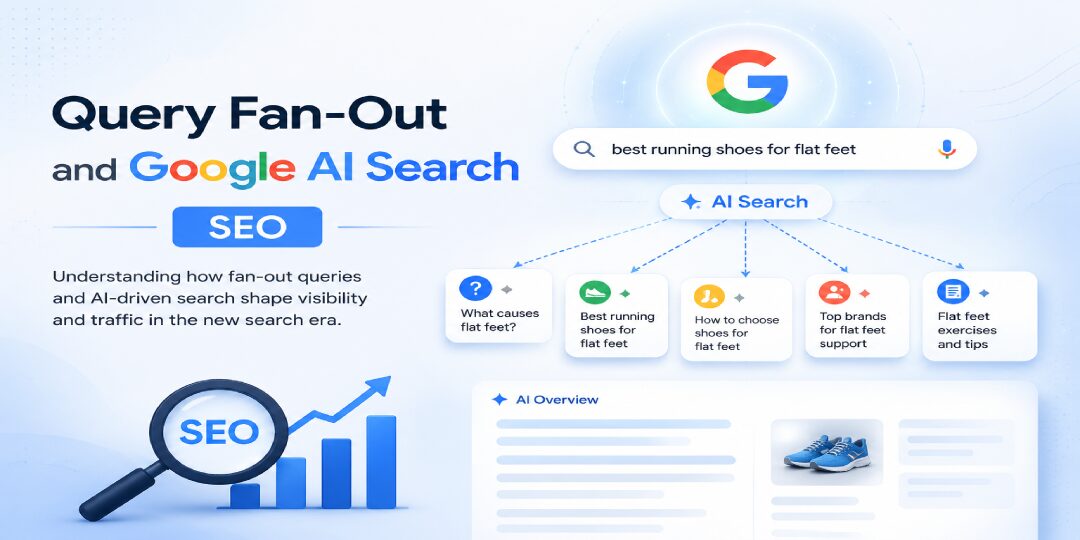
 A simple visual of one search branching into several hidden sub-queries.