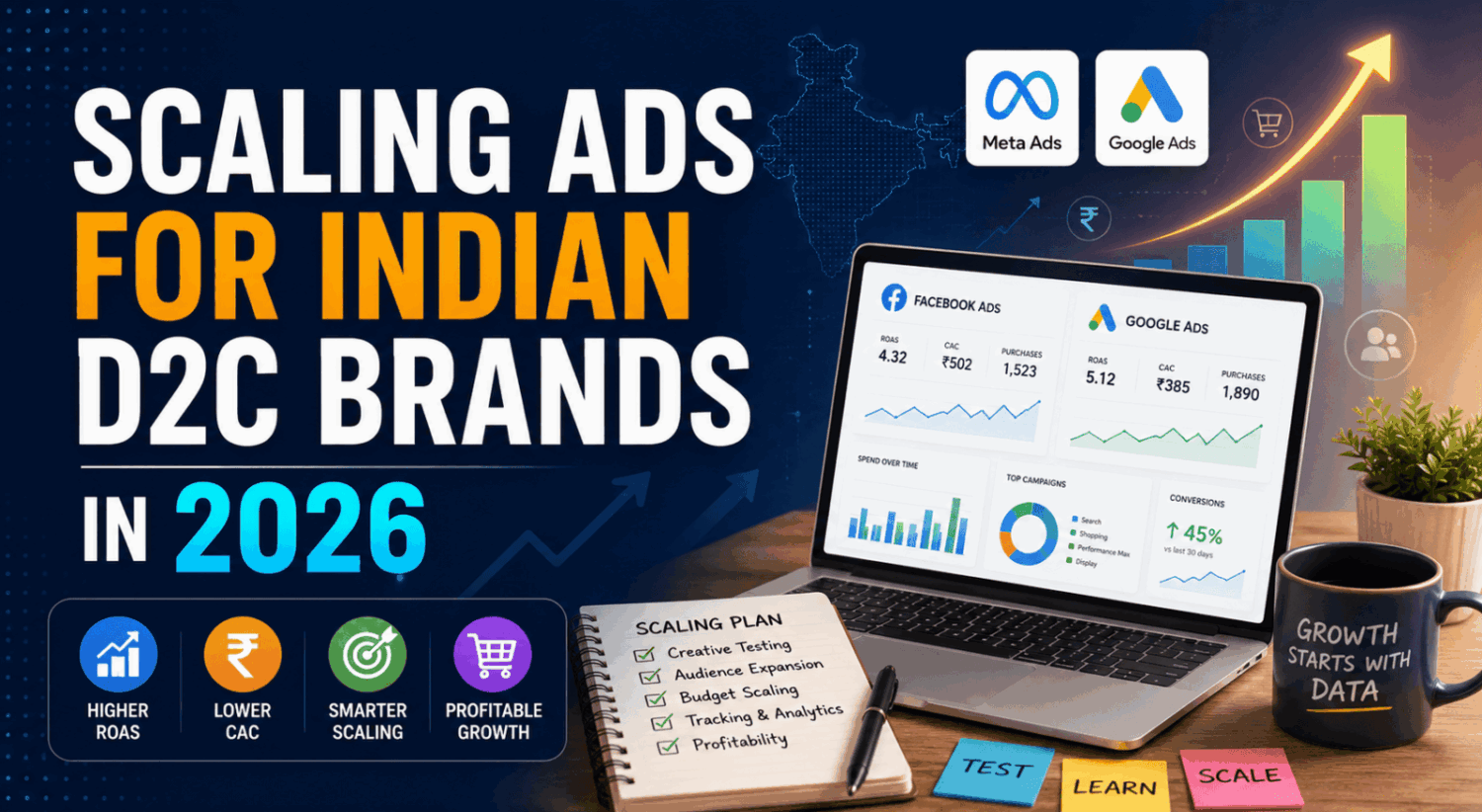
Your ads work great at ₹50,000 a month. You push the budget to ₹5 lakh, and your ROAS falls off a cliff. If that sounds familiar, you are not doing anything wrong. You just hit the wall that catches most Indian D2C brands.
Scaling Facebook and Google Ads for Indian D2C brands is hard because auction costs rise faster than most margins can absorb. Meta and Google keep getting more expensive as more Indian brands bid for the same shoppers, and your ROAS drops unless something else in your business improves at the same pace. This is not just a Meta problem or a Google problem. It is the core tension inside almost every Indian e-commerce marketing plan right now: demand for ad inventory is growing faster than the supply of profitable customers. This guide breaks down exactly why that happens and the specific levers that protect your ROAS as spend grows, so you can scale with confidence instead of guesswork.
Key Takeaways
- Meta CAC for Indian D2C brands rose about 32% between 2025 and 2026, from roughly ₹380 to ₹502, driven mostly by rising auction competition.
- ROAS falls when you scale because audiences saturate, creative fatigues, and Meta’s 2026 attribution changes stop counting likes and shares as clicks.
- Break-even ROAS equals 1 divided by your gross margin. Know this number before you set a spend target.
- Scale budget in 20 to 30% steps every three to five days. Overnight doubling resets the algorithm and tanks performance.
- Google captures existing demand; Meta creates new demand. Split your budget based on which one applies to your product.
- Tier 2 and Tier 3 cities often deliver CAC as low as ₹200 to ₹800, versus ₹800 to ₹1,500 in metro markets.

Why Scaling Facebook and Google Ads Feels Harder in 2026
The numbers explain most of the pain. Meta CAC for Indian D2C brands rose from roughly ₹380 in 2025 to around ₹502 in 2026, a jump of about 32% in one year. Meta CPMs in competitive categories like beauty, fashion, and wellness now run ₹110 to ₹180 on average, and they spike past ₹220 during festival season. Google Search CPCs show the same trend. Categories like jewelry now see CPCs as high as ₹65, while home and furniture brands pay ₹15 to ₹45 per click.
Part of this comes down to simple supply and demand. India’s digital ad spend market is projected to reach nearly $20.46 billion by 2029, and Google and Meta still hold most of that budget share. More brands are bidding for the same inventory every quarter, which pushes prices up across almost every D2C category. This is the backdrop for nearly every conversation about D2C advertising in India today.
The categories feeling the most pressure right now are beauty, fashion, wellness and supplements, jewelry, and home decor. These are also the most crowded D2C spaces in India, so the auction competition compounds the cost problem. If you sell in one of these categories, expect your cost per click and cost per mille to climb faster than the market average, and plan your margin accordingly.
The Real Reasons ROAS Drops When You Push More Budget
Rising costs are only half the story. The other half is what happens inside your account once you increase spend.
Auction inflation outruns your margin. If your CPM rises 15% but your conversion rate stays flat, your cost per purchase rises by roughly the same amount. Unless your average order value or margin grows to match, your ROAS has to fall.
Audiences get saturated fast. Once you exceed the size of your best-fit audience, Meta and Google start showing your ads to less relevant people. This is why doubling your budget overnight almost always backfires. Scale in 20 to 30% steps and give each increase three to five days before judging it.
Creative fatigue sets in quickly. Indian D2C brands running the same three ad creatives for a month will see performance drop even if nothing else changes. Fresh creative angles, not new audiences, are usually what fixes flat performance in paid social advertising campaigns.
Attribution got stricter in 2026. Meta changed how it counts clicks this year. Likes, shares, comments, and saves are no longer counted as website clicks, so ROAS numbers that looked healthy last year are not directly comparable to this year’s numbers. If your reported ROAS dropped without a real sales drop, this is often why.
Break-even math gets less forgiving as you scale. The formula is simple: break-even ROAS equals 1 divided by your gross margin percentage. If your margin is 40%, you need at least a 2.5x ROAS just to cover product and platform costs, before you count overhead. Brands with high return rates or heavy discounting have almost no room left when ad costs rise.
Google Ads vs Facebook Ads: Two Different Jobs, Not Two Competing Channels
A lot of Indian founders treat Google Ads and Facebook Ads as rivals fighting for the same budget. That is the wrong frame. Google captures demand that already exists, while Meta creates demand that does not exist yet.
Someone typing “vitamin C serum” into Google already wants that product. You are just winning the click. Nobody searches for a product they have never heard of, so Meta has to do the harder job of generating desire from a cold scroll. This is why category research matters before you split your budget between search and paid social advertising. If your product category has real, measurable search volume in Google Keyword Planner, Google deserves a serious share of spend. If your product is new or hard to categorize, Meta should carry more of the load until your brand name itself starts getting searched.
We break down this decision in more depth in our comparison of Google Ads and Facebook Ads, including which one to start with based on your product type and budget size.

Five Levers That Protect ROAS as You Scale
These are the levers that separate D2C brands that scale profitably from brands that burn cash chasing spend targets.
- Fix your unit economics before you touch the ad budget. Know your break-even CAC before you spend a rupee. Calculate it as AOV multiplied by gross margin percentage. Set your target CAC at 60 to 70% of that number, so you have room for overhead and profit. Skipping this step is the single biggest reason ad accounts look fine early and then quietly bleed money as spend grows.
- Build a permanent creative-testing engine. Brands that ship 8 to 12 fresh creative concepts a month consistently outperform brands shipping two or three. Set aside 10 to 20% of your budget as a standing testing campaign, and feed winners into your main scaling campaign. Test different hooks and angles, not just color variants of the same ad.
- Scale budget gradually, not overnight. Increase spend in 20 to 30% steps every three to five days. Overnight doubling resets the algorithm’s learning phase and usually tanks your ROAS for a week or more. This applies to both Facebook Ads scaling and Google Ads scaling. Both platforms need time to recalibrate after a budget jump.
- Get your tracking clean before you scale. Run Meta Pixel alongside Conversions API so you are not losing signal to iOS privacy restrictions. Deduplicate purchase events. Set up Google Ads conversion tracking with accurate order values. A dirty pixel or broken conversion tag will make even a great campaign look like it is failing.
- Fix your site and product feed, not just your ads. A one-second delay in page load can cost you 7% of conversions. Mobile checkout needs UPI and COD set up correctly, since most Indian D2C traffic is mobile. For Google Shopping, a clean, accurate feed with correct pricing and images matters more than bid strategy. We cover the exact feed checklist in our guide to optimizing Google Shopping Adsfor ecommerce growth.
A Practical Scaling Framework
Phase | Focus | Budget Signal |
Days 1–15 | Fix pixel, tracking, and landing page speed | Validate offer at ₹1,500–3,000/day |
Days 16–45 | Launch testing campaign, find 3–4 winning creative angles | Hold budget steady, watch CAC by city/tier |
Days 46–90 | Scale winners in 20–30% steps, expand to Tier 2 cities | Scale past ₹3–5 lakh/month once ROAS holds for 2 weeks |
Common Mistakes That Kill ROAS When Scaling
Many Indian D2C brands judge a campaign inside a 24-hour window instead of waiting for the attribution window to settle, which leads to decisions made on incomplete data. Others kill ads at low spend before Meta’s algorithm exits its learning phase, resetting progress and wasting budget. Some restructure the entire account every 10 days instead of letting it stabilize, which is one of the most expensive habits in Indian performance marketing. Many brands also ignore Tier 2 and Tier 3 cities, where CAC can run ₹200 to ₹800 versus ₹800 to ₹1,500 in metro markets. Too many brands chase platform-reported ROAS instead of tracking blended CAC across all channels, which hides the true cost of growth.
What This Means for Your Indian E-Commerce Marketing Strategy
Growing your paid social advertising and search spend is not about finding one hack that fixes ROAS overnight. It is about treating unit economics, creative supply, tracking accuracy, and budget pacing as one connected system. Brands that fix all four tend to scale past the ten lakh a month mark and keep their margins intact. Brands that fix only their ad account tend to plateau, then panic, then cut budget the moment ROAS dips.
Scale With a Team That Protects Your Margin, Not Just Your Spend
Scaling Facebook and Google Ads for Indian D2C brands profitably takes more than a bigger budget. It takes clean tracking, a real creative testing system, and disciplined pacing. If your ROAS is already slipping as you try to grow, we can audit your account and show you exactly where the leak is.
Book a Free Strategy Callwith TechEasify’s performance marketing team today.
FAQs
Why is it difficult to scale Facebook and Google Ads for Indian D2C brands?
Because auction costs on both platforms are rising faster than most Indian D2C brands’ margins can absorb. Meta CPMs and CACs have climbed sharply since 2025, and Google CPCs are rising in competitive categories like beauty, jewelry, and wellness. Without strong unit economics, fresh creative, and clean tracking, ROAS compresses as spend increases.
What ROAS should Indian D2C brands target in 2026?
Most healthy accounts run 3x to 5x on Meta and 3.8x to 5.5x on Google, but your real target should be your break-even ROAS (1 divided by gross margin), plus a profit buffer, not a generic industry number.
Should I start with Google Ads or Facebook Ads?
Start with whichever platform matches your product’s search demand. If people already search for your category on Google, start there. If your product is new or hard to categorize, start with Meta and build demand first.
How much budget do I need to scale profitably?
You can validate an offer at ₹1,500 to ₹3,000 a day. A stable acquisition engine usually needs ₹3 to 5 lakh a month. Past ₹10 lakh a month, creative volume and account structure decide most of your results, not bidding tactics.