Key Takeaways
- The top 10 search engines aren’t equal, search engine market share changes by country and device.
- Google leads global search traffic, Microsoft Bing stays strong on desktop and Windows.
- Privacy-first options (like DuckDuckGo and Startpage) reduce tracking.
- Regional leaders (like Baidu, Naver, Seznam) matter for local reach.
- Business takeaway: visibility depends on technical health, content quality, and trust signals, not one platform.
Led by Google, the market leader, search engines still decide what gets seen in 2026. Google shapes news, product research, local buying, and even how people check facts with search queries. For businesses, they shape traffic quality, brand trust, and sales pipeline.
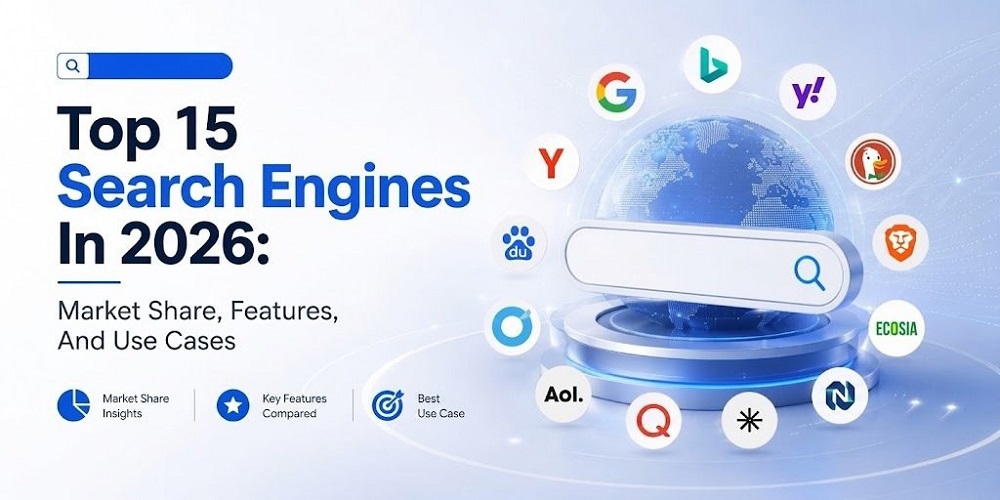
This guide explains the top 15 search engines and why each one exists. It also clarifies why search engine market share differs by country and by device (mobile vs desktop), and why search results can look different across engines, delivering distinct search results on each platform. The post ends with a broader search engines list and practical steps businesses can use to improve rankings across more than one platform.
What Is A Search Engine, And How Does It Work?
A search engine is software that finds pages, stores them, and ranks them when users enter search queries. Most web search follows a simple pipeline that begins with crawling and indexing.
- Crawl: Web crawlers like Google’s Googlebot and Microsoft Bing’s Bingbot visit links and discover new or updated pages.
- Render: Some engines, including Google, load pages like a browser to see real content.
- Index: The engine stores page data and extracts key signals.
- Understand: Systems interpret user intent behind search queries, along with entities and language.
- Rank: Algorithms order results based on relevance to search queries, quality, and context.
These factors influence the SERP. Location changes local packs. Language changes which pages qualify. Device can change layout and features. Personalization algorithms, fresh news, and paid placements also shift what shows first in search results.
Organic results vs ads, what the difference means for users
Ads are paid placements that appear at the top of search results because an advertiser bids on keywords or audiences. Organic results are ranked without direct payment for the position in search results. Most engines label ads with markers like “Sponsored” or “Ad.” For users, this matters because ads can be useful, but they aren’t the same as earned relevance in search results. For businesses, it’s a budget tradeoff: ads can buy visibility now, while long-term SEO earns durable rankings that don’t stop when spend stops.
The way people search has changed. A few years ago, you typed a question into Google and scrolled through results. Today, search is splitting into two paths: traditional search engines that show you websites, and AI-powered tools that answer your question directly.
This shift matters. If you want to find a store or compare products online, traditional search works best. If you need research, explanations, or deep dives into complex topics, AI search handles that better. The smartest move is using both.
Here’s what each search engine does in 2026, and which one actually fits your needs.
Quick Comparison: Search Engines
| Search Engine | User Privacy | Best For | Popular Region |
| Tracked – builds detailed ad profiles | Everyday searches, shopping, local businesses | Global (90% market share everywhere) | |
| Bing | Tracked – integrates with Microsoft accounts | Microsoft ecosystem users, AI summaries | East Asia, Germany, Brazil, Windows users |
| Yahoo | Tracked – uses Bing’s tracking | News, financial data, Yahoo Mail users | United States (legacy users) |
| DuckDuckGo | Private – zero tracking, anonymous | Privacy-conscious users, anonymous search | United States, Europe (tech-savvy users) |
| Baidu | Tracked – subject to Chinese oversight | Chinese language searches, Chinese content | China (53% market share), Mainland Asia |
| Yandex | Tracked – Russian government access | Russian language searches, Russian services | Russia (76%), Ukraine, Kazakhstan, Belarus |
| Seznam | Tracked – Czech data collection | Czech language searches, Czech local services | Czech Republic (13.5% market share) |
| Ecosia | Mostly private – minimal tracking, environmental focus | Environmentally conscious users | Global (strongest in Europe, US) |
| StartPage | Private – zero tracking with anonymous proxy | Privacy seekers wanting Google results anonymously | United States, Europe, global privacy-conscious users |
| Naver | Tracked – Korean data collection | Korean language searches, Korean local content | South Korea (81% market share) |
| ChatGPT Search | Tracked – OpenAI collects usage data | Conversational research, follow-up questions | Global (integrated into ChatGPT users) |
| Perplexity AI | Tracked – collects search and user data | Academic research, fact-checking, citations | Global (growing in US, UK, Europe) |
| Google AI Mode | Tracked – same as Google’s tracking | AI summaries with Google’s full index | Global (integrated into Google everywhere) |
| Gemini | Tracked – Google ecosystem tracking | Writing, coding, complex analysis | Global (Google account required) |
| Claude | Tracked – Anthropic collects usage data | Document analysis, long-form writing | Global (growing in US, UK, Europe) |
Want Better Visibility Across Search Engines?
Get help improving your rankings on Google, Bing, and AI search tools with SEO that supports real traffic, better trust, and stronger local reach.
Top 15 Search Engines In The World (Ranked, With Pros And Cons)
Search engine market share changes from month to month, and it also varies by region. For a baseline on global search engine share, many marketers refer to StatCounter and similar tracking tools.
Google still leads by a wide margin, but it is not the only search engine people use. Bing, Yahoo, DuckDuckGo, Baidu, Yandex, and several regional search engines still attract millions of users every day.
Here are the top 15 search engines in the world, ranked by popularity and usefulness.
1. Google
Global Market Share: Around 90% worldwide.
The world’s largest search engine with 90% global market share. Fast, comprehensive index covering billions of pages. Integrated maps, shopping, news, and images. AI Mode adds summaries. Tracks user behavior for ad targeting. Best for everyday searches and discovering websites.
Best Use Case: Everyday searching, shopping, maps, and local business lookups.
Key Feature: Fast results with news, images, maps, and AI summaries in one place.
Advantages: It is fast, familiar, and useful for almost any type of search.
Limitation: Ads take up a lot of space, and smaller sites can be harder to find.
2. Microsoft Bing
Global Market Share: Around 4% to 5% worldwide.
Microsoft’s search engine with 4-5% global market share. Integrates with Windows, Edge, and Microsoft 365. Powered by ChatGPT AI summaries built-in. Results are good but slightly behind Google. Strongest in East Asia, Germany, and Brazil. Tracks user data linked to Microsoft accounts.
Best Use Case: Windows users, Microsoft tools, and AI search results.
Key Feature: It works closely with Windows, Edge, and Microsoft 365.
Advantages: It has built-in AI answers and a solid image search tool.
Limitation: It still feels behind Google for many everyday searches.
3. Yahoo

News and email portal that uses Bing’s search index. Displays financial data, sports scores, and weather. Most users are legacy Yahoo Mail customers. No unique search technology. Similar ad dominance to Google. Not recommended for pure search quality.
Global Market Share: Around 1% worldwide.
Best Use Case: News, finance, email users, and quick updates.
Key Feature: It combines search with news, sports, and finance content.
Advantages: It is simple to use and useful if you already use Yahoo Mail.
Limitation: It does not have strong search power on its own.
4. DuckDuckGo

Global Market Share: Less than 1% worldwide.
Privacy-first search engine with 100 million monthly searches. Zero tracking, no cookies, no ad profiling. Blends results from multiple sources. Quality is good but less precise than Google. Simple interface, lightweight, and genuinely private. Popular with privacy-conscious users globally.
Best Use Case: Private searching without tracking.
Key Feature: It does not track your searches or build a user profile.
Advantages: It is private, clean, and easy to use.
Limitation: Results can feel less detailed than Google for some searches.
5. Baidu
Dominates China with 53% market share. Built for Mandarin language and Chinese content. Handles Chinese characters, payment systems, and local services perfectly. Useless for English searches. Subject to Chinese government content restrictions. Essential for searching in mainland China.
Global Market Share: Around 2% worldwide, with strong use in China.
Best Use Case: Searching in Mandarin and finding Chinese websites.
Key Feature: It is built for Chinese language and local services.
Advantages: It works very well for Chinese users and local content.
Limitation: It is not very useful for English searches.
6. Yandex
Global Market Share: Around 1.5% worldwide.
Russia’s dominant search engine with 76% market share. Also strong in Ukraine, Kazakhstan, and Belarus. Built for Russian language (Cyrillic). Includes maps, email, and translation tools. Minimal international coverage. Geopolitical concerns about government ties. Essential in Russia, irrelevant elsewhere.
Best Use Case: Russian language search and local Russian services.
Key Feature: It handles Cyrillic text and Russian content very well.
Advantages: It is strong for local search in Russia and nearby regions.
Limitation: It has limited value outside Russian-speaking countries
7. Ecosia
Global Market Share: Less than 1% worldwide.
Eco-friendly search engine with 15-20 million monthly users. Uses Bing’s index. Donates 80% of revenue to tree-planting organizations. Has planted 250+ million trees since 2009. Results quality is decent but inferior to Google. Choose for environmental values, not search superiority.
Best Use Case: Users who want their searches to support tree planting.
Key Feature: It uses search revenue to fund reforestation projects.
Advantages: It is eco-friendly and easy to switch to from other engines.
Limitation: Search quality depends on Bing, so it is not the strongest choice.
8. Naver
Global Market Share: Less than 1% worldwide, but very strong in South Korea.
South Korea’s dominant search engine with 81% market share. Launched AI Tab in April 2026 (3 million users in one month). Handles Korean language perfectly. Integrated shopping, maps, blogs, webtoons, and weather. Completely inaccessible for non-Korean searches. Essential in South Korea only.
Best Use Case: Korean searches, shopping, maps, and local content.
Key Feature: It combines search with blogs, cafes, maps, and shopping tools.
Advantages: It is built for Korean users and Korean-language results.
Limitation: It is mostly useful only in South Korea.
9. StartPage
Global Market Share: Less than 0.5% worldwide.
Privacy-focused search delivering Google-quality results anonymously. Uses Google’s index without tracking. Includes Anonymous View proxy that masks IP, location, and DNS. Blocks trackers and prevents social media retargeting. Free, zero data logging. Best privacy option that doesn’t sacrifice result quality.
Best Use Case: Privacy-focused users who still want Google-like results.
Key Feature: It gives Google results without tracking you.
Advantages: It is private, simple, and easy to trust.
Limitation: It does not offer the same full experience as Google itself.
10. Seznam
Global Market Share: Around 1.5% worldwide, with strong use in the Czech Republic.
Eastern Europe’s strongest native search engine with 13.5% of Czech market. Built for Czech language and local content. Includes Firmy.cz (business directory), Zboží.cz (shopping), and Mapy.cz (maps). Weak international results. Essential in Czech Republic, ignored elsewhere.
Best Use Case: Czech language searches and local Czech services.
Key Feature: It is built around Czech content and local tools.
Advantages: It works well for Czech users and Czech local search.
Limitation: It is not very useful outside the Czech market.
11. ChatGPT Search
Global Market Share: Growing fast.
AI search combining conversation with real-time web access. Ask questions naturally, get detailed answers with sources cited. Lets you ask follow-up questions. Free tier has limited searches. $20/month for unlimited. Slower than Google but better for research and learning.
Best Use Case: Research, learning, and follow-up questions.
Key Feature: It gives direct answers in a conversation style.
Advantages: It is good for explanations, summaries, and deeper thinking.
Limitation: It is not the best choice for shopping or local searches.
12. Perplexity AI

Global Market Share: Growing fast.
Research-focused AI search with citations as the primary feature. Every answer shows exactly which sources provided information. Synthesizes live web data and shows its work. 5 free Pro searches daily, $20/month for unlimited. Slower than Google, excellent for fact-checking and academic research.
Best Use Case: Research that needs sources and quick summaries.
Key Feature: It shows citations with its answers.
Advantages: It is helpful for fact-checking and study work.
Limitation: It is not as fast or broad as traditional search engines.
13. Google AI Mode
Global Market Share: Built into Google’s main search system.
Google Search enhanced with AI layer on top. Gemini synthesizes answers from Google’s index and displays them above traditional links. Free for logged-in Google users. Combines Google’s speed with AI summarization. Less detailed than dedicated AI search engines. Ad ecosystem intact.
Best Use Case: Users who want AI answers without leaving Google.
Key Feature: It adds AI summaries on top of normal search results.
Advantages: It is easy to use and does not need a new platform.
Limitation: It still keeps you inside Google’s ad-heavy system.
14. Gemini
Global Market Share: Growing fast.
Google’s standalone AI assistant more powerful than AI Mode. Upload images, ask complex reasoning questions. Handles writing, coding, and analysis. Multimodal input (text, images, documents). Free tier available, Gemini Advanced at $20/month. Excellent for creative and analytical work, not optimized for quick searches.
Best Use Case: Writing, coding, and complex tasks.
Key Feature: It can handle text, images, and documents.
Advantages: It is useful for creative work and deeper thinking.
Limitation: It is better for tasks than for quick web search.
15. Claude
Global Market Share: Growing fast.
Anthropic’s AI assistant known for honesty and accuracy. Excellent at analyzing long documents (up to 500 pages). Strong at nuanced reasoning and admitting uncertainty. Less likely to make up information. Free tier available, Claude Pro at $20/month. Best for document analysis and precise writing.
Best Use Case: Long documents, writing help, and careful analysis.
Key Feature: It handles long text very well.
Advantages: It is strong at reading, writing, and explaining complex ideas.
Limitation: It is not built mainly for live web search.
Which Search Engine Should You Use?
No single search engine is perfect. The best choice depends on what you’re doing.
For quick answers and shopping: Use Google. It’s fast, comprehensive, and shows you real products, services, and local businesses. Google AI Mode gives you summaries at the top if you want them.
For privacy: Use StartPage or DuckDuckGo. StartPage gives you Google-quality results with a free anonymous proxy. DuckDuckGo is simpler and faster if you accept slightly lower result quality.
For Czech local search: Use Seznam. It beats Google for Czech businesses, services, and content because it’s built for the language and region.
For Korean local search: Use Naver. It dominates South Korea with 81% market share and integrates shopping, maps, and entertainment seamlessly.
For research and learning: Use Perplexity or ChatGPT Search. Both synthesize information and let you ask follow-up questions. Perplexity shows sources immediately. ChatGPT is more conversational.
For document analysis: Use Claude. It handles long PDFs, research papers, and complex documents better than any search engine.
For writing and coding: Use Gemini. It’s built for creative work and has access to your Google ecosystem.
For environmental values: Use Ecosia. Your searches fund tree planting.
Most people benefit from using multiple tools. Search Google for quick answers. Use StartPage if you care about privacy. Use Perplexity for research. Use Claude for documents. Use Gemini for writing. The combination covers every need and makes you more productive.
Complete Search Engines List And How Businesses Can Rank Across Them
Many teams need a wider list of alternative search engines beyond Google, for research, brand monitoring, and niche discovery. For a broad reference set, PCMag’s roundup of alternative search engines and Wikipedia’s list of search engines help map the ecosystem, including legacy players like Ask.com, AOL, and Yahoo Search.
A compact list of additional alternative search engines (grouped):
- Privacy-first: Brave Search (privacy focus), Qwant (EU privacy), Mojeek (independent crawler), Swisscows (family filter), Kagi (paid search)
- Legacy/general: Ask.com, AOL, Yahoo Search, with Ask.com and AOL still serving general queries
- AI-powered search engines: Perplexity (answer summaries), You.com (AI + web), Andi (chat-style search), Phind (dev-focused answers). Tools like ChatGPT have influenced the rise of these AI-powered search engines.
- Meta-search: Searx/SearxNG (self-hosted), MetaGer (meta-search), Dogpile (metasearch engine), Yippy (clustered results)
- Niche tools: Google Scholar (research papers), WolframAlpha (computational), PubMed (medical studies), Indeed (job search), Internet Archive (archived web content)
- Regional: Goo (Japan portal), Daum (Korea portal), Rambler (Russia portal), Orange (France portal)
Ranking across engines like Google follows the same basics, with different weights. Google emphasizes keeping pages crawlable, fast, and stable for optimal search results. Publish content that matches user search queries on Google and answers follow-up search queries. Google rewards pages that earn links and mentions from trusted sites. Boost local SEO with consistent business data, as Google prioritizes accurate listings. Don’t ignore UX, titles, and internal structure, which Google uses to evaluate site quality.
Regulated industries (healthcare, finance, IT services) also need trust pages, clear policies, and strong expertise signals. Tracking should cover Google Search Console, Bing Webmaster Tools, and rank tools that segment by region and device. When execution needs scale, teams often use SEO services and digital marketing services from search engine optimization experts, including an SEO company in India for cost-effective support, or enterprise SEO solutions for large sites.
Teams that want a clear plan and priority list can also book a free consultation to review current rankings, technical gaps, and quick wins.
Ready To Rank Across More Search Engines?
Talk to our team and get SEO support for Google, Bing, and AI search platforms.
AI Search Vs Traditional Search Engines
Search has split into two clear camps, and they work in different ways.Traditional search engines like Google show ranked website links. You search, scan results, click around, and check sources yourself. It takes a little more effort, but you stay in control.
AI search tools like Perplexity and ChatGPT work differently. They read the web, pull together the main points, and give you a direct answer. That saves time, especially when you want a quick explanation or a summary.
The best choice depends on the task. Use traditional search for shopping, local businesses, and finding real websites. Use AI search for research, learning, and writing. In most cases, the smartest move is to use both.
Comparison Table
| Feature | Traditional Search (Google, Bing) | AI Search (ChatGPT, Perplexity) |
| Search Results | Ranked list of website links | Direct synthesized answer |
| Sources | You find and verify sources yourself | Sources cited in answer |
| Research | Takes multiple clicks and reading | Quick summary with context |
| Shopping | Shows real stores, products, prices | Describes products, not actual links |
| Local Search | Maps, hours, reviews, actual locations | Describes nearby places, less specific |
| User Experience | Ads mixed in, requires clicking | Clean interface, conversational |
| Speed | Instant (just showing links) | Slower (AI thinking + web search) |
| Accuracy | What’s published online | What AI synthesizes from sources |
| Best For | Discovering websites, shopping, local | Learning, research, writing, analysis |
| Verification | Easy to check sources yourself | Depends on trusting AI’s synthesis |
FAQ: Common Questions About Search Engines And Seo In 2026
Which is the best search engine for SEO in 2026?
Google still drives most search results in most countries, so it stays the priority for top search results. Microsoft Bing matters more than many teams expect on desktop and for B2B.
Are privacy search engines better for users?
They can be. Users who want less tracking and enhanced user privacy often prefer DuckDuckGo or Startpage, but they may see fewer local features and less personalization.
How can Techeasify help businesses rank on multiple engines?
Techeasify helps businesses rank across Google, Bing, and AI search tools by building strong SEO foundations, improving content, and fixing technical issues. The team focuses on search intent, local visibility, and clean site structure so pages can perform well on more than one engine, not just Google.
What affects rankings most across top search engines?
Content relevance, page quality, and trust signals stay consistent, much like Google’s core factors for search results. Technical crawl access and site performance can decide whether strong content ranks at all.
Conclusion
Search habits aren’t uniform. They shift by country, language, device, and privacy preference. That’s why the top 10 search engines matter as a set, not as a single winner. Google may dominate global search, but in the global search landscape, Google faces competition from regional engines that can control entire markets based on search engine market share. Microsoft Bing serves specific audiences well, and privacy-first engines prioritizing user privacy can influence high-intent audiences.
For businesses, the practical goal is simple: earn visibility where buyers search, then convert that attention with fast pages and clear offers. Companies that want more qualified traffic, stronger leads, and higher trust can book a free consultation to get a clear SEO plan and measurable ranking targets.