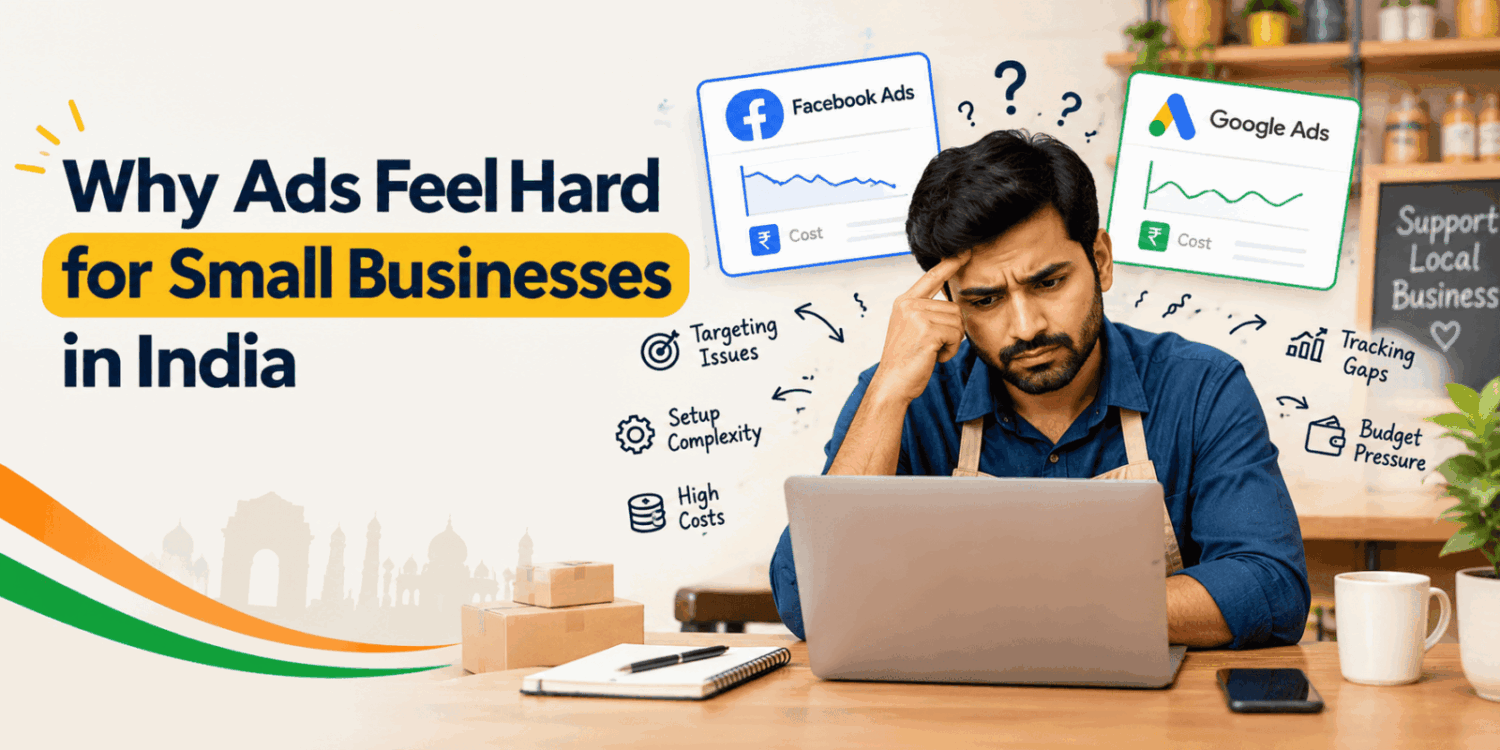
You turned on a campaign. You watched the budget drop. Sales did not follow.
If that sounds familiar, you are not alone. Thousands of Indian business owners try Facebook and Google Ads for small businesses every month, and many walk away frustrated. The ads are not broken. The platforms are not scams. But the way most small businesses set them up makes success much harder than it should be, with rules, costs, and quirks that generic tutorials rarely cover.
This guide breaks down why paid ads feel so costly and confusing in India, and what actually causes weak results. It is written for business owners and marketing managers who want plain answers, not more jargon. By the end, you will know exactly where your ad account is likely leaking money, and what to fix first.
Key Takeaways
- The platforms aren’t the problem. Most Indian small businesses lose money on setup, targeting, tracking, or budget mistakes, not on Google or Meta’s algorithms.
- India adds real complexity. An 18% GST charge on ad spend, iOS privacy limits, and a market split across languages and city tiers all raise the difficulty.
- Missing tracking is the biggest silent killer. Skip the Meta Pixel, Conversion API, or GA4, and the platform starts guessing instead of optimising for sales.
- Cash-on-delivery and WhatsApp orders often go untracked, which hides your true return on ad spend.
- Festive-season CPCs spike hard. Plan budgets ahead of Diwali and major sale events instead of reacting to rising costs.
- Fix tracking and targeting before you raise budget. More spend on a broken setup just loses money faster.
- Google Ads and Facebook Ads work best together, not as an either/or choice.
Why Online Advertising in India Feels So Hard Right Now
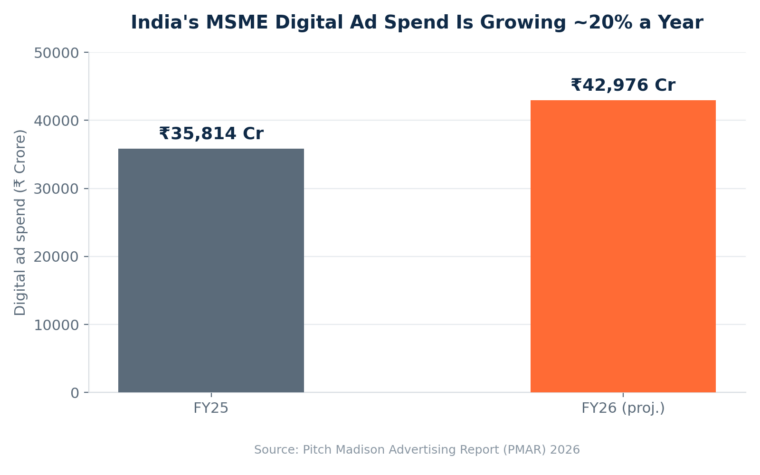
India’s digital ad market is booming. MSME digital ad spending is growing fast, projected to rise from ₹35,814 crore to ₹42,976 crore this year, according to the Pitch Madison Advertising Report 2026. More small businesses than ever are putting money into online advertising in India.
But more spending does not mean more skill. Most small business owners run one or two campaigns a year. Google and Meta update their platforms constantly. That gap between how often you advertise and how often the rules change is the root of most digital advertising challenges.
Add India-specific factors on top. There is an 18% GST charge on every rupee of ad spend. There are tighter iOS privacy rules that hide user data. And there is a market split across many languages and city tiers. None of this shows up in a generic “how to run Facebook ads” tutorial. It is why local guidance matters so much.
India is also not one market. A skincare brand in Mumbai and a hardware store in a Tier 3 town need very different campaigns, even on the same platform. Ad copy, payment options, and shopping times all shift by region. Owners who copy a generic template from a YouTube video miss this nuance, and results suffer.
The Real Reasons Ads Feel Costly and Complex
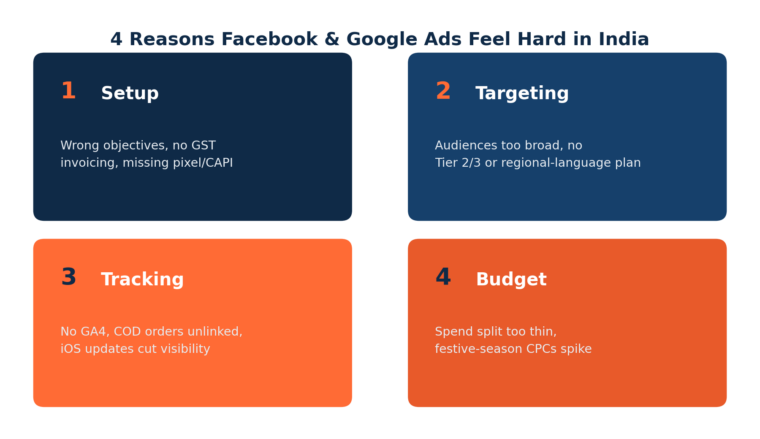
Most struggling ad accounts fail for one of four reasons: setup, targeting, tracking, or budget. Let’s look at each one.
1. Setup Mistakes That Start You Off Wrong
Most accounts go wrong before the first ad even runs. Business owners pick the wrong campaign objective, so the platform optimizes for clicks or views instead of sales. Business verification gets delayed because documents do not match. GST details are missing, so ad invoices cannot be used for input tax credit.
The biggest setup error is skipping the Meta Pixel or Conversion API, and the Google tag. Without these, the platform is advertising blind. It cannot learn who converts, so it cannot find more people like them.
2. Targeting That Is Too Broad or Too Narrow
Many owners either target all of India to “reach more people,” or narrow the audience so tightly that the algorithm cannot find enough buyers. Both waste money.
India adds complexity too. A single national campaign ignores how differently a metro buyer reacts compared to a Tier 2 or 3 buyer. Regional language, local pricing, and festival buying patterns all change what “good targeting” looks like. Specific, well-researched audiences win. Vague ones burn budget.
3. Tracking Gaps That Hide the Real Result
You cannot fix what you cannot see. This is where small business advertising in India runs into trouble most often.
Three tracking gaps show up again and again:
- No GA4 or conversion tracking connected to the website
- Cash-on-delivery and WhatsApp orders never linked back to the ad that drove them
- iOS privacy changes limiting how much Meta can see about user behavior
When tracking breaks, the ad platform’s algorithm loses its main signal. It starts guessing. Costs rise, and results get harder to explain to anyone checking the numbers.
4. Budget and Bidding Errors
Small budgets split across five platforms rarely work anywhere near their potential. Each channel needs enough spend and enough time to exit its learning phase and find a stable audience. Spread too thin, none of them ever get there.
Advertising costs and complexity also rise sharply during festive seasons, when every brand competes for the same shoppers. A ₹20 search click in a quiet month can jump well past that during Diwali. Owners who do not plan for this get blindsided and pull back at the worst possible time.
Common Myths That Make Ads Feel Harder Than They Are
A few beliefs quietly waste more budget than any algorithm change. It helps to clear these up before you touch your account again.
“A bigger budget fixes bad results.” More money on a broken setup just means faster, bigger losses. Fix tracking and targeting first, then scale spend once you see a real, repeatable return.
“Boosting a post is the same as running ads.” A boosted post optimizes for likes and reach. A properly built campaign, run from Meta Ads Manager with a clear objective, optimizes for the outcome you actually need, like a sale or a form fill.
“Google Ads and Facebook Ads are direct competitors, so pick one.” They usually work best together. Google Ads captures people already searching for what you sell. Facebook and Instagram Ads build awareness with people who have not started searching yet. Businesses that use both, with consistent messaging, tend to see steadier growth.
What This Actually Costs Small Businesses
Wasted ad spend is only part of the damage. Every rupee spent without a clear result also costs:
- Time the owner spends trying to “fix” a campaign without knowing what is broken
- Trust in digital advertising itself, which leads many businesses to quit paid ads entirely
- Growth, since a competitor with a working funnel keeps taking the customers you paid to reach
This is the real reason Facebook and Google Ads for small businesses get a bad reputation. The tools work. The way most accounts are built does not. Businesses that fix the fundamentals, even on a modest budget, usually see a very different outcome within a few months.
How to Make Facebook and Google Ads Work for Your Business
Fixing this does not require a huge budget. It requires the right order of operations.
- Fix tracking first. Set up GA4, the Meta Pixel, and Conversion API before spending another rupee.
- Pick one clear objective per campaign. Sales, leads, or awareness — never all three at once.
- Narrow your targeting with real data, not guesses, using past customers, location, and language.
- Set a realistic minimum budget per platform so each one can exit its learning phase.
- Review weekly, not daily. Campaigns need a few days of data before any signal appears.
- Plan for seasonal cost spikes ahead of festive shopping periods.
A short Google Ads or Facebook Ads audit usually reveals which of these six steps is missing. Most accounts are only missing one or two, not all of them.
Should You DIY or Hire an Expert?
If you have the time to learn the platforms properly, test creative weekly, and monitor GST-compliant billing, running ads yourself is possible. Many founders start this way.
But watch for two warning signs: rising spend with flat sales, or a report you cannot explain. In both cases, hiring a specialist is usually cheaper than guessing. Done right, Facebook and Google Ads for small businesses in India can be one of the most predictable ways to grow, not the most frustrating. Paid ads reward experience. A managed account, backed by proper SEO and a clear measurement plan, tends to outperform a DIY account running the same budget. If you are comparing agencies for this, our guide on what to check before hiring a digital marketing agency in India is a useful next read.
Why Trust This Guide
This guide draws on real account patterns we see across Indian small businesses, not generic global advice. TechEasify is a Google Partner-recognized agency based in Surat. Our team has managed Meta and Google Ads for 47+ active clients across fashion, wellness, real estate, and D2C brands, averaging a 3.5X return on ad spend through well-structured funnels. We have seen firsthand how fixing setup, targeting, and tracking, before touching budget, turns a struggling account around.
Get Ads That Actually Work for Your Business
Facebook and Google Ads are not the problem. Weak setup, loose targeting, broken tracking, and thin budgets are. Fix those four, and the same ₹1,000 you were “wasting” starts working for you instead.
If you want a second pair of eyes on your account, TechEasify offers a free consultation to review your current setup and show you exactly where the budget is leaking. Contact us today to get a free consultation.
Frequently Asked Questions
Why do Facebook and Google Ads feel so expensive for small businesses in India?
Rising CPCs during festive seasons, the 18% GST charged on ad spend, and budgets spread too thin across platforms all add real cost. Weak tracking makes it worse, since the algorithm cannot optimize toward actual sales.
How much should a small business budget for Google Ads or Facebook Ads in India?
There is no fixed minimum. But each platform needs enough daily budget to exit its learning phase. This is usually a few thousand rupees a day per campaign, depending on your industry and city tier.
Why do my ads get clicks but no sales?
This usually points to a tracking or targeting gap. Check that your Pixel, Conversion API, and GA4 are firing correctly, and confirm your landing page matches what the ad promised.
Is it worth hiring an agency instead of running ads myself?
If you lack the time to test, track, and optimise weekly, a specialist agency usually earns back its fee through lower wasted spend and faster learning-phase completion.
Does GST apply to my Google Ads or Facebook Ads spend in India?
Yes. Google Ads and Meta both charge 18% GST on ad spend billed in India. Registered businesses can typically claim this as input tax credit, so keep your GSTIN updated in your ad account billing settings.