You built a clean online store. You wrote product descriptions. You even started a blog. Six months later, your organic traffic has barely moved.
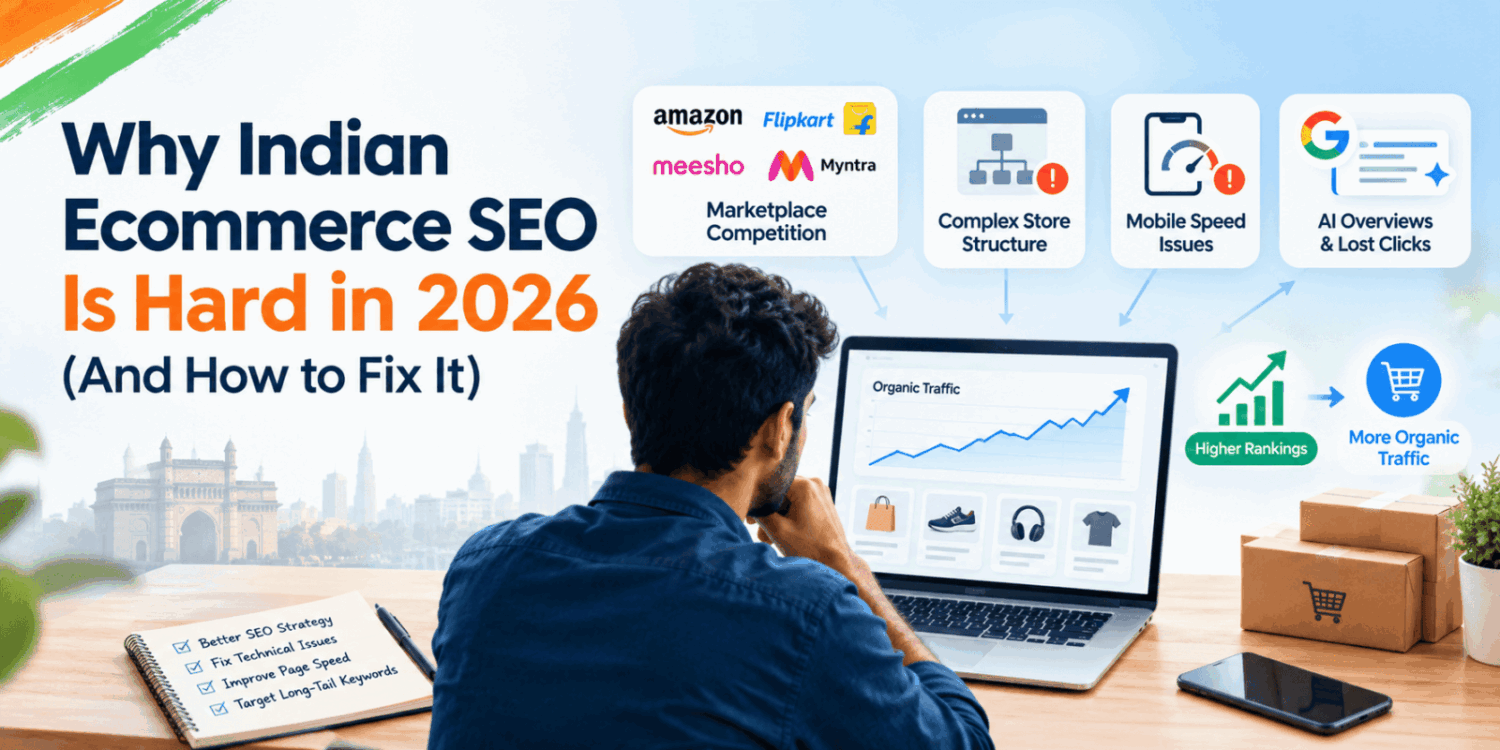
You are not doing something wrong. SEO for Indian e-commerce is genuinely harder than SEO for almost any other business type, and 2026 has made it harder still. Between marketplace giants, slow mobile sites, and Google’s AI Overviews eating clicks before shoppers even reach your store, the old playbook does not work anymore.
This guide breaks down exactly why Indian online stores struggle to rank, backed by real 2026 data. Then it gives you practical fixes you can act on this month.
Key Takeaways
- Google controls 97.76% of India’s search market, so any ranking drop hits your store immediately, with no other search engine to fall back on.
- Indian e-commerce stores compete directly with Amazon, Flipkart, Meesho, Myntra, and Nykaa for most product keywords, not just other small stores.
- Faceted navigation can generate millions of crawlable URLs from filter combinations, wasting Google’s crawl budget and delaying how fast new products and price changes get indexed.
- Only about 39% of Indian e-commerce sites pass Core Web Vitals on mobile, where 70 to 75% of traffic actually happens.
- AI Overviews now appear on roughly 28 to 47% of product research queries in India, cutting organic clicks on generic content by 15 to 22%.
- Fixing crawl budget and technical issues comes before publishing more content, since Google can’t rank pages it hasn’t properly discovered yet.

Why SEO for Indian E-commerce Feels Like an Uphill Battle
India’s search market runs almost entirely on one platform. Google holds 97.76% of the search market share in India as of August 2026. That sounds simple. It is not.
When one search engine controls nearly all discovery, every algorithm update, every AI feature rollout, and every ranking shift hits Indian online stores at full force. There is no fallback traffic from Bing or Yahoo to soften the blow. If your search engine rankings slip on Google, your organic traffic drops immediately, and there is nowhere else to recover it from.
That concentration is just the first layer. Underneath it sit five structural barriers that make e-commerce SEO in India uniquely difficult right now.
Barrier 1: You’re Not Competing With Stores. You’re Competing With Amazon
Most SEO advice assumes you are fighting other small stores for rankings. In India, you are fighting Amazon, Flipkart, Meesho, Myntra, and Nykaa for nearly every commercial keyword.
These platforms carry enormous domain authority. Google’s algorithms have leaned harder into brand trust signals to fight spam, which means marketplace giants often outrank smaller stores even when your page speed, content, and technical setup are better. A well-optimized product page from a new D2C brand can still lose to a thin Amazon listing simply because Amazon has decades of accumulated trust.
This is why broad keywords like “buy running shoes online” rarely work for smaller Indian stores. Long-tail, specific searches, such as a exact product name plus size or city, are more realistic targets while your domain builds authority.
Barrier 2: Your Store’s Own Structure Works Against You
Here is something most founders never check: how many URLs does your store actually generate?
Take a clothing store with four filters, sixty categories, and a handful of sort options. Size, color, brand, and price band combinations alone can create hundreds of thousands, even millions, of crawlable URLs. Add pagination and sorting, and a store with 4,000 real products can generate over ten million crawlable pages.
Googlebot has a limited crawl budget. If it spends that budget crawling filter combinations instead of your actual products, your new listings take weeks to get discovered, and your price updates sit stale in search results. This single issue is one of the most common, and most invisible, causes of poor rankings for Indian online stores.
Other structural problems stack on top of this:
- Duplicate content from filtered URLs, sorted views, and variant pages
- Broken product lifecycle handling, where discontinued products get deleted instead of redirected, wiping out link equity they earned over years
- Missing or invalid schema markup, often because Indian catalogs lack GTINs and nobody sets up SKU, MPN, or brand attributes correctly instead
- Deep click depth, where products sit six or more clicks from the homepage, a signal Google reads as low importance
None of this shows up in a normal audit unless you specifically dig for it. And no amount of blog content fixes a technical foundation that is actively working against you.
Barrier 3: Mobile Speed Kills Rankings Before Content Even Matters

Roughly 70 to 75 percent of Indian e-commerce traffic happens on mobile. That should push every store to prioritize mobile speed. Most do not.
Real-world testing on Indian websites in 2026 found a median mobile Largest Contentful Paint of 4.2 seconds and a median mobile Interaction to Next Paint of 380 milliseconds. Compare that to Google’s own “good” thresholds under its Core Web Vitals guidelines: LCP under 2.5 seconds, INP under 200 milliseconds, and CLS under 0.1. Indian mobile sites are missing every single one on average.
Only about 39 percent of e-commerce sites pass all three Core Web Vitals on mobile. That gap matters more than most founders realize, because mobile performance is now 40 to 60 percent worse than desktop performance on the same store, according to 2026 benchmarking data. Payment widgets for UPI and cash-on-delivery flows add to the load, since Indian shoppers on mid-range Android phones and weaker connections abandon slow pages fast.
If your product pages load slowly on a real Android phone over 4G, and not on your office laptop over office Wi-Fi, that is the version Google actually judges.
Barrier 4: AI Overviews Are Eating Your Clicks
This is the newest, and most underestimated, challenge facing Indian online stores.
Google’s AI Overviews now appear on a meaningful share of shopping and informational queries, and they are growing fast. Search Engine Land reported AI Overviews on shopping queries jumped from 2.1 percent in late 2025 to 14 percent by March 2026. Indian data shows AI Overviews appearing on roughly 28 to 47 percent of informational and product-research queries.
The effect on organic traffic is direct. Indian websites have seen average traffic declines of around 22 percent on queries where an AI Overview appears, with e-commerce product research pages losing 15 to 22 percent of clicks. Even when your search engine rankings hold steady, a top-three position can lose meaningful click-through rate simply because Google answers the question before the searcher scrolls down.
The takeaway is not to give up on SEO. It is that generic, commodity-style content gets absorbed into AI summaries with no credit to you. Pages that add something an AI answer cannot easily replicate, like original comparisons, real pricing, and specific local detail, are the ones that still earn the click.
Barrier 5: Indian Shoppers Search and Trust Differently
Search intent in India does not map cleanly to Western SEO playbooks. Shoppers search in English, Hinglish, and regional languages, sometimes in the same session. A meaningful share of purchase intent shows up in local, near-me style queries even for products that end up bought online.
Trust is also a live SEO issue, not just a checkout issue. Cash on delivery still makes up a large share of transactions in Tier-2 and Tier-3 cities, which means shoppers researching a purchase are also quietly evaluating whether your store is safe to buy from. Return policy visibility, real reviews, and clear customer service pages all function as trust signals that affect both conversion and, indirectly, how long visitors stay engaged with your site.
How to Fix These SEO Challenges and Grow Organic Traffic
None of these barriers are permanent. Here is where to start, in order of impact.
Priority | Fix | Why It Matters |
1 | Audit crawl budget and block low-value filter URLs | Stops Google wasting time on pages that will never rank |
2 | Fix Core Web Vitals on real mid-range Android devices | Directly affects both rankings and mobile conversion |
3 | Add proper canonical tags and product schema | Reduces duplicate content and improves rich result eligibility |
4 | Redirect, don’t delete, discontinued products | Preserves link equity your pages already earned |
5 | Target long-tail, specific keywords over broad head terms | Realistic ranking chances against marketplace giants |
6 | Build original, comparison-style content | Content AI Overviews can’t easily replace |
7 | Strengthen trust signals: reviews, policies, local proof | Improves both SEO engagement and conversion |
Most Indian stores treat these as a one-time project. They are not. Industry guidance in 2026 suggests allocating 5 to 10 percent of digital revenue to ongoing SEO work, because algorithms, AI search features, and marketplace competition keep shifting.
If you want a clear read on where your own store stands before committing budget, our team breaks down how to evaluate local SEO services in India and what a credible engagement should actually include.
Ready to Fix What’s Actually Holding Your Store Back?
Guessing at fixes wastes months you don’t have. A proper audit shows you exactly which of these barriers is costing you the most organic traffic, and in what order to fix them.
Get a Free Website Audit with TechEasify and find out what’s really capping your search engine rankings.
Frequently Asked Questions
Why is SEO for Indian e-commerce harder than regular SEO?
E-commerce sites have thousands of product and category pages, constant inventory changes, and faceted navigation that generates millions of extra URLs. Indian stores also compete directly against Amazon, Flipkart, and Meesho for the same search terms, which regular content sites don’t face.
How long does it take to see results from e-commerce SEO in India?
Most stores start seeing measurable movement in organic traffic within three to six months, once technical issues are fixed and category pages are properly optimized. Full authority-building against marketplace competitors can take 12 to 24 months.
Do AI Overviews mean SEO is no longer worth it?
No. AI Overviews reduce clicks on generic, commodity content, but original comparisons, real pricing, and detailed local content still get cited and clicked. SEO shifts toward depth and originality rather than disappearing.
What’s the single biggest SEO mistake Indian online stores make?
Writing more content before fixing crawl budget and duplicate content issues. If Googlebot is wasting its budget on filter URLs, new blog posts and product pages won’t get discovered quickly, no matter how good they are.
Should a small D2C brand focus on product pages or category pages first?
Category pages usually deliver the highest return, since they target higher-volume commercial keywords and don’t compete with your own product pages for the same search terms.