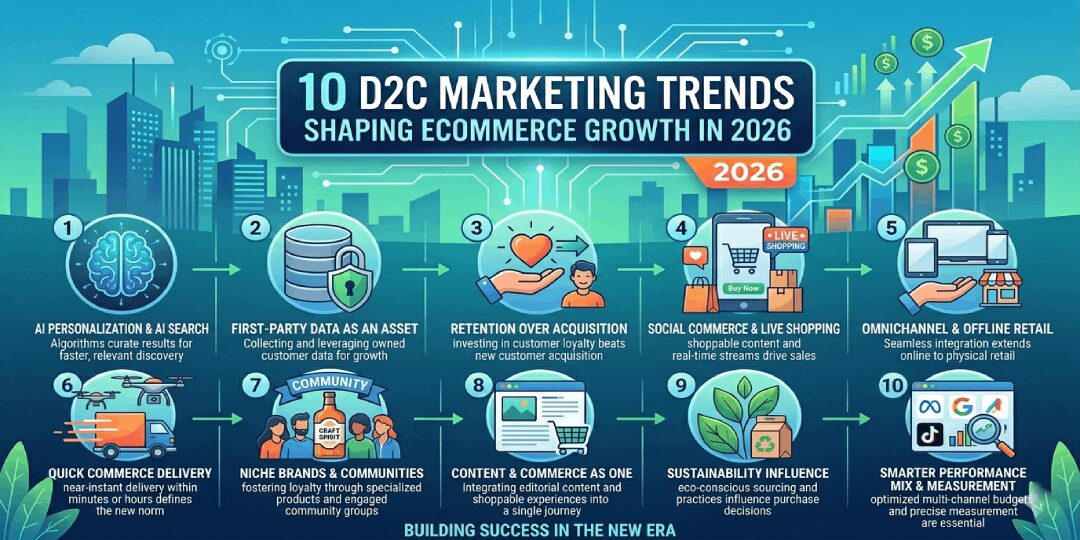
India’s digital commerce market is projected to reach $185.1 billion in 2026, and D2C brands are a big reason why. According to Future Market Insights, India’s digital commerce market is expected to hit USD 185.1 billion in 2026. These 10 D2C Marketing Trends matter now because your brand is selling in a harder market, where customer acquisition cost (CAC, the cost to win one new customer) is rising, AI is changing discovery, and buyers expect faster delivery with less friction.
D2C marketing is simple. You sell directly to your customer, without depending fully on retailers or marketplaces. That gives you more control, but it also puts more pressure on your website, content, retention, and paid media.
TL;DR
- AI personalization and AI search are changing discovery
- First-party data is becoming your best growth asset
- Retention is beating acquisition
- Social commerce and live shopping are driving sales
- Omnichannel growth now includes offline retail
- Quick commerce is shaping delivery expectations
- Niche brands and communities are winning loyalty
- Content and commerce now work as one journey
- Sustainability is influencing purchase decisions
- Performance marketing needs a smarter mix and better measurement
Author note: This piece is written for founders, ecommerce managers, and growth teams building D2C brands in India.
Techeasify works with D2C brands across ecommerce, SEO, and growth campaigns, so the patterns below come from active market shifts, not theory.
What is D2C marketing, and why is 2026 a make-or-break year?
If you’ve asked what is d2c marketing, the short answer is this, you sell straight to the buyer through your own channels. That usually means your website, email, SMS, social storefronts, and branded experiences.
The model is growing fast. India’s D2C segment is expected to hit $60 billion by 2030, and reports say it’s growing about 3 times faster than overall ecommerce. A recent industry report from The Statesman also notes that India’s D2C ecommerce could reach $55 to $60 billion by 2030.
At the same time, profitable growth is harder. Paid media costs more. Tracking is weaker. Privacy standards are tighter. Your margins can disappear fast if you rely on one channel.
The takeaway, growth is still there, but cheap growth isn’t.
The big shift from easy growth to smarter, owned growth
A few years ago, paid social could carry the whole plan. Now it can’t. You need first-party data, stronger retention, and a sharper reason to choose your brand.
Owned growth wins because you control it. Your list, your store, your repeat buyers, and your positioning are harder to copy.
10 D2C Marketing Trends shaping ecommerce in 2026
These are the shifts to watch if you want stronger margins, better customer experience, and more stable growth.
AI personalization and AI search are changing how customers discover products
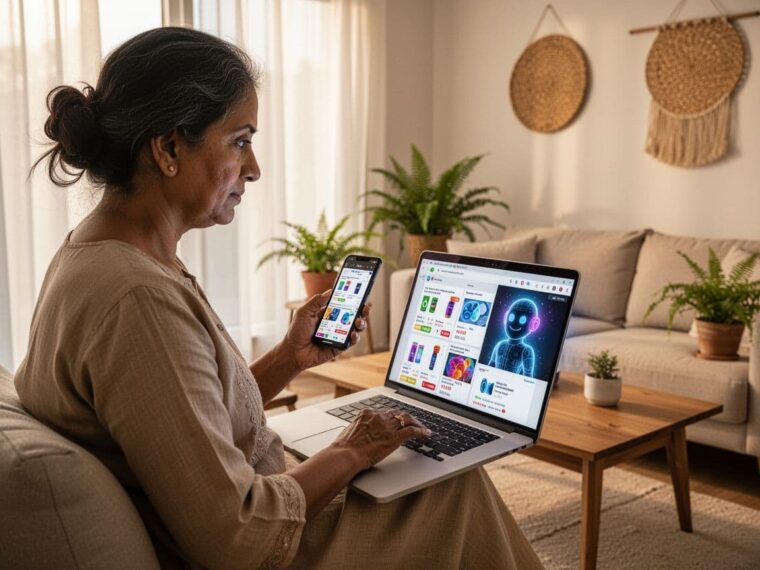
One of the biggest D2C Marketing Trends is this, shoppers no longer start only on Google. They ask ChatGPT, Perplexity, and AI-powered search tools for comparisons, reviews, and product fits.
That changes what your product pages need to do. Clear benefits, strong FAQs, plain-language specs, and real buying answers now matter more. You should also track AI-referred traffic separately, because it behaves differently from search and paid clicks.
Action tip: Rewrite your top product pages to answer the exact questions buyers ask AI tools.
First-party data is becoming your most valuable growth asset

Third-party cookies keep losing value, so your owned data matters more. That includes email subscribers, SMS opt-ins, purchase history, quiz responses, and loyalty behavior.
This makes your D2C marketing strategy more stable. A simple funnel can start with a skin quiz, move into an email offer, and then push a second-purchase reminder. Because the data is permission-based, it also fits stricter privacy expectations.
Action tip: Build one first-party capture path on every key landing page.
Retention is beating acquisition as ad costs keep rising

CAC has climbed for many D2C brands since 2023, so your repeat buyers now carry more of your profit. That’s why retention is back at the center.
A well-known benchmark still holds up, a 5% increase in retention can lift profits by 25% to 95%. Brands like Mamaearth helped normalize repeat-friendly categories, where reminders, bundles, and subscriptions make sense. Your tools here are simple, welcome flows, loyalty points, refill nudges, and post-purchase upsells.
Action tip: Fix your post-purchase journey before adding more top-of-funnel spend.
Social commerce and live shopping are turning content into checkout

Instagram Reels, YouTube Shorts, and WhatsApp are no longer only awareness channels. They now act like storefronts. Social commerce GMV is projected to grow from $5.37 billion in 2023 to $25.69 billion by 2029.
Live shopping works because it reduces doubt in real time. Demos, urgency, and instant replies help buyers move faster than they do on a static product page.
Action tip: Make your next creator video shoppable with product tags and a clear buy path.
Omnichannel D2C Marketing Trends are pushing brands offline too

Online-first brands are opening pop-ups, kiosks, and experience-led stores because trust still grows faster in person. Lenskart showed this well by blending digital discovery with offline trial and service.
Offline doesn’t replace ecommerce. It supports it. In categories with fit or feel concerns, AR try-ons and stores work together to lower hesitation and raise conversion.
Action tip: Test one temporary offline format before committing to a full retail rollout.
Quick commerce and faster delivery are becoming part of the brand promise
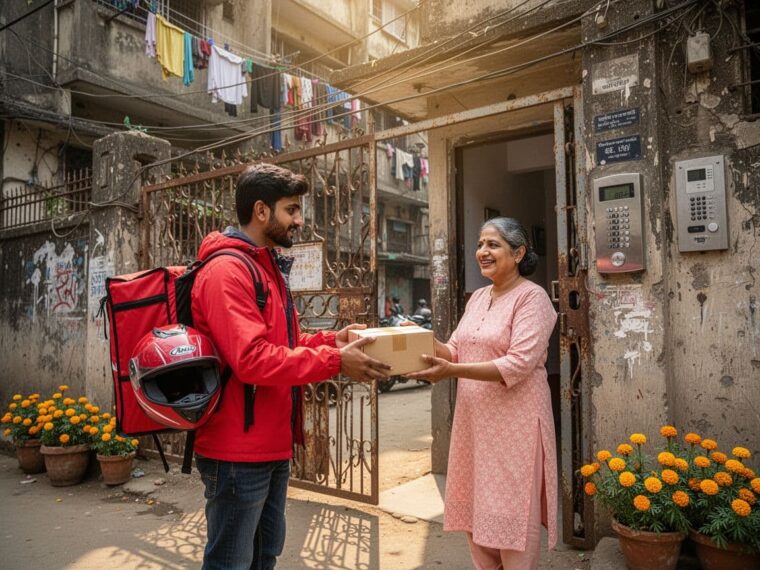
In major Indian cities, fast delivery now shapes brand perception. That matters most in beauty, food, wellness, and daily-use products.
Quick commerce partnerships, micro-fulfillment, and ONDC (Open Network for Digital Commerce, India’s open digital commerce network) can help you reach this demand without building everything yourself. Fast delivery is now part of the experience, not only an ops choice.
Action tip: Match your delivery promise to your category, city mix, and reorder cycle.
Niche brands and strong communities are winning more loyalty than mass-market messaging

Broad messaging gets ignored. Focus wins. Brands like SNITCH, boAt, and Bewakoof grew by standing for something specific, style, identity, price-value, or culture.
Community-led growth is also getting stronger in Tier 2 and Tier 3 markets. User-generated content, private groups, regional creators, and shared values can turn buyers into advocates.
Action tip: Build your brand around a clear tribe, not a generic audience.
Content and commerce are blending into one customer journey

Your blog, buying guides, landing pages, creator clips, and reviews now do one job together, move people closer to purchase. Helpful content brings in better-intent traffic, which can lower CAC over time.
That means you can’t publish filler. You need real answers to buying questions, comparison pages, and product education. If you’re tightening your organic strategy, this ecommerce SEO guide 2026 is a useful next read.
Action tip: Audit your content by one metric, does it reduce buying hesitation?
Sustainability is becoming a real buying factor, not just a brand story
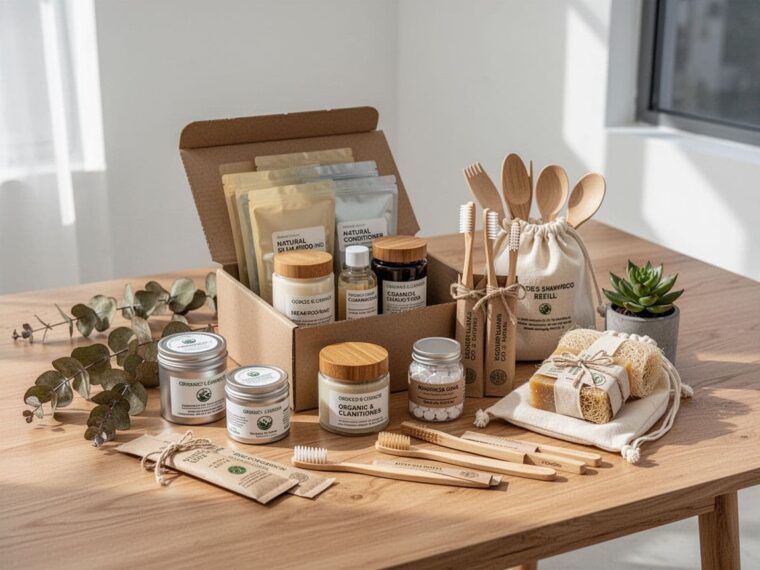
Many younger shoppers now look at packaging, sourcing, and product transparency before they buy. They can also spot weak claims quickly.
That puts pressure on your brand to be clear. Recyclable packaging, refill options, repair support, and honest sourcing notes work better than vague “eco-friendly” language.
Action tip: Make one measurable sustainability claim and prove it clearly on-site.
Performance marketing is shifting from channel dependence to smarter mix and measurement
If most of your revenue still depends on one paid channel, you’re exposed. Tracking is less clean now, and media costs can change fast.
A better mix might include Meta, Google, YouTube Shorts, influencers, affiliates, email, and WhatsApp. You should judge performance by contribution margin, LTV (lifetime value, the revenue a customer brings over time), and repeat purchase rate, not only ROAS. If you’re reviewing partners, this guide to performance marketing for D2C brands can help.
Action tip: Shift budget using margin and repeat-rate data, not only last-click returns.
How to turn these D2C Marketing Trends into a practical growth plan
Your priority depends on your stage. If you’re new, get the basics right first, clear positioning, a conversion-ready store, and strong first-party capture. A weak site makes every channel more expensive, so solid website development company in India support can matter more than one more campaign.
If you’re scaling, focus on retention systems, diversified paid media, and social commerce. That’s where your d2c brand growth strategy starts to stabilize. If you’re mature, push into omnichannel, AI-led personalization, and tighter measurement across channels.
Techeasify has seen brands improve LTV simply by fixing the store journey, email flows, and channel mix together. That’s often the difference between noisy growth and profitable growth.
The takeaway, don’t chase every trend, build the stack that fits your stage.
FAQs about D2C marketing in 2026
What is D2C marketing?
D2C marketing is how you attract, convert, and retain customers when you sell directly through your own channels. That includes your website, email, SMS, social commerce, and paid media.
Why does D2C marketing matter more in 2026?
It matters more because discovery is changing, privacy is tighter, and ad costs are harder to control. If you own your audience and buying journey, you protect your margins better.
What should a D2C marketing strategy include?
Your strategy should cover positioning, website conversion, first-party data capture, retention, content, paid acquisition, and measurement. The strongest plans connect these parts instead of treating them separately.
How big is the India D2C market in 2026?
Exact full-market estimates vary by source, but India’s wider digital commerce market is projected at $185.1 billion in 2026. D2C is expected to grow to $60 billion by 2030, outpacing overall ecommerce.
What does a D2C marketing agency do?
A D2C marketing agency helps you grow through strategy, paid media, SEO, content, retention, analytics, and store optimization. The best teams tie acquisition and retention to profit, not vanity metrics.
The brands that win in 2026 won’t be the loudest. They’ll be the ones that own customer data, improve retention, diversify acquisition, and make buying easier at every step. That’s the real shift behind these 10 D2C Marketing Trends.
India still offers a massive runway for D2C growth. If your brand needs sharper strategy, stronger ecommerce execution, or better SEO and performance support, Techeasify is a practical partner to have in the room.