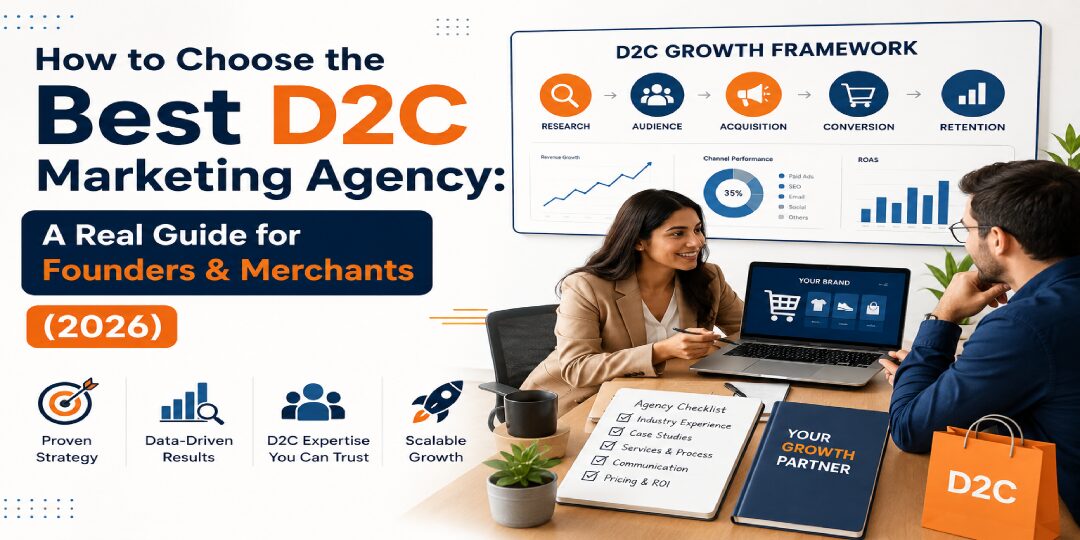
Look, picking a d2c marketing agency isn’t just about who has the fanciest deck. Your choice directly impacts your customer acquisition costs, conversion rates, how many people actually come back to buy again, and whether your brand actually grows or stalls.
If you’re a founder, a Shopify merchant, or leading marketing at a brand in India, you know this already. You need someone who actually gets your store, understands your product margins, knows your customers. And yeah, fees are all over the place. One agency might charge ₹25K a month for a single channel. Another wants ₹2L+ for full-service work. The difference comes down to who they’re working with, what they’re doing, and how transparent they are about it.
The best decision doesn’t come from picking whoever sounds the most impressive. It comes from comparing their actual process, what they’ll report to you, how they price things, what the contract says, and whether you actually feel like they get your business.
Key Takeaways
- You need someone who understands the full picture: getting customers, converting them, keeping them coming back, and calculating lifetime value.
- Before you sign anything, make sure they know Shopify, can read analytics, can manage creative work, handle SEO, and understand CRM stuff.
- Get crystal clear on your KPIs, who actually owns your accounts, how often you’ll hear from them, and how you can get out if it isn’t working.
- Agency retainers aren’t the only cost — add your ad spend, any creative work, Shopify tweaks, and tools. Compare the total picture, not just the monthly fee.
- Use your first 90 days to test things, actually learn what works, and build a plan that makes sense for your growth.
What Does a D2C Marketing Agency Actually Do?
So here’s the thing about D2C. You’re selling straight to customers through stuff you control: your website, your Shopify store, your email list, maybe WhatsApp, your social accounts. You’re not leaning on Amazon or Flipkart or someone else’s platform to do the selling for you.
A typical digital marketing agency? They throw ads at the problem and count clicks. An ecommerce agency might focus on getting sales in the store and call it a day. But a real D2C specialist — they’re thinking about the whole journey. Getting people to know you exist. Getting them to actually buy. Making them want to come back again and again.
The good ones connect the dots. They look at where you’re getting customers from, how much it costs to get them, whether they convert on your site, whether they stick around, and what they’re worth over time. One channel can look great on paper while the rest of your business quietly falls apart. A solid D2C partner doesn’t let that happen.

Why D2C Marketing Really Needs Someone Who Knows What They’re Doing
Here’s where it gets real. D2C doesn’t give you much wiggle room for sloppy work. You can have an incredible Meta ad, but if your product page loads slowly or doesn’t explain what you’re selling, no one’s buying. You could have amazing SEO content that ranks perfectly, but if your offer sucks, it doesn’t matter. You might see great return on ad spend in one month and completely miss that your margins are thin or people never buy twice.
And then there’s the privacy stuff. Apple’s privacy changes, Google phasing out cookies — it’s made clean data harder to come by. You need people who understand how to track things properly using your first-party data. They should know product feeds, landing pages, how to test different creative approaches, email sequences, why people abandon their carts, and how to group customers by behavior.
| Option | What they focus on | The blind spot |
|---|---|---|
| General digital agency | Getting eyeballs on your brand online | Doesn’t really understand how ecommerce margins work |
| D2C marketing agency | Growing your owned channels and repeat customers | Needs you to give them store access and customer data to work well |
| In-house team | Building your brand the way you want it | Takes time to hire the right people across multiple skills |
You can check out how Techeasify thinks about ecommerce growth. They also do ecommerce development services if your store needs marketing and technical work at the same time.
When You Probably Need an Outside Agency
When is it time to bring someone in? Honestly, when your sales are bouncing all over the place. When you’re spending more to get each customer but your sales aren’t going up. When people buy once and never come back. When you don’t have good tracking data. When your Shopify store feels stuck.
Also if you don’t have the skills in-house, or you literally don’t have time to test new creative or try different channels, that’s a sign you need help.
A freelancer works great if you need one thing done well, like running your Meta ads or managing your email list. But when paid ads, conversion optimization, analytics, keeping customers, and store improvements all need to happen together? That’s when an agency makes more sense.
What Services Should Actually Be on the Table
Don’t get distracted by how many services an agency lists. The real question is whether they actually work together.
If they’re running your Meta and Google ads, those ads should be sending the right people to the right pages. If they’re doing SEO, it should help people find your product pages and category pages organically. If they’re managing email, it should be bringing past customers back for repeat purchases.
Here’s what usually matters:
- Performance marketing — finding new customers through paid ads and testing what actually works.
- SEO and content — getting people to find you organically when they’re searching for products you sell.
- Conversion optimization — making sure your product pages, cart, and checkout don’t scare people away.
- Email, SMS, and CRM — keeping customers coming back after their first order.
- Marketplace strategy and feeds — if you’re on Amazon, Flipkart, etc., managing that stuff too.
- Analytics — knowing what’s working and what isn’t.
- Shopify work — sometimes your store just needs tweaks to convert better.
Now, creative design, serious Shopify development, and tools like Klaviyo for email might not be included in the base fee. Ask exactly what you’re paying for before you sign anything. Your ad traffic, your product feed, your customer data, your landing pages, and your retention campaigns shouldn’t feel like they’re completely separate from each other.
How They Should Actually Report Your Results
Okay, here’s something a lot of agencies get wrong. They show you traffic numbers and follower counts. Those don’t pay your bills.
What actually matters? Your conversion rate. How much you’re spending to get a customer. How much profit you’re actually making on ads. Your average order value. How many people buy from you twice. What a customer is worth over their lifetime. How much revenue comes from email. How much from organic search. Why people are leaving at checkout. Your actual profit margin per customer.
You want reporting that breaks down by channel, by campaign, by product, by who’s buying. New customers versus repeat customers — those should be separate. Before any work starts, you should know your baseline numbers. Then you want a dashboard you can check weekly and a real conversation monthly about what’s working.
Here’s the thing: a campaign can look amazing in isolation. Solid return on ad spend, lots of orders coming in. But if people are returning products, you’re discounting everything, shipping costs are killing you, and nobody’s buying a second time? That campaign isn’t actually working.
How to Actually Choose a D2C Marketing Agency
Picking the best d2c marketing agency isn’t about picking the most famous one. It’s about fit. A skincare brand, a fashion label, and a consumer electronics company all have different creative needs, different buying cycles, different repeat purchase patterns. What works for one might flop for another.
Here’s what I’d do: make a quick scorecard. Five things: strategy, execution, measurement, communication, and whether they actually get your business. Rate each one 1-5 after every conversation with an agency.
Look for people who’ve actually worked with ecommerce brands. Who know Shopify inside and out. Who have clear team roles so you know who you’re actually working with every day. Who communicate straight with you. Who use tools that make sense for your business.
Ask who’s going to be on your account day-to-day. Senior sales people give nice presentations. But if you never hear from them again after signing, that’s a problem.
When they show you case studies, don’t just look at the percentages. Look at what the situation was when they started. How much they spent. How long they worked. What they actually did. What the actual results were. A “200% increase” means nothing without context.

Questions You Should Actually Ask
When you’re talking to an agency, ask stuff that shows how they actually think:
- Walk me through how you’d audit our store, our tracking, our offer, and our customer data.
- If you were looking at our business right now, which channels would you focus on first? Why those?
- What does the first 30 days actually look like with you?
- How do you test ad creative? Like, what’s the actual process for deciding what to scale?
- How are you going to handle tracking across Meta, Google, Shopify, and our CRM?
- What paid tools or apps are we going to need to have?
- Who owns our ad accounts, our tracking pixels, our customer data, and our creative files when this is done?
- How often are we actually talking? Weekly meetings? Monthly reviews? What does communication look like?
- If we need to pivot or our budget changes, how does that work?
- How are you defining success? It’s not just revenue, right?
The answers matter more than the questions themselves.
Agency vs. Freelancer vs. Building a Team In-House
| Choice | Cost | When this makes sense |
|---|---|---|
| Freelancer | Hourly, project-based, or monthly | You need one specific skill for a focused project |
| Your own team | Salaries, benefits, tools, training | You’ve got the management bandwidth and want full control |
| Agency | Monthly retainer, project fees, or tied to ad spend | You need multiple skills at the same time |
Real talk: a freelancer can move fast on a narrow job. An in-house team means you own everything, but it takes time to hire and manage. An agency brings breadth and experience, plus they’ve seen what works and what doesn’t at other companies.
Pick based on your actual goals, your budget, and what you can realistically handle internally.
Red Flags You Should Actually Walk Away From
If an agency promises you guaranteed results, don’t even listen anymore. Nobody controls whether your product-market fit actually works. Nobody controls stock, competitor moves, platform updates, or algorithm changes. Anyone promising that is lying.
Watch out for vague deliverables. If you can’t write it down, you can’t measure it. Copied strategies. Vanity metrics (traffic and followers don’t equal sales). Prices that seem impossibly cheap. Pressure to run every channel at once when you’re not ready. Contracts that lock you in forever with no way out.
You should own your ad accounts, your data, your pixels, everything. If an agency is keeping you hostage with access, that’s sketchy. A good partner is straight about assumptions, budget limits, what could go wrong, how long testing takes, and what’s honestly out of their hands.
Before you sign anything, get it in writing: what you’re getting, who approves what, how you can exit, what happens to your data and accounts. And ask to see a sample of their reports.
How Much Will a D2C Marketing Agency Actually Cost?
First thing: agency fees and your ad spend are different costs. Your actual budget might also include creative work, Shopify development, email tools like Klaviyo, content production, or influencer work.
Based on what we’re seeing in 2026 India, here’s the ballpark (and I’m being honest that these are broad ranges, not guarantees):
- Single-channel work usually runs around ₹25,000 to ₹80,000 monthly.
- Growth programs usually fall around ₹80,000 to ₹1.5 lakh monthly.
- Full-service or scale programs often run ₹1.5 lakh to ₹6 lakh or more monthly.
They might charge you a flat monthly retainer, a percentage of what you’re spending on ads, a hybrid setup, or project-based fees. Costs go up when you add channels, increase your ad budget, need more creative production, have a huge catalog, want detailed reporting, have technical complexity, or are expanding to new markets.
Here’s what matters: compare total cost (retainer plus spending plus tools) against what you’re actually getting and what it should do for your business. The cheapest option isn’t always the cheapest if you end up with weak strategy, bad reporting, and nothing to show for it.
Your First 90 Days With a New Agency Should Look Like This
Month 1 (Days 1-30): They should be doing audits. Your store. Your tracking. Your customers. Your offer. Your competition. They’re getting access to everything. They’re checking whether your reporting is even working. They’re taking baseline measurements so you know where you started.
Month 2 (Days 31-60): Now the actual work starts. Paid campaigns launching. Product pages getting improved. Creative tests running. Email flows being built. SEO priorities being mapped out. You should be getting real findings, not just promises.
Month 3 (Days 61-90): By now, they should have data. They’re making actual decisions about which channels to prioritize and how much to spend. You should have a plan for keeping customers. A clearer process for testing. A growth roadmap for the next quarter.
Be realistic though. Paid ads can show you signals quickly. SEO takes time. Getting people to come back takes consistent effort. Don’t expect everything to work overnight.
Why Some Businesses Work With Techeasify
Techeasify is one option worth evaluating if you need help across website development, ecommerce marketing, SEO, paid traffic, converting visitors, and keeping customers.
They bring custom growth strategy, ecommerce experience, Shopify knowledge, an SEO-first mindset, and focus on actual performance. If your store needs technical fixes before paid traffic will actually convert, their Shopify development experts can review your foundation first.
But honestly, before you pick any partner — check their process, their relevant experience, their reporting style, who’s actually on your team, and what’s included. You can also request a free consultation to talk through a D2C growth audit and what matters to you right now.
Frequently Asked Questions
What is a D2C marketing agency?
It’s a team that helps consumer brands get customers, convert them, and keep them coming back through channels you own. Usually that means your website, your Shopify store, email, social, etc. They focus on strategy, traffic, conversions, analytics, and retention.
How is a D2C marketing agency different from a digital marketing agency?
A regular digital agency does broad online marketing stuff. A D2C specialist gets into the specific ecommerce world: product pages, repeat customers, profit margins, lifetime value, first-party data. It’s a different focus.
How do you choose the best D2C marketing agency?
Look at experience with ecommerce brands, their working process, which KPIs they care about, how transparent their reporting is, who owns your accounts, how they communicate, and what they charge. Check evidence and methods, not just nice presentations.
What services should a D2C marketing agency provide?
Most brands need a mix: SEO, paid ads, social, email and CRM, content, conversion optimization, analytics, possibly Shopify work, possibly marketplace management. The right combo depends on your stage and goals.
How long does D2C marketing take to show results?
It depends. Your offer, your budget, competition, site quality, existing data. Paid ads can show early signals fast. SEO, getting repeat customers, building brand trust — those take longer.
Is SEO important for D2C brands?
Yeah, it matters. It reduces how much you need to spend on paid ads. It helps your product pages and categories get found by people actively searching. It works best with good site structure, honest content, and a solid store experience.
Pick Based on Fit, Not Hype
The right d2c marketing agency should actually understand your goals, your store, your margins, your customer journey. Look for full-funnel thinking, ecommerce and Shopify expertise, clear KPIs, honest pricing, you owning your data, and a real onboarding plan that makes sense.
The cheapest retainer isn’t always the best deal. Bad strategy, unclear reporting, and poor execution cost way more than paying a stronger partner.
Spend time comparing your options, then talk to people who can actually explain how they’d approach growing your business.