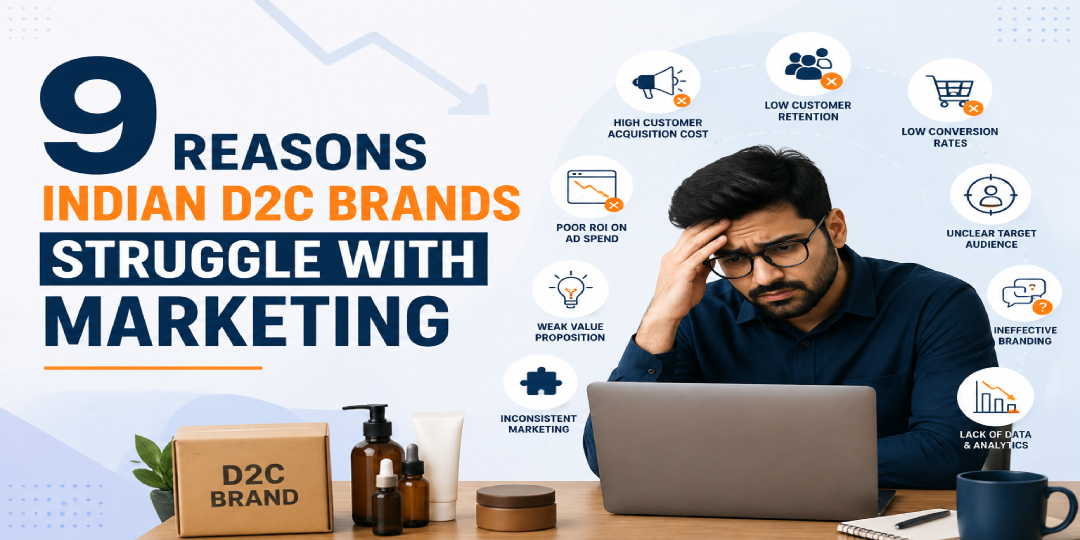
You may be running SEO, Instagram, Meta Ads, Google Ads, influencers, email, WhatsApp, and marketplace campaigns, yet CAC keeps rising, ROAS moves without warning, and customers don’t remember your brand. More channels won’t fix that.
The real issue is usually disconnected execution. Digital marketing for Indian D2C brands works when every channel supports the same customer journey, message, and business goal.
- Connect channels instead of managing them separately.
- Build brand demand alongside paid acquisition.
- Track purchases, profitability, and repeat behavior.
- Test creative with a clear learning process.
- Measure sustainable growth, not platform vanity metrics.
Why Indian D2C Brands Struggle With Marketing
Indian D2C brands often struggle because SEO, paid ads, content, social, and retention run in silos. Positioning is unclear, tracking is incomplete, creative testing is inconsistent, and ads are scaled before the store has enough conversion data. The result is rising CAC, unreliable ROAS, and marketing reports that don’t match business reality.
A connected plan can bring search, paid media, website conversion, and retention under one operating system. That is where digital marketing and web development services can help, especially when one team needs support across multiple channels.
| Marketing Problem | Business Impact | Recommended Fix |
|---|---|---|
| Channel silos | Wasted budget | Integrate marketing channels |
| Weak positioning | Low differentiation | Define brand positioning |
| Poor tracking | Bad decisions | Improve analytics |
| Weak creative testing | Ad fatigue | Build testing framework |
| SEO ignored | Paid dependency | Build organic visibility |
| Rising CAC | Lower profitability | Improve funnel efficiency |
| No retention strategy | Low LTV | Build retention campaigns |
| Vanity metrics | Misleading reports | Track business KPIs |
| No unified strategy | Inconsistent growth | Create integrated roadmap |
 Nine Marketing Breakdowns That Hold Indian D2C Brands Back
Your Marketing Channels Work in Silos
Why is it difficult to manage different digital marketing channels for Indian D2C brands simultaneously?
It is difficult because every channel often has a separate owner, target, audience, and report. SEO may target problem-aware buyers, while Meta pushes discount-led ads and social content talks only about trends. That creates duplicate work, conflicting claims, and weak attribution.
Build marketing channel integration around one journey: SEO and content for discovery, paid media for acquisition, landing pages for conversion, retargeting for hesitation, then email or WhatsApp for repeat purchase. A beauty brand’s ingredient guide, Google Search ad, product page, and replenishment message should feel connected.
You Scale Ads Before Building a Strong Brand
Paid acquisition is useful, but it can’t carry the full business. If your fashion or home brand looks similar to every other ad in the feed, people compare price, delivery, and discounts. CAC rises quickly when there is no reason to remember you.
Brand building for small businesses should work with performance marketing. State one clear promise. Use a consistent visual identity. Show customer reviews, product proof, founder knowledge, and useful content before asking for a sale. As Salesforce’s D2C guide explains, community and direct customer relationships matter as much as reach.
You Try to Scale Facebook and Google Ads Without Enough Data
Why are Facebook and Google Ads difficult to scale for Indian D2C brands?
Scaling is hard when tracking misses purchases, audiences are too small, product-market fit is still unclear, or the landing page converts poorly. Increasing the budget doesn’t solve those issues. It often gives an already weak campaign more money to waste.
Use a simple ladder: Test, Measure, Optimize, Expand, and Scale. Check purchase tracking, product page speed, COD confirmation flow, offer clarity, and attribution before raising spend. Strong paid advertising services should improve setup and learning before they chase volume.
You Treat SEO as a Blog Task Instead of a Growth Channel
Random blogs rarely grow an ecommerce store. D2C SEO needs category pages, collection pages, product page copy, internal links, commercial search terms, technical performance, and content that answers buyer questions.
A health brand can target ingredient questions, but it also needs pages for the products customers are ready to buy. Organic search data shows the words buyers use before purchase. Those terms can improve ad copy and landing pages too. Start with this practical ecommerce SEO guide rather than publishing articles with no link to revenue.
Your Brand Positioning Sounds Like Every Competitor
Why is it difficult to create a digital marketing and branding plan for small brands in India?
Small teams often need to sell quickly, so positioning gets skipped. The result is vague copy such as “premium quality at affordable prices.” Nearly every skincare, food, and lifestyle store can say that.
Answer five questions: who do you serve, what problem do you solve, how are you different, why should people trust you, and why should they buy now? Specificity wins. A snack brand for protein-focused office workers has a clearer job than a brand claiming to make “healthy snacks for everyone.”
You Optimize Clicks Instead of Profitable Growth
Cheap clicks, high reach, likes, and follower counts can look good in a dashboard. They don’t prove that your store is making money. A campaign may show strong ROAS while shipping costs, returns, discounts, and payment fees weaken contribution margin.
Track CAC, blended ROAS, conversion rate, average order value, repeat purchase rate, customer lifetime value, revenue, and contribution margin. The D2C marketing growth guide also reinforces that acquisition and long-term customer value belong in the same plan.
Platform reports show ad activity. Your business metrics show whether that activity creates profitable customers.
Your Creative Testing Has No Repeatable Process
Creative becomes a bottleneck when you reuse one product shot, one offer, and one headline until performance falls. Creative fatigue is common in beauty, apparel, and consumer electronics because audiences see the same promise too often.
Use a repeatable sequence: Creative Hypothesis, Test, Measure, Learn, and Iterate. Test one meaningful variable at a time, such as the hook, product angle, UGC clip, testimonial, demonstration, offer, or format. Record what changed and what happened. You will build a usable creative library instead of guessing each week.

You Ignore Retention After the First Purchase
New customer acquisition gets attention because it is visible. Retention often sits with no owner. That puts your brand under constant pressure to replace yesterday’s buyers with new ones.
Use post-purchase education, review requests, WhatsApp updates, email flows, loyalty benefits, replenishment reminders, cross-sells, and responsive support. A supplements brand can remind customers when supply may run out. A home brand can share care tips before asking for another purchase. Acquisition, conversion, retention, and experience are one journey, as the D2C marketing guide explains.
You Have No Unified Digital Marketing Strategy
This is usually the root problem. Individual tactics cannot create a growth system unless they share goals, audiences, budgets, messages, data, and reporting.
Your strategy should define the business goal, ideal customer, positioning, channel mix, content plan, SEO priorities, paid media budget, retention flows, and measurement rules. Digital marketing for Indian D2C brands becomes easier to manage when every team can see how its work affects the next stage of the customer journey.
How to Build Digital Marketing for Indian D2C Brands as One Growth System
Use this D2C Growth System to connect operations instead of adding disconnected campaigns:
Brand -> Content + SEO -> Google Ads + Meta Ads -> Website / Landing Page -> Conversion -> Email / WhatsApp Retention -> Repeat Purchase -> Customer Data -> Better Marketing Decisions
Start with your growth goal. It may be profitable new-customer acquisition, higher repeat purchase, stronger category visibility, or a better conversion rate. Then define your ideal customer with enough detail to guide creative, keyword research, offers, and product pages.
Assign every channel a clear role:
- SEO builds long-term visibility around product and category intent.
- Google Ads captures high-intent demand.
- Meta Ads creates demand, tests messages, and retargets visitors.
- Content educates buyers and handles objections.
- Email and WhatsApp build retention.
- Social media builds community, while influencers add trust.
Create one shared dashboard for spend, CAC, conversion rate, AOV, repeat purchase, LTV, and contribution margin. Review it weekly with the people who manage ads, content, website, and customer support.
The feedback loop matters. SEO reveals intent. Google Ads tests commercial terms. Meta Ads tests creative angles and brings visitors back. Content answers concerns. Retention increases repeat sales. Analytics tells you where to invest next. The wider mix of website, email, social commerce, and paid media is covered in these D2C marketing trends.
When You Should Work With a D2C Marketing Agency
You may need a digital marketing agency for D2C brands when CAC keeps rising, paid campaigns plateau, organic traffic stalls, reporting is inconsistent, or the founder is still managing every channel. Expansion into a new category or market is another common trigger.
A useful D2C marketing agency or ecommerce marketing agency connects strategy, D2C SEO services, Google Ads management, Facebook Ads management, creative, landing pages, analytics, and regular optimization. It should not treat each service as a separate monthly deliverable.
Before you choose a partner, check for:
- Relevant D2C and ecommerce experience across the channels you need.
- Clear reporting tied to business metrics, not only ad-platform metrics.
- Strong conversion tracking and a defined creative testing process.
- Transparent scope, realistic communication, and no guaranteed ROAS or ranking claims.
You can also compare your current setup against a practical web marketing guide before you outsource.
Build a Connected Growth System
You don’t necessarily need more channels. You need a connected system that links positioning, SEO, content, paid acquisition, website conversion, measurement, and retention.
That system gives you a better use of budget and a clearer view of customer value. Digital marketing for Indian D2C brands should create more predictable growth, not a weekly chase for cheaper clicks.
If your channels are active but not working together, Book a Free Strategy Call to discuss your D2C marketing goals.